Get Full Government Meeting Transcripts, Videos, & Alerts Forever!
Get email alerts on the B3 Lot Coverage Zota topic
No spam. Unsubscribe anytime.
Planning commission votes to remove B3 minimum lot-coverage requirement after lengthy debate; staff alternative proposed but not adopted
Summary
The Planning Commission voted May 20 to remove the minimum lot-coverage requirement from the B3 corridor-business zoning designation after a multi-hour debate and public comment from developers, retailers and residents.
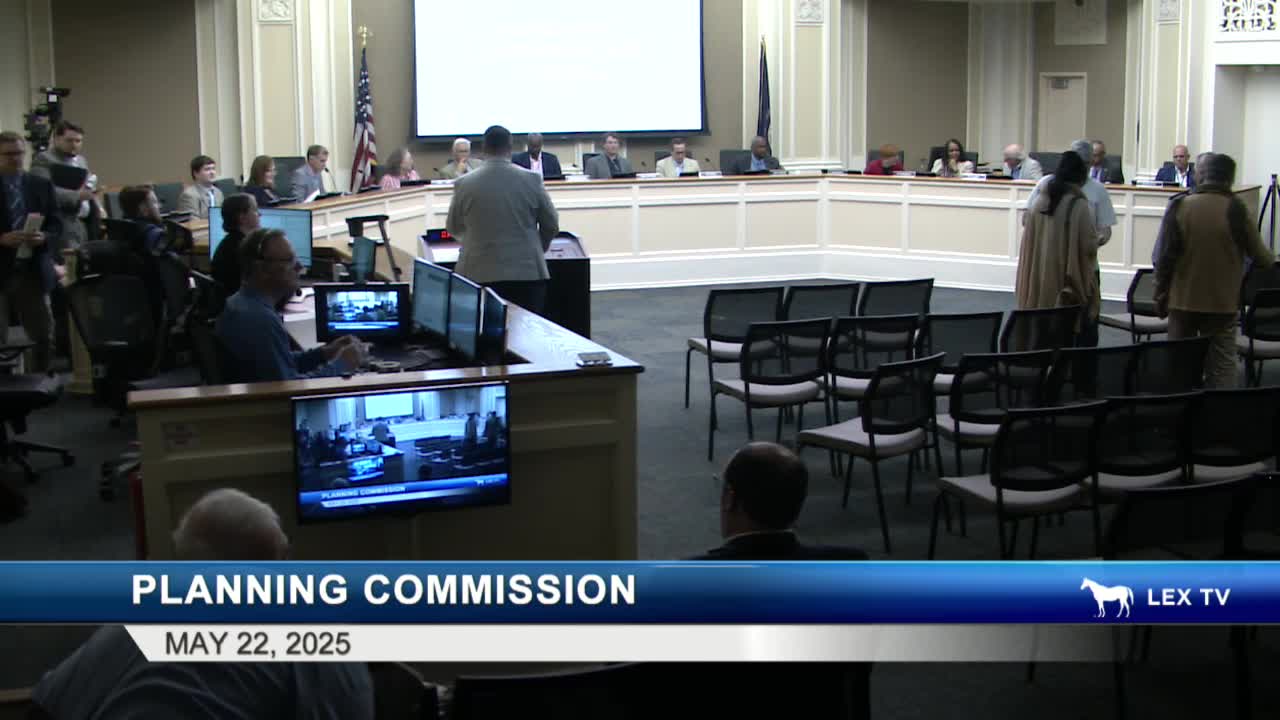
The Lexington City Planning Commission voted May 20 to approve the original zoning-text amendment proposed by the commission to remove the minimum lot-coverage requirement for the B3 (corridor business) zone, after a multi-hour discussion and public comment from developers and business representatives.
Planning staff presented the background and a staff alternative. Chris Taylor of the planning division said the city initially adopted a 30 percent lot-coverage minimum as part of a broader urban growth-management update intended to encourage higher land utilization on commercial corridors. Staff later proposed a revised approach that measures a ratio between building square footage and vehicular use area (VUA) and would allow compliance credits for VUA areas covered by canopies and for VUA constructed with accepted permeable materials.
Taylor said staff pursued the VUA approach as a more flexible alternative after the original lot-coverage standard proved difficult for some commercial configurations. "The goal was to attempt to, again, get a little bit more out of the land," Taylor said during his presentation. He described the staff alternative as a sliding-scale test that could be met by adding building square footage, shading parking with canopies, or using permeable pavement.
Developers and commercial stakeholders urged the commission to reject the restrictive standard. Attorney Michael "****" Murphy and other representatives cataloged local examples where retail and restaurant anchors would not meet the proposed standard: a coffee shop and convenience store, several fast-casual restaurants and other corridor properties they analyzed would fall below the VUA threshold under the staff approach. Brandon Gross, representing Goodwill, testified that the lot-coverage standard (and the new VUA test) had led to projects being terminated or moved to other locations; he and others said proposed compliance options (canopies, permeable pavers, additional building square footage) would add substantial cost and complexity.
Members of the public also spoke in favor and opposed to the changes. Citizens and local small-business representatives recommended delaying broad changes until related policies—such as the city’s complete-streets standards and other pending council amendments—are finalized.
After extended discussion the commission considered a motion by Commissioner Nickel to approve the original proposed text amendment (which removes the minimum lot-coverage requirement for B3). The motion was seconded by Commissioner Barstell and carried. Commissioners discussed that a waiver process would remain available and that the council is also considering notification measures and other procedural changes.
What this means: The Planning Commission’s action forwards its recommendation to the Urban County Council consistent with the commission’s initiation of the ZOTA. The zoning text change will be part of the council’s pending amendments for first reading; council action and any further modifications will be subject to the council’s adoption process.
Ending: Staff said it will continue to work with stakeholders and the council on related items such as parking, permeable materials standards and any implementation guidelines.