Get Full Government Meeting Transcripts, Videos, & Alerts Forever!
Get email alerts on the Elected Officials Pensions topic
No spam. Unsubscribe anytime.
Virgin Islands committee debates capping salary used to compute governor and lieutenant governor annuities
Summary
The Committee on Budget, Appropriations and Finance heard testimony and wide-ranging questions on a bill that would cap the salary used to calculate retirement annuities for the governor and lieutenant governor, with supporters citing fiscal prudence and opponents urging broader, data-driven retirement reform.
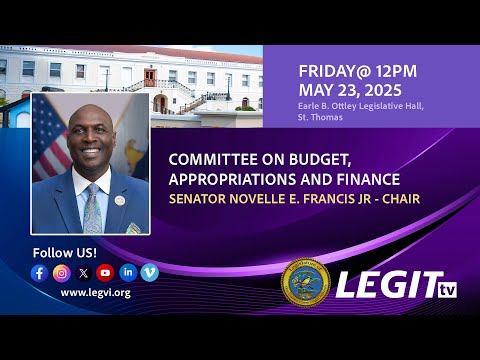
The Committee on Budget, Appropriations and Finance met May 23 in St. Thomas to hear testimony and debate on Bill No. 36-0032, which would cap the salary amounts used to compute the elected governor and lieutenant governor retirement annuities at $150,000 and $125,000, respectively.
Sponsor Senator Kurt Viollet said the measure "seeks to do is to set a cap that would be utilized for computing what salary the governor, lieutenant governor, will be able to retire to, now and and in the future and retroactively," arguing the change would limit future annuity costs charged to the general fund. He noted the current statute calculates annuities as a percentage of an officeholder's average salary in the last term and that a higher salary could raise lifetime annuity payouts substantially.
Cindy L. Richardson, director of the Division of Personnel, testified in strong opposition to the bill in its current form. "I express strong opposition to the inclusion of such a provision in this section of the law because it lacks a clear data supported purpose," she said, urging a broader, equitable review of retirement policy and recommending an actuarial study and statutory grandfathering if changes are made prospectively.
Testimony and questioning during the committee hearing concentrated on how annuities are computed and on the financial state of the elected-governors retirement fund. The post auditor, Dr. Theodora Phillip, told the committee, "To my knowledge, ... it should go directly to the Department of Finance," in reference to where elected officials' contributions are processed. Commissioner Kevin McCurdy said, "To replenish that fund, the contributions from the current, governor lieutenant governor goes into the fund and the appropriations from, this body."
Committee members cited several facts from agency statements and records during the hearing: the elected-governors retirement fund balance was reported at $669,708.32 as of May 20, 2025; the legislature has appropriated about $6,430,068 to the fund over the past decade; about seven individuals currently receive payments from the fund; and the average annual payout over the past three years was roughly $603,000. Witnesses and members also confirmed the governor's and lieutenant governor's salaries were increased effective Dec. 2, 2024 (to $192,000 and $168,000, respectively, as discussed in the hearing), and that the bill would cap the salary figures used in annuity calculations going forward at $150,000 and $125,000.
Opponents urged a comprehensive approach. Richardson and other staff emphasized retirement reforms should be based on actuarial and comparative analysis, not a targeted statutory cap that applies to two offices alone. Richardson recommended a systemwide actuarial review, uniform treatment of comparable public officials (e.g., judges), and avoiding static caps without economic adjustments such as indexing to CPI.
Supporters said a cap was a reasonable fiscal safeguard. Minority Leader Senator Dwayne DeGraff said plainly, "I vote yes," and other members argued the territory should avoid open-ended annuity growth at a time of constrained finances. Several senators pressed staff and administration officials for factual clarifications during the hearing — for example, whether the elected officials pay a contribution percentage into the fund (Richardson said approximately 9% and indicated she would provide formal figures), how the statutory "average salary" for annuity calculation would be computed now that the governor's salary changed during a term, and the status of legislatively appropriated retroactive wages and other appropriations.
Director Richardson and Commissioner McCurdy also answered questions about related budget items raised during debate, including timing of retroactive wage payments for government employees and scheduled disbursements connected to Act 89-85; officials stated batches of retroactive checks were being processed and that payments tied to that appropriation were scheduled to be completed by the end of the month.
The committee did not take a final vote on Bill No. 36-0032 during the portion of the meeting included in the transcript. Members on both sides urged further factual follow-up — including a request that the commissioner of finance provide an accounting for the Southern Trust settlement fund and that staff provide definitive numbers on the elected officials' contribution rates and the practical mechanics for computing "average salary" in §3080 under recent pay changes.
The hearing record shows substantive testimony both for and against the proposal and several outstanding data requests. The committee will continue consideration of Bill No. 36-0032 pending receipt of the requested financial and actuarial information.