Get Full Government Meeting Transcripts, Videos, & Alerts Forever!
Get email alerts on the Senior Services Millage topic
No spam. Unsubscribe anytime.
Washtenaw commissioners shape senior millage framework, agree on base funding approach and next steps
Summary
At a May 21 Washtenaw County working session, commissioners discussed a draft framework to implement the recently approved older adults millage, including a proposed $200,000 baseline allocation for designated "qualified senior centers," a competitive RFP process for program funds and two staffing models for a new Office of Aging Services, but made no final vote and directed staff to refine the plan for formal consideration.
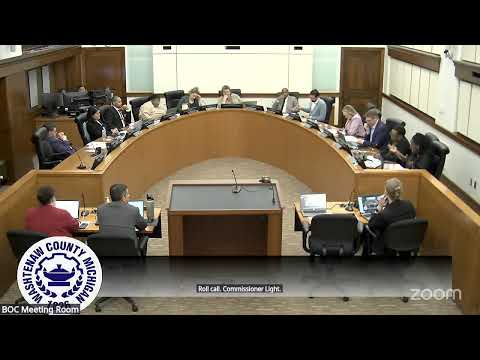
At a May 21 Washtenaw County working session, commissioners spent more than two hours discussing a draft framework to implement the county's recently approved older adults millage. The board did not take a final vote; instead members reviewed a proposed list of "qualified senior centers," signaled support for a base funding approach, and directed staff to refine an RFP- and equity-based implementation plan and return it for formal consideration.
Commissioner Annie Summerville, who led the presentation and drafting work, told colleagues the goal is to move money quickly to support basic operations at established centers while reserving programmatic funds for competitive awards aligned with needs-assessment results and equity priorities. "At the very least" the proposed baseline, she said, would help a center hire a director and a second staff member so the facility does not close when a single employee is absent.
The draft framework presented to the board proposes two funding tracks: a baseline operational allotment for "qualified senior centers" (an annual allocation of at least $200,000 per center was proposed during the discussion) and a programmatic RFP process for additional services such as nutrition, transportation, housing-related supports, minor home repair, legal assistance and congregate or medically tailored meals. Commissioners and community members debated which local organizations should be designated as qualified senior centers eligible for the baseline allotment, and whether some sites should instead pursue program grants through the competitive RFP process.
Why this matters: Washtenaw voters approved a 0.5-mill older adults millage in November 2024. The board must now translate the ballot language into an administrative structure that distributes roughly the millage revenue across operations, direct grants to community organizations, and administrative support for a new county office to run the program. Commissioners framed the questions around equity, geography, and service capacity: how to ensure rural areas and lower-opportunity neighborhoods receive funds while also supporting high-demand urban sites.
Key points from the discussion
- Qualified senior centers vs. program applicants: Summerville circulated a countywide list developed from outreach and research. A group of facilities characterized as the most established (often with regular meal programs, facilities and staff) were shown as likely candidates for the baseline allocation. Other organizations with specialty or institutional ties (examples cited included a Jewish community center and a university-run resource center) were discussed as better-suited to apply for programmatic grants under the RFP process rather than receive the baseline operating allotment.
- Baseline funding level: Several commissioners supported the $200,000 per-center baseline included in the draft. Supporters said it is modest compared with the overall millage and could cover core operations (director, coordinator, utilities, basic programming). Others pressed for clearer data showing how that baseline aligns with local need and operating budgets.
- Equity and geographic coverage: Commissioners repeatedly asked that allocations be informed by data on older adults' economic vulnerability and access to services. Several members urged targeted help for rural areas and parts of eastern Washtenaw County where grocery stores, pharmacies and transit are sparse. The draft names a mix of centers across the county and allows any center to apply for competitive program dollars in addition to or instead of baseline funding.
- Legal help and other direct services: The group discussed funding legal assistance for older adults (eviction, guardianship, benefits counseling). Commissioners and community advocates noted the Older Americans Act's existing federal support for elder legal programs and asked that any locally funded service avoid duplicating existing statewide services. Several commissioners argued for a dedicated elder-legal resource tied to the millage as a deterrent to financial exploitation of older residents.
- Transportation and minor repairs: Commissioners and advocates said mobility and home maintenance are fundamental to aging in place. The draft directs the future Office of Aging Services to convene transportation stakeholders and consider a range of models, including door-through-door services, vouchers or partnerships with existing providers. Minor home repair programs were described as a natural county role, possibly managed through OCED (Office of Community and Economic Development).
- Administrative structure and staffing: Summerville presented two staffing scenarios for a proposed Office of Aging Services: one with six positions (director, manager, three constituent-facing specialists and one finance/data position) and a smaller five-person model. Commissioners generally favored starting lean but ensuring enough constituent-facing staff to answer calls, manage referrals and handle grant administration. Commissioner comments flagged the need to define "administrative" costs (how much of millage revenue is used for staffing/administration versus direct services) and asked for continued collaboration with the county administrator on final budget and implementation details.
- Oversight and review: The draft calls for a Millage Review Committee with an odd-numbered membership (the draft shown to commissioners proposed 11 members) and a requirement that at least three review-committee members be aged 60 or older. Commissioners stressed that the committee and the eventual director should prioritize equity, use data-driven needs assessments and hold grantees to annual reporting obligations. Several commissioners asked that the board retain the ability to request presentations from any agency receiving millage funds.
What the board decided (and what remains): No final policy was adopted at the working session. Commissioners generally signaled support for the overall framework'a mix of baseline center funding plus programmatic RFPs'and for naming a set of established facilities as initial "qualified senior centers," while reserving the right to adjust the list based on future needs assessments and the director's recommendations. The board directed staff to continue refining the document (including clearer definitions, a finalized list of qualified centers, the millage review committee charter, and staffing/financial projections) and to return the package for formal consideration during the public meeting process.
Ending: Commissioners asked that staff provide more explicit metrics tying allocations to the county's opportunity-index and ALICE-type measures, and that the final framework include a path for centers to transition from program grantees to baseline recipients if they expand capacity. The board set the expectation that the Office of Aging Services and the Millage Review Committee will work publicly and iteratively, with annual reporting to the Board of Commissioners and a multi-year needs-assessment cycle to refine priorities.