Get Full Government Meeting Transcripts, Videos, & Alerts Forever!
Get email alerts on the Utility Rate Policy topic
No spam. Unsubscribe anytime.
Committee advances bill to reduce solar cost shift to non-solar ratepayers; opponents warn of contract and implementation issues
Summary
AB 942 would revise rooftop solar subsidy structures affecting investor-owned utility customers to reduce a cost shift to non-solar customers, according to the bill's author and supporters; solar-industry witnesses warned about contracts, PUC implementation burdens and potential unintended consequences.
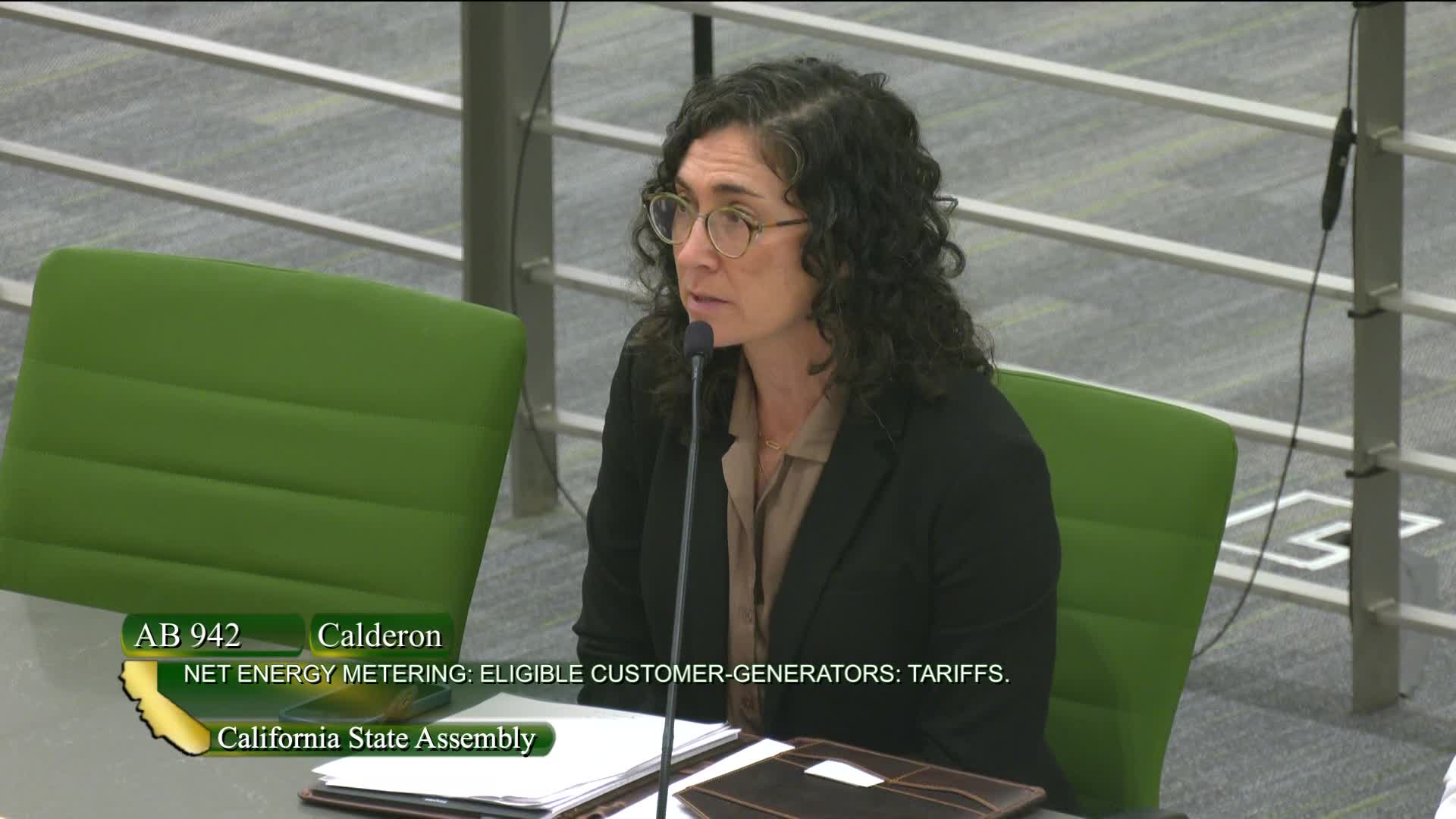
Assemblymember Calderon presented AB 942, which she said would revise long-standing rooftop solar subsidy structures to reduce a cost shift onto non-solar ratepayers. Calderon and supporters said the net energy metering (NEM) subsidy shifted roughly $8.5 billion onto non-solar customers in 2024 and that reforms would save non-solar ratepayers roughly $3.5 billion over the next 20 years while redistributing some climate-credit funds to help renters and low-income customers.
Support testimony came from labor and consumer advocates, including Scott Wedge of the California State Association of Electrical Workers and Rachel Koss of the Coalition of California Utility Employees. They told the committee that customers without rooftop solar pay a disproportionately large share of grid costs because solar customers receive retail rates for exported energy and avoid paying retail rates for self-consumed energy.
Opposition witnesses, including Bridal Hevner of the California Solar and Storage Association, and representatives of the Solar Energy Industries Association and several local government and building-industry groups, said the bill would (in their view) interfere with long-term customer expectations, create substantial implementation work for the California Public Utilities Commission and utilities, raise contract concerns tied to interconnection agreements, and lead to disputes over property transfers, renter treatment and appeals processes. Hevner also questioned the bill’s zero fiscal-impact designation and said a CPUC proceeding would likely be required to work out details.
Committee members discussed geographic scope (the bill would apply only to investor-owned utility service territories), impacts on low-income customers and issues raised by opponents about implementation. Several members expressed concern about rate affordability and equity; some members said they would work with the author. The committee voted to report AB 942 out on a roll call; the transcript records several members not voting and at least one recorded no vote.