Get Full Government Meeting Transcripts, Videos, & Alerts Forever!
Get email alerts on the Clean Energy Electrification topic
No spam. Unsubscribe anytime.
Committee advances bill requiring large cities to plan for EV charging and building electrification
Summary
The Assembly Appropriations Committee advanced AB 39, which would require California cities and counties with populations of 75,000 or more to create plans to meet local electrification goals for vehicle charging and building electrification, with special focus on disadvantaged communities and multiunit housing.
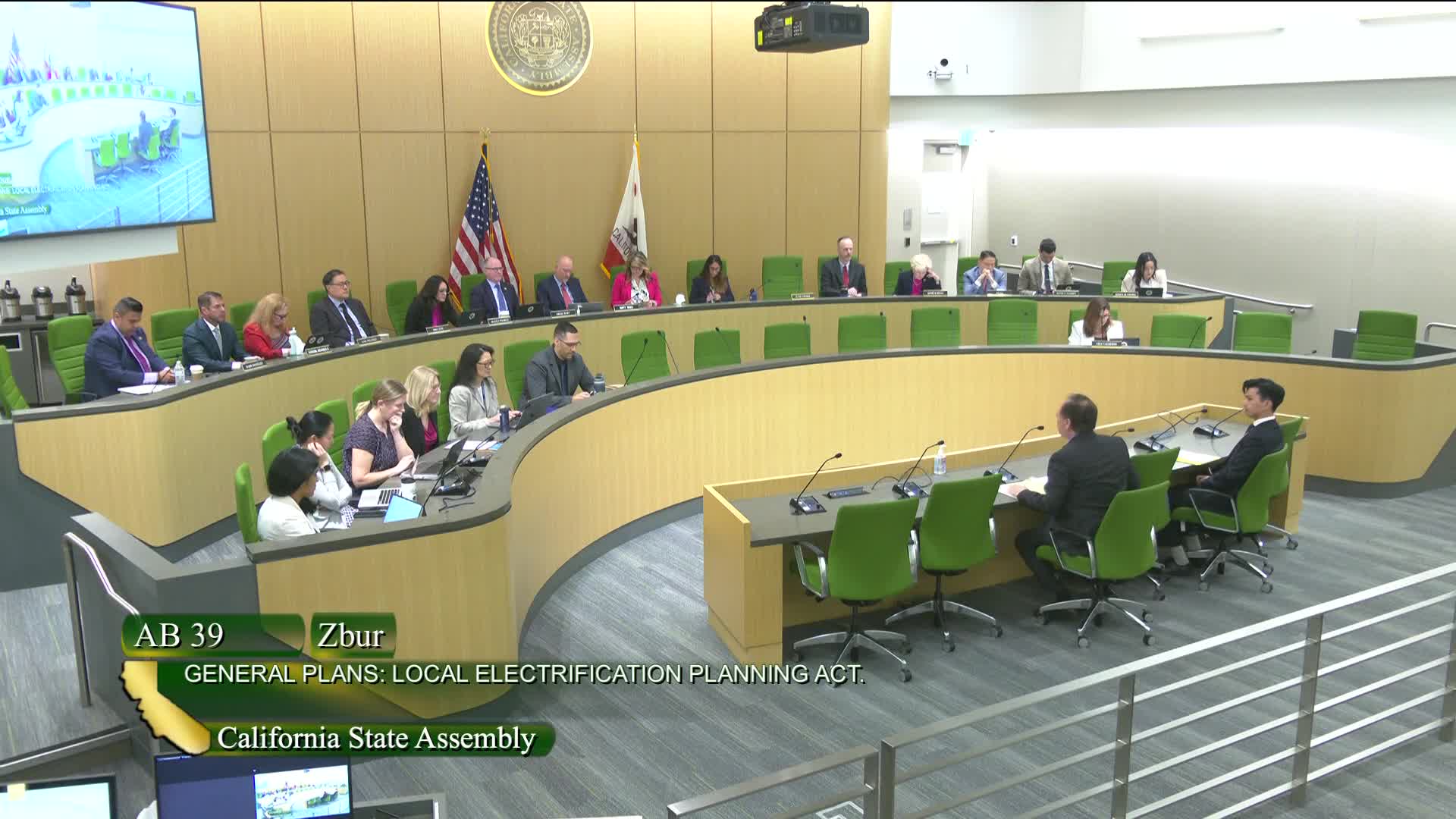
Assemblymember Zibur presented Assembly Bill 39 on May 21, 2025, telling the Assembly Appropriations Committee the measure would require cities and counties with populations of 75,000 or more to create and adopt local plans to meet electrification goals for vehicles and buildings.
The bill’s author said California will need roughly 1,000,000 vehicle chargers to support an estimated 8,000,000 passenger electric vehicles by 2030 and that additional infrastructure will be necessary to meet the state’s 2035 vehicle electrification mandate. Zibur said renters and residents of multifamily housing often lack options to install chargers and that local planning can help address permitting, siting and equity barriers.
Brandon Wong, representing joint sponsors the Building Decarbonization Coalition and CalSTART, told the committee that local governments play a central role in permitting and siting charging and in removing local barriers to heat pump and electric appliance installations. Sean Bellack of the California Association of Realtors spoke in support and thanked the author for working with stakeholders on amendments.
AB 39 requires local plans to focus on disadvantaged communities, low-income households and small businesses so that investments in zero-emission technology benefit historically underserved groups. The bill allows jurisdictions with existing relevant plans to build on those plans rather than create duplicate efforts.
There were no primary witnesses in opposition during the hearing. Committee members had no substantive questions recorded on the transcript. After presentation and brief testimony, members moved the bill and it was reported out of committee on a roll call.
AB 39 is now advanced to the Assembly floor for further consideration.