Get Full Government Meeting Transcripts, Videos, & Alerts Forever!
Get email alerts on the Transportation Infrastructure topic
No spam. Unsubscribe anytime.
Austin council hears competing cases for I‑35 'cap and stitch' roadway funding; decision on roadway elements set for Thursday
Summary
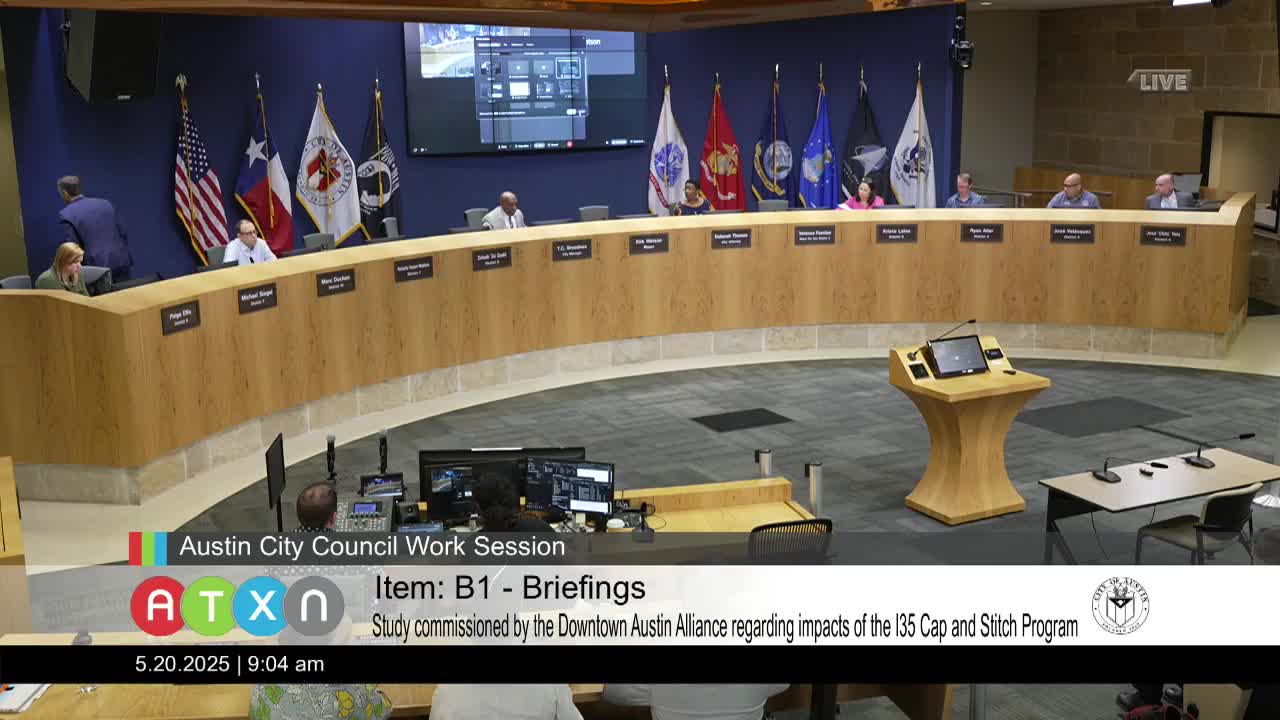
Austin City Council members spent a multi‑hour work session weighing whether to fund roadway elements that would preserve the option of building caps — decked parks and public space — over Interstate 35, with a Thursday vote set to consider funding for the structural, roadway work.
Austin City Council members spent a multi‑hour work session weighing whether to fund roadway elements that would preserve the option of building parks and other public space atop new deck structures — commonly called "caps" — over Interstate 35.
City staff and downtown advocates urged council members to approve funding for the roadway‑level work on Thursday so the city can "future proof" the corridor and preserve the ability to add full caps later. Davon Barber, president and CEO of the Downtown Austin Alliance, told the council the project could "prime the pump" for private investment in downtown and presented a consultant study estimating large, long‑term fiscal gains if the caps encouraged redevelopment. Thomas Simpson of HR&A Associates said, "Investments of this magnitude are almost always partnerships, and they're frequently seeded by city government." Mike Rogers, assistant city manager, framed the immediate choice as a vote on roadway elements tied to items 41, 402 and 403 on the council agenda.
The staff recommendation — described in presentations and subsequent council comments — is the more limited Scenario 1: roadway elements for caps at Cesar Chavez to Fourth Street and at 11th–12th streets. Council staff advised that the city must commit to deck funding by November 2026 to avoid change‑order escalation; TxDOT staff confirmed that a November 2026 commitment would avoid the larger escalation that occurs if the city waits beyond that date. TxDOT representatives and city staff said a roughly $20 million preliminary estimate would be needed to advance the deck and tunnel designs from their current schematic level to full bid‑ready plans, but that figure is contingent and preliminary.
Why supporters say yes
HR&A’s analysis, commissioned by the Downtown Austin Alliance, identified roughly 60 acres of under‑ or under‑developed land within a quarter mile of the proposed downtown caps and estimated that, at full build‑out, the caps could help unlock between $12.5 million and about $40 million a year in incremental property tax and related fiscal revenue to the city (HR&A described those as gross, long‑term figures that would accrue as development completed over many years). The consultants also estimated a one‑time private‑property premium in the $150 million to $370 million range in the study area under some scenarios.
Davon Barber said the caps would reconnect neighborhoods and help downtown retain and attract businesses and investment, arguing the project is a long‑term play for the city’s economic competitiveness. "We are the caretakers, the stewards of downtown," Barber said.
Why opponents say no or slow down
Speakers at the public‑comment period and several council members highlighted sharp trade‑offs. Vocal Texas and housing advocates urged council members not to use bond capacity or other limited city funds for caps while homelessness, affordable‑housing production and other basic services remain underfunded. Mel LeBlanc of Vocal Texas said, "I'm asking you to vote no on the cap and stitch project," arguing bond dollars are needed for housing.
Public‑health and environmental speakers warned of air‑pollution and health risks for people using intensive‑activity amenities near freeway emissions; Public Citizen’s Texas office recommended avoiding locating fields or heavy physical‑activity uses within the most polluted buffer areas. Others questioned reliance on private philanthropy: council members and presenters acknowledged that Dallas, a commonly cited precedent with successful caps, drew substantially larger private contributions than Austin has secured so far.
Costs, timing and operations
Council members and speakers cited markedly different cost and operating‑cost figures. City staff and TxDOT presented schematic estimates for the recommended downtown roadway and deck elements and a table of phases and contingencies; HR&A’s fiscal projections and several public commenters noted that those revenues — if realized — would take years to materialize and would not, on their own, pay annual park operations and maintenance (O&M). One council member said staff had estimated O&M for five caps could be roughly $47 million a year; HR&A’s modeled annual fiscal increase at full build‑out was far lower, producing concern about a structural operating shortfall if the city assumed full O&M responsibility.
TxDOT said the council can vote Thursday to fund roadway elements (the structural work and support that would allow future caps to be added) without immediately funding the deck amenities on top. TxDOT representatives said committing to deck funding by November 2026 would avoid a change‑order escalation; staff added that design‑level contingency varies and that the most certain pricing requires moving designs forward to bid.
What the council was asked to decide
City staff asked council to authorize funding for the recommended roadway elements this week, with the understanding that the city would continue to develop a financing plan that might include combinations of federal or state funds, philanthropic gifts, value‑capture mechanisms and other sources. Council members requested more detail on realistic philanthropic targets and an operations and maintenance plan, and several asked staff for a timeline and milestones for any fundraising or governance structure that would operate the parks.
No formal vote on funding was recorded in this work session. Staff repeatedly emphasized that Thursday’s agenda would include items related to the roadway elements and that the council would be taking a decision on those items then.
Public comments and equity concerns
Public testimony reflected a wide split: labor representatives urged ensuring strong wages and worker protections for construction and operations; neighborhood leaders and pedestrian advocates argued caps could unlock connectivity and long‑term local development; unhoused‑services advocates and some residents urged prioritizing housing, basic services and parks near where people live rather than high‑cost downtown infrastructure. Several speakers called for the city to ground its decisions in the 1928 planning history and its present‑day equity implications.
What happens next
Council members and staff agreed to provide additional materials before Thursday, including a clearer capital stack tied to the staff recommendation, a fundraising timeline and additional details about governance options for operations. TxDOT and city staff said they could provide a more detailed cost and phasing schedule that reflects the November 2026 decision deadline for deck funding. The council will consider the roadway elements on Thursday as items 41, 402 and 403 on its agenda; no formal funding action occurred during the work session recorded in this transcript.
Reporting note: The presentation and public testimony included a range of estimates and scenarios. The article quotes are drawn from the session transcript; fiscal projections discussed by HR&A were presented as model outcomes contingent on full build‑out and private development responding to the caps.