Get Full Government Meeting Transcripts, Videos, & Alerts Forever!
Get email alerts on the Municipal Budgeting topic
No spam. Unsubscribe anytime.
Leavenworth staff propose shifting mill levy to recreation fund to free sales tax for capital projects
Summary
City staff presented a five-year capital improvement plan that assumes shifting ad valorem (mill) support from debt service to the recreation fund as bonds retire, freeing roughly $4.2 million in sales tax for CIP projects over five years if no new debt is issued.
Leavenworth City staff presented a proposed five-year capital-improvement plan that would shift the ad valorem (mill) support currently used for debt service into the recreation fund as bonds are paid off, reducing the recreation fund’s dependency on sales tax and freeing money for other capital projects.
The recommendation matters because the city currently transfers a portion of collected sales tax to cover recreation and debt service, leaving only about half of sales tax available for CIP projects in 2025; staff said the proposed changes would free additional sales-tax revenue as debt declines, creating an estimated $4.2 million in additional CIP funding over five years if no new debt is issued.
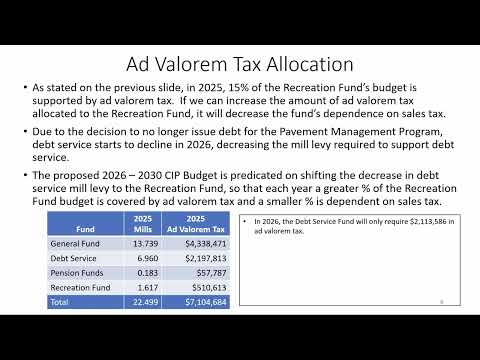
City staff said the capital projects fund is primarily sales tax–funded (25% of city sales tax is earmarked to the CIP sales tax fund) and that the recreation fund in 2025 received about 68% of its revenue from sales tax, 15% from ad valorem tax and 17% from fees and other taxes. As debt service falls over the next decade, staff proposed moving the mill levy that previously supported debt service into the recreation fund so the recreation fund would be supported more by ad valorem tax and less by sales tax.
Roberta (staff member) explained the financial assumptions underpinning the plan: assessed value growth of roughly 3% per year from 2022–2036 and a 4% assessed value increase assumed for 2025; a proposed 0.834‑mill increase supporting the recreation fund in 2026 (an increase of about 0.31 mills above the plan baseline); and that the last bond payment under current projections would be made in 2036. Roberta summarized: “If we issue no new debt and the mill levy that supports the debt service is shifted to the recreation fund as debt is paid off … over the next 5 years, there will be an additional $4,200,000 of sales tax available to fund the CIP projects.”
City staff noted constraints and fixed obligations: some sales-tax transfers are contractually required (TIF transfers), and certain debt-service payments cannot be reallocated until specific payoff dates. Roberta also flagged that debt service payments are a large near-term pressure and that staff are continuing to refine projections for solid-waste and wastewater alternatives that will affect the final CIP schedule.
City staff said the CIP as presented is a draft and will change as commissioners consider priorities and as staff deliver final numbers on outstanding items (notably solid waste). Commissioners and staff discussed that the proposed shift depends on not issuing new debt and on assessed-value growth assumptions.
The presentation closed with staff saying the 2026 CIP proposal is explicitly predicated on the shift of mills from debt service into the recreation fund and that, under those assumptions, recreation would be fully supported by ad valorem tax by 2034 and the last bond payment would be in 2036.
Staff indicated they will return with updated numbers and that the commission will have further opportunities to re-prioritize projects during the budget session.