Get Full Government Meeting Transcripts, Videos, & Alerts Forever!
Get email alerts on the State Operations Vacancies Compensation topic
No spam. Unsubscribe anytime.
Budget control sections would eliminate thousands of vacant positions and allow administration authority to suspend scheduled pay increases; lawmakers and labor
Summary
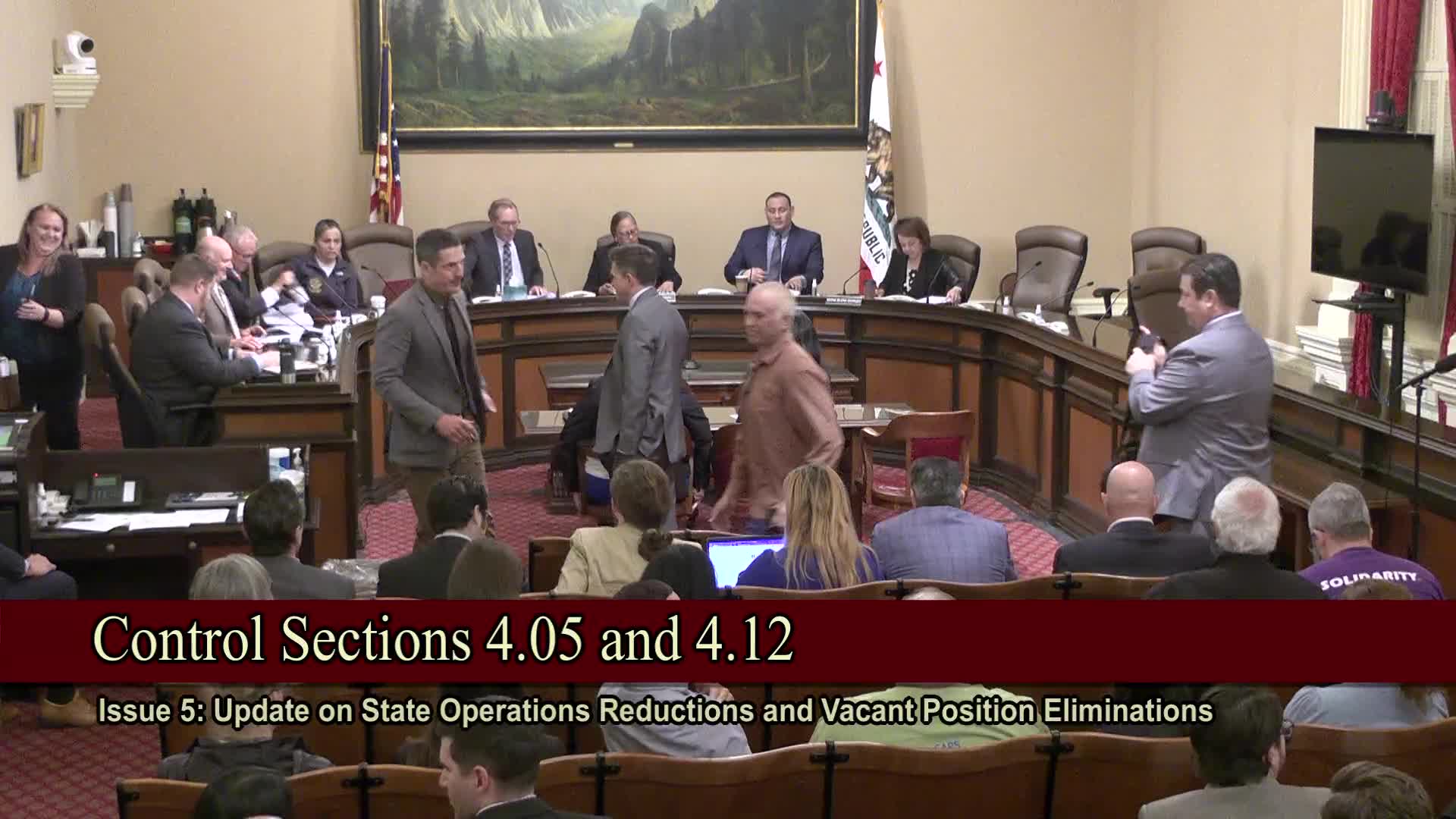
Department of Finance told the Senate subcommittee the administration proposes to implement state‑operations and vacant‑position savings under control sections in the 2024 budget act and would reserve authority to suspend scheduled pay increases if collective bargaining does not produce the targeted savings.
The Department of Finance told the Senate subcommittee that the 2024 budget act's control sections authorized identification and implementation of significant state‑operations and vacant‑position savings, and the administration provided updates in a May 2025 letter to the Joint Legislative Budget Committee.
Finance staff Han Dong Min summarized the package of reductions tied to control sections 4.05 and 4.12, saying the administration will reduce departmental budgets in 2024‑25 by approximately $1.0 billion (including about $605 million General Fund) under 4.05, and propose $1.6 billion in 2025‑26 and ongoing (including about $1.2 billion General Fund). Under control section 4.12, Finance proposed current‑year reductions of about $502 million (including $195 million General Fund) and 2025‑26 and ongoing reductions of about $490 million (including $182 million General Fund), and proposed elimination of roughly 6,002 vacant positions in 2025‑26.
On employee compensation, the May revision assumes savings of about $766.7 million (including $283.3 million General Fund) related to salary and wages while preserving budgeted health‑care increases. Control sections 3.9 and 3.91 would permit the administration to suspend scheduled pay increases and, if necessary, impose reductions through a budget revision when collective bargaining does not achieve the required savings. The Legislative Analyst's Office advised the committee that adopting open‑ended authority to impose compensation changes can damage labor relations and recommended that the legislature reject the administration's proposed control‑section language or, at minimum, specify reduction targets and require legislative review before imposed terms take effect.
Senators expressed frustration with the timing and level of detail provided: the control‑section information was due Jan. 10 but the administration provided the materials in mid‑May, leaving limited time for legislative review. Members asked for department‑by‑department analyses of the service impacts, potential fee or tax impacts from special‑fund adjustments, and alternatives to broad‑based compensation reductions. The Department of Finance said it would work with legislative staff to provide additional detail.
Public testimony during the hearing included many state employees and union representatives who opposed the proposed compensation reductions and vacancy eliminations, arguing that the proposals would undercut recruitment, harm services and violate negotiated agreements. Union witnesses and individual state scientists, engineers and program staff urged the committee to pursue alternative savings such as contract and lease reductions and to honor ratified collective‑bargaining agreements.
Why this matters: The control sections and proposed reductions affect thousands of positions, core state services and collective‑bargaining rights. The legislature must weigh tradeoffs between immediate budget relief and longer‑term workforce capacity and program delivery.