Get Full Government Meeting Transcripts, Videos, & Alerts Forever!
Get email alerts on the Cannabis Policy topic
No spam. Unsubscribe anytime.
Administration proposes shifting cannabis illicit‑market enforcement to tax fund; LAO and public raise legal and budget trade‑offs
Summary
The Department of Cannabis Control proposed shifting some illicit‑market enforcement costs from the Cannabis Control Fund to the Cannabis Tax Fund, requested authority to seal premises used for illegal cannabis operations, and sought refinements to grant eligibility for local enforcement assistance.
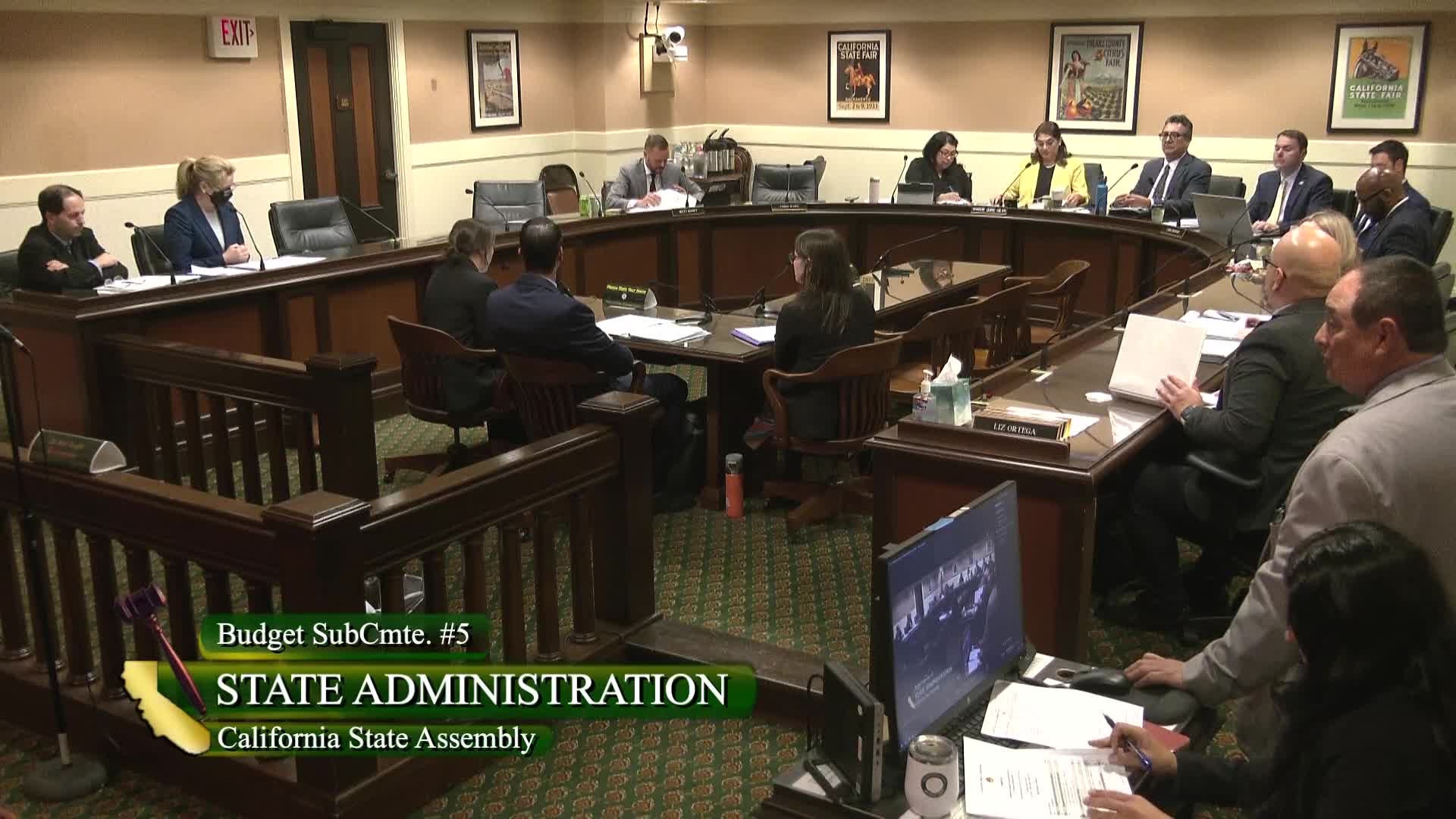
The Department of Cannabis Control told Assembly Budget Subcommittee 5 the May Revision includes a multi-part plan to sustain enforcement against the illicit cannabis market while limiting fee pressure on licensed businesses.
Deputy Director Christina Dempsey said the administration proposed shifting certain enforcement costs from the Cannabis Control Fund to the Cannabis Tax Fund so that enforcement activities can continue without increasing license fees. The department also sought trailer‑bill authority to authorize DCC to seal locations where illicit activity is occurring to prevent rapid reopening of illegal shops, and it proposed refinements to eligibility and prioritization for Proposition 64 Allocation 3 grants that fund local law enforcement and community programs.
The Department of Finance acknowledged the cannabis tax fund faces a negative balance in 2026–27 under current projections and said the timing of any fund‑shift should be considered alongside policy choices on the excise tax rate. The Legislative Analyst’s Office explained the trade‑offs: a funding shift would support the licensed market by avoiding fee increases for operators but would draw down resources available for allocation 3 programs; meanwhile, AB 564 (bill under consideration) would freeze the excise rate at 15% rather than permitting a scheduled rise to 19%, which would also favor the legal market but reduce allocation 3 funds that would otherwise increase with a 19% rate.
LAO analysts presented options for the Legislature, including adopting the administration’s fund shift, allowing the excise tax rate to rise (which would increase allocation 3 funds and partially offset the shift), delaying action until tax policy is resolved, or raising fees or curtailing DCC enforcement activity. DCC officials said delaying an administrative funding change would make it more difficult to avoid fee increases or to quickly reallocate spending because fee regulation changes take months to implement.
Public testimony included support for increased enforcement from legal operators and unions; civil‑liberties and public‑defender groups urged caution on the proposed sealing authority, arguing it raises Fourth Amendment and due‑process concerns and should be considered in a policy committee rather than in the budget. Rural County Representatives and local public‑safety stakeholders supported refined BSCC grant criteria and prioritization to focus resources on jurisdictions without regional mitigation programs.
Ending note: The subcommittee received the administration’s proposals and technical assessments from DOF and LAO. The policy trade‑offs—enforcement funding, licensee fee pressure, excise‑tax rate choices, and constitutional concerns about sealing authority—remain subject to further legislative and policy committee review ahead of final budget actions.