Get Full Government Meeting Transcripts, Videos, & Alerts Forever!
Get email alerts on the Utility Finance And Operations topic
No spam. Unsubscribe anytime.
Austin Energy reports larger reserves and lower passthrough rates but warns of tariff and supply‑chain cost pressure
Summary
Austin Energy reported on May 20 that a one‑time transfer into a power supply stabilization reserve improved second‑quarter cash metrics and that the utility has reduced the power supply adjustment five times this fiscal year, while warning that tariffs and supply‑chain price increases could raise costs and affect near‑term projects.
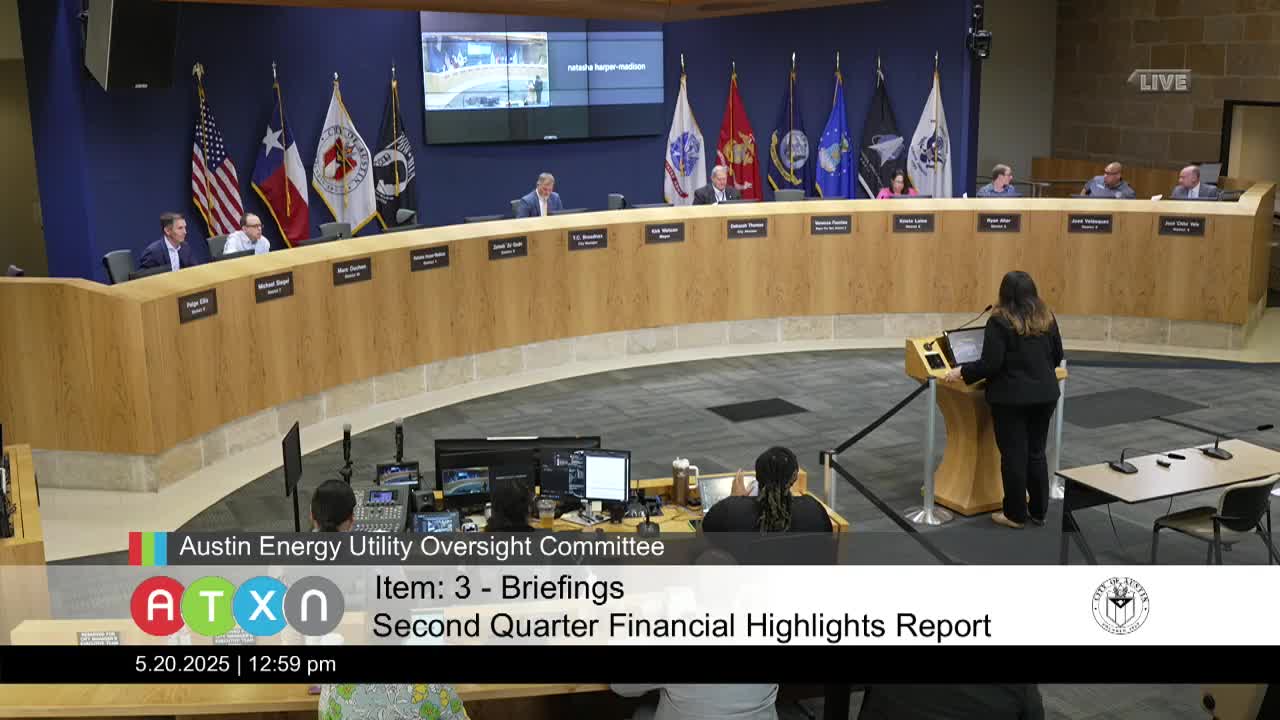
Austin Energy staff reported second‑quarter financial and operations results to the Utility Oversight Committee on May 20, saying the utility’s short‑term financial position looks stronger because of a one‑time reserve transfer but that inflationary materials costs and tariff uncertainty create medium‑term budget pressure.
Interim General Manager Stuart Riley and Finance Director Stephanie Koudelka explained that Austin Energy moved approximately $30,000,000 of power supply over‑recovery into a power supply stabilization reserve to meet the utility’s financial policy target for days cash on hand; staff said that transfer improves the utility’s reported cash position for the quarter but is a non‑recurring event.
"That 30,000,000 resulted in two things," Finance Director Stephanie Koudelka told the committee, adding the transfer allowed the utility to meet its financial policy target (she described the policy minimum as 90 days of power supply cost cash on hand) but that reviewers should treat the reserve transfer as a one‑time recognition when evaluating sustained financial health.
Koudelka reported Austin Energy was approximately $103,000,000 over‑recovered on power supply as of the end of the second quarter; staff said they have reduced the power supply adjustment (PSA) rate five times in the fiscal year, with a cumulative reduction that staff characterized as 23% lower compared with earlier in the fiscal year, producing lower customer bills going into summer.
Staff cautioned that tariff and supply‑chain pressures remain significant. Riley said suppliers are honoring some pre‑tariff pricing in the short term but "we have heard from them to expect 25% or more increase to those materials." Riley described adaptive steps the utility has taken — revising engineering standards, expanding sourcing personnel and consolidating inventory into a new warehouse set to come online this summer — to reduce vulnerability to material shortages.
On operations, Deputy General Manager and Chief Operating Officer Lisa Martin reported Q2 renewable production at about 49% of load and carbon‑free production at 77% of load for the quarter; she told the committee Austin Energy hit a new winter system peak (27.22 megawatts) in February and that distribution reliability metrics were stable to improving due to ongoing distribution hardening and smart‑grid device installations.
Koudelka said Standard & Poor’s affirmed the utility’s double‑A bond rating with a stable outlook; staff noted the utility’s internal AA target (200 days cash) is higher than the financial policy minimum (150 days) and that the current days‑cash figure includes the over‑recovery amounts, which will be returned to customers or used to cover power costs in volatile market conditions.
Ending: Staff said they will continue to monitor tariff and supply‑chain risks and to pursue resilience work on the distribution system; no rate increase proposals were approved at the committee meeting.