Get Full Government Meeting Transcripts, Videos, & Alerts Forever!
Get email alerts on the Unemployment Insurance topic
No spam. Unsubscribe anytime.
Unemployment commission adopts remote‑participation policy; reviews 2025 benefit increases and VEC service reforms
Summary
The state Commission on Unemployment Compensation adopted an electronic participation policy and received an update from the Virginia Employment Commission on operational reforms and the effects of four 2025 bills that raise weekly benefits and change commission membership.
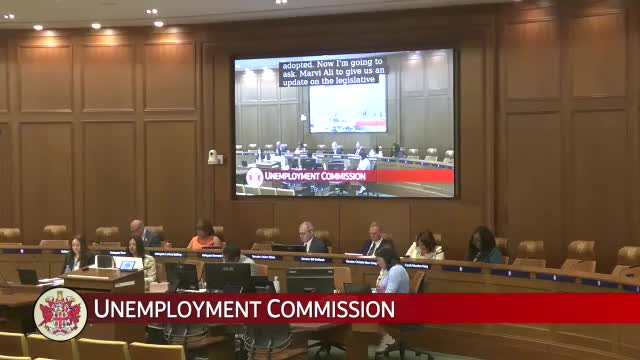
The Commission on Unemployment Compensation adopted an electronic participation policy and reviewed several 2025 General Assembly enactments and Virginia Employment Commission (VEC) operational reforms during a meeting in Richmond. Senator Adam Evan, chair of the commission, opened the meeting and led the roll call and a voice vote to adopt the remote‑participation policy.
The commission received a staff briefing on four bills from the 2025 session that take effect July 1 and other legislative and administrative developments. Marvie Veil (staff member) summarized the measures, saying SB 878 “talks about this commission on unemployment compensation and its membership and its powers and duties,” and described changes that move some subcommittee functions to the full commission and add two non‑legislative citizen members. Veil said those two citizen members “will be the same members serving on the subcommittee for the first year” and thereafter will be appointed by legislative leaders and committees as specified in the enacted language.
Veil also described two benefit‑related bills and one administrative threshold change. SB 1057 raises the threshold for deducting wages from weekly benefits: wages up to $100 will not reduce a claimant’s weekly benefit amount (previously the exclusion was $50). SB 1056 and HB 1766 increase weekly benefit amounts and create a work group to study numeric indexing of benefits: the law raises the weekly benefit by $52 effective Jan. 1, 2026, and requires the commission, in consultation with the VEC, to convene a work group (to include employee and employer stakeholder representatives) that will meet quarterly and consider annual adjustments tied to an economic metric.
Veil noted one bill the commission had recommended—an allowance for dependents in calculating benefits—did not pass and was left in appropriations; he said the commission could revisit the topic.
The meeting included a detailed presentation from Mitch Melas, commissioner of the Virginia Employment Commission, on agency transformation and performance. Melas said VEC reorganized around customer outcomes, shifted staff into direct service roles and reprioritized administrative support; as a result, the agency reported nearly $5.3 million in personnel savings and about $11 million in IT contract savings since the pandemic funding ended. He described a new website “digital lobby,” an Ask VEC virtual assistant and an ID.me login option introduced in January 2024 that Melas said has driven a 39% increase in online claim filings and produced an overall 80% rate of online filings.
Melas also described operational metrics the VEC reported to the commission: timely appeals decisions rose from 22% to nearly 90% over the last two years; timely first payments increased from about 20% to nearly 85%; the agency has processed more than 135,000 cases since January 2022 (65,000 in 2024 alone); and first‑level appeal average age fell to about 10 days. Melas said automation and staffing changes—examples included a scheduling bot that reduced a 90‑minute docket scheduling task to 10–15 minutes—helped reduce backlog and redeploy staff.
Commission members asked for details and clarifications. Melas and staff said the work group on indexing must include employee and employer stakeholder representatives and will be convened by the commission in consultation with VEC; the statutory language requires those stakeholder representatives be present. Susan Landis, VEC director of unemployment insurance, told the commission “The waiver program, Senator Evan, is fully implemented,” referring to an overpayment‑waiver application process that the agency mails with overpayment decisions and which is available on VEC’s website.
Agency staff outlined several regulatory proposals under review, including a possible change to shorten the filing window for weekly claims from 21 days to 14 days (the agency said about 98% of filers submit within 14 days and the change would be pursued through a public regulatory process) and proposed guidance making in‑person first‑level appeals hearings discretionary under the chief of first‑level appeals, with accommodations for people with disabilities.
Public comment from Flannery O’Rourke, unemployment‑insurance program director for the National Employment Law Project, urged the commission to pursue permanent and emergency measures to strengthen the program, including increasing benefit duration to 26 weeks, expanding eligibility and reemployment services, convening the statutorily required work group and advisory committee, and considering employer‑side charging waivers during disasters. O’Rourke said higher state benefits can increase federal reimbursements for federal workers and increase disaster‑related benefit amounts paid by the federal government.
Chair Evan said the commission would seek to convene advisory and study groups; Marvie Veil noted the advisory committee established by earlier legislation is statutorily scheduled to meet once every five years (next by 2027) but the chair indicated the commission would work to have it meet this calendar year. The commission adjourned without further formal votes reported.