Virginia finance secretary says April revenues outperformed forecast; administration monitoring federal job exposure
Loading...
Summary
Secretary of Finance Steve Cummings told the Senate Appropriations Committee that April general fund receipts exceeded expectations and the administration remains cautiously confident about FY2025, while actively tracking potential revenue effects from federal job reductions and paused federal grants.
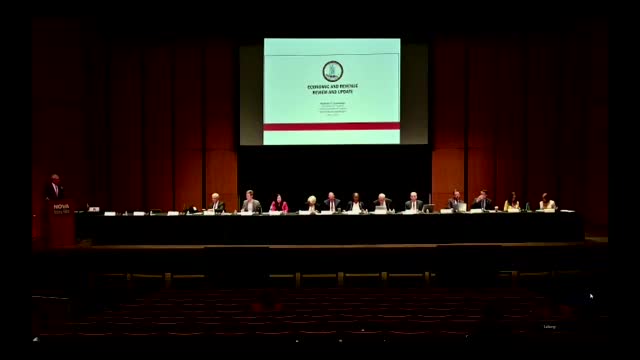
Steve Cummings, Virginia’s secretary of finance, told the Senate Finance and Appropriations Committee at a meeting hosted at Northern Virginia Community College that April revenues were stronger than expected and that the administration is closely monitoring potential revenue impacts from federal job reductions and changes to federal grants.
Cummings said year‑to‑date general fund revenues through April were about $1.49 billion, or 6.3%, ahead of last year and $211 million (0.8%) ahead of the official forecast. He reported April alone came in $322 million above April 2024 and exceeded the monthly forecast by $126 million. The presentation listed a projected FY2025 revenue surplus of $2.1 billion relative to the budget adopted after the 2024 special session.
The secretary attributed part of April’s strength to unusually large nonwithholding payments tied to final and estimated payments: nonwithholding rose 22% in April and was about $389 million for the month. Payroll withholding, the largest single revenue source, was up about 6.3% year over year but missed the monthly forecast by roughly $170–180 million; Cummings said the miss appears driven by timing of the end‑of‑month deposits and that some of the shortfall likely posted in early May. Sales and corporate income taxes also outperformed their April forecasts, he said.
Cummings warned that uncertainty remains for FY2026. He briefed the committee on the size and scope of Virginia’s federal employment exposure: the administration estimates roughly 320,000 civilian federal employees living in Virginia (about 9% of the state’s withholding base when excluding military), roughly 120,000 active‑duty military, and about 200,000 federal contractor employees. Cummings said withholding tied to civilian federal employees was about $1.8 billion on an annual basis and withholding tied to federal contractors about $1.0 billion, producing roughly $2.8 billion in total withholding for those groups. He explained that, in his modeling, a 5% reduction in those groups would equal about 26,000 full‑time positions and roughly $140 million in lost withholding over a year.
To guard against downside risk, Cummings said the governor’s budget included a $900 million unappropriated balance intended as a first line of defense against a possible 3% revenue decline. He also described the administration’s cross‑secretariat monitoring work: weekly withholding reports for federal agencies and the top 100 federal contractors, weekly unemployment tracking, and ongoing federal grant tracking across agencies to determine which grants might be paused or resumed.
Committee members pressed the secretary about regional impacts. Senators raised concerns about Northern Virginia and Hampton Roads — two areas with concentrated federal employment and contractor activity — and how local housing markets and businesses might feel a sharper impact than statewide aggregates suggest. Cummings and committee members discussed mitigants, including Virginia Works, job fairs and retraining, state economic development project pipeline commitments that the secretary said could create tens of thousands of private sector jobs, and the Commonwealth’s low unemployment rate and sizable job openings.
Cummings also told the committee rating agencies have been briefed; he said conversations with Moody’s, S&P and Fitch affirmed that the Commonwealth has capacity to absorb a moderate revenue decline through expenditure adjustments and reserves, but that careful monitoring is required.
The secretary concluded that, based on current receipts through April, the administration remains confident it will meet the FY2025 forecast, but that the state is in an “all hands on deck” mode to track federal job developments, trade and grant actions that can affect the revenue outlook.
Ending: Committee members thanked the secretary and moved to other agenda items. No formal votes or policy changes occurred during this presentation; members asked for continued weekly updates from the administration on withholding and grant status.