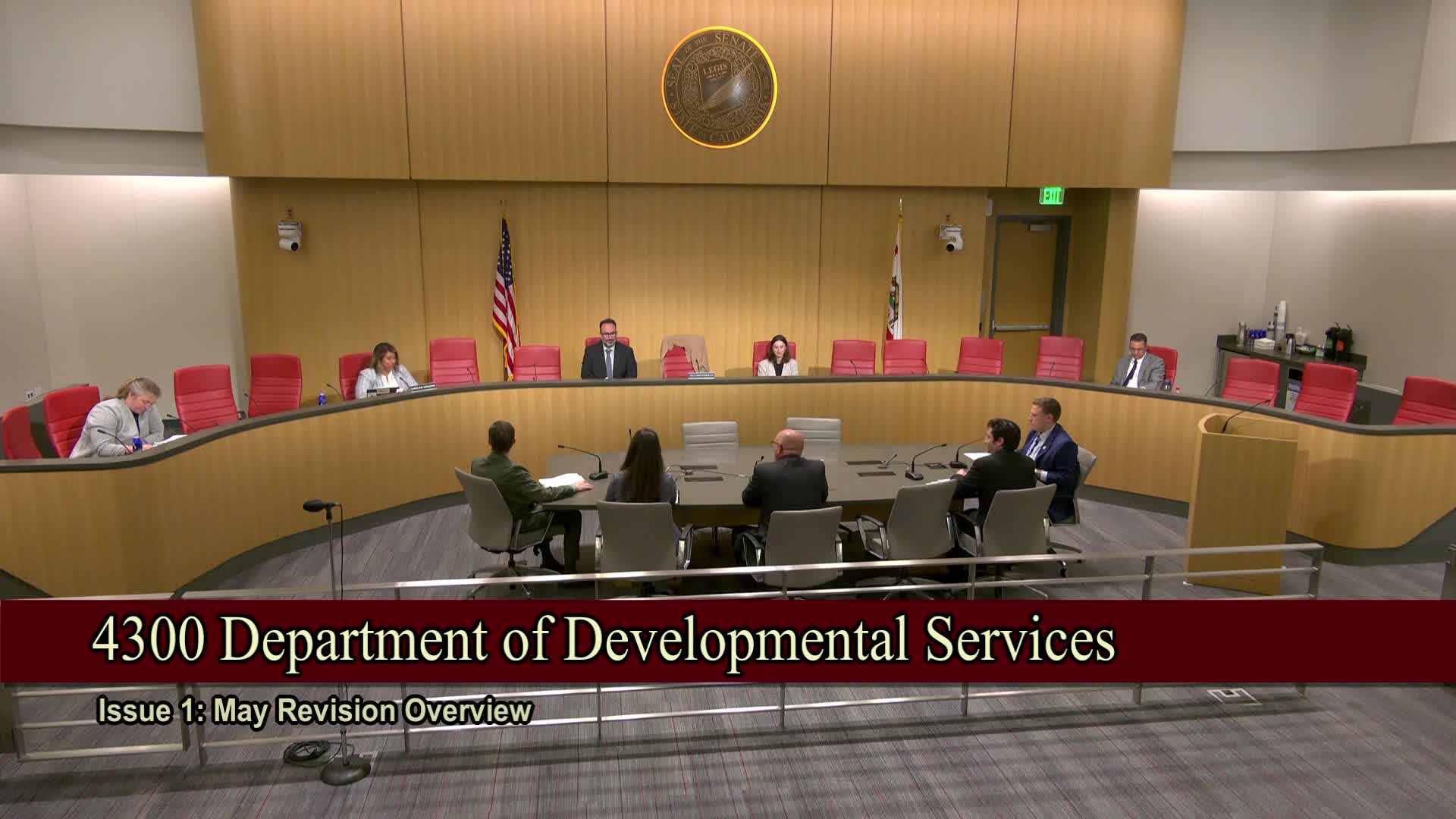
Department of Developmental Services May revision proposes earlier end to hold‑harmless, quality incentives and other changes; LAO asks for assumptions

3408344 · May 19, 2025

Loading...

AI-Generated Content: All content on this page was generated by AI to highlight key points from the meeting. For complete details and context, we recommend watching the full video. so we can fix them.

Summary

DDS Director Pete Chervenka told the Senate subcommittee the May revision retains program growth while proposing cost‑management steps including an earlier end to a rate reform hold‑harmless period, a quality‑incentive payment approach tied to provider compliance, and adjustments to the Self‑Determination Program.

Pete Chervenka, director of the Department of Developmental Services (DDS), told the subcommittee the May revision continues overall program growth but includes a package of proposals intended to "bend future cost curves" while preserving core entitlements under the Lanterman Act.

What the administration proposed

- The May revision includes an adjustment to end the hold‑harmless policy and to accelerate certain rate‑reform timing by four months earlier than originally planned, which the department scored as a near‑term savings item.

- A proposed quality incentive program would condition some provider payments on meeting a set of requirements (including electronic visit verification and fiscal/audit requirements); DDS said its current assumption is that about one‑third of providers would be noncompliant with at least one of the criteria in the first year, which underlies the administration's projected savings estimate.

- A proposal for the Self‑Determination Program (SDP) would slow or reduce automatic growth assumptions (DDS described a $22.5 million technical adjustment roughly equal to 10% of projected SDP growth as modeled in the May revision).

Questions and LAO review

- The LAO asked the administration to explain its methodology for estimating the number of providers who would fail to achieve compliance and to clarify whether savings scored in the initial year would persist in subsequent years as more providers come into compliance. The LAO also asked whether partial‑year compliance would trigger payment eligibility.

- LAO raised concerns that EVV and independent fiscal/audit requirements could disproportionately affect smaller providers and asked DDS to explain the access implications and any mitigation strategies.

Other items

- DDS described investments for the Life Outcomes Improvement System (case management and fiscal modernization), monitoring positions for certain residential settings, and workload support to implement federal CMS rules and AB 1147 (Public Records Act responsibilities previously discussed).

Discussion vs. decisions

All items were administration proposals presented for legislative consideration; no committee vote was recorded. LAO requested further documentation and methodological detail for the savings assumptions and potential access impacts.

Ending note

DDS and DOF officials said they are available to work with the legislature and stakeholders to refine assumptions and ensure program continuity while addressing long‑term fiscal sustainability.