Get Full Government Meeting Transcripts, Videos, & Alerts Forever!
Get email alerts on the Emergency Medical Services topic
No spam. Unsubscribe anytime.
San Francisco EMS reports modest gains in offload times, high cardiac-arrest survival and expansion of data systems
Summary
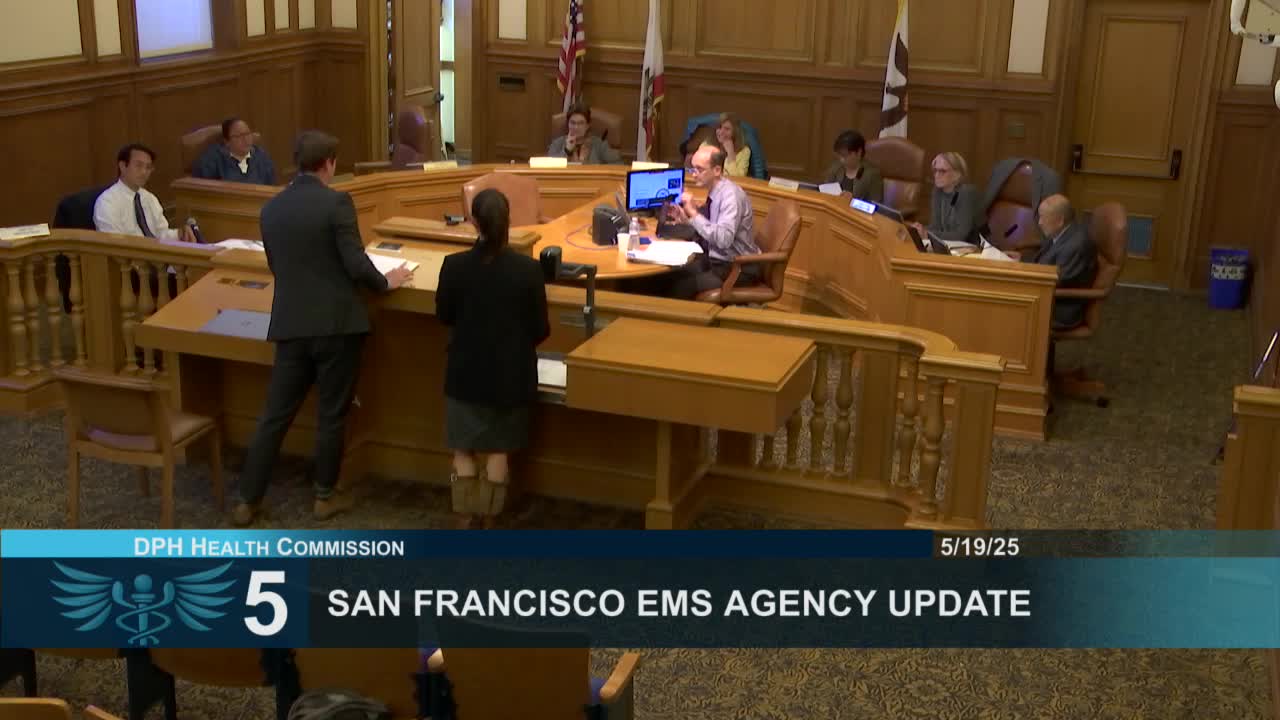
San Francisco EMS told the Health Commission it has rolled out new data and permitting software, reported year‑over‑year improvements in ambulance patient offload times, and described programs including paramedic‑initiated buprenorphine and PulsePoint outreach.
San Francisco EMS Agency Director Andrew Holcomb and Medical Director Dr. Amelia Bridal told the Health Commission on May 20 that the agency is rolling several data and operations initiatives aimed at improving ambulance availability and patient outcomes.
Holcomb said the agency launched a citywide move to ImageTrend for credentialing, permitting and enforcement workflows and that the initial start‑up was funded by a CareStar grant. "We're moving it all over into ImageTrend," he said, describing the platform as a single hub for EMT/paramedic applications, ambulance permitting, complaint tracking and fiscal activities.
The presentation highlighted incremental year‑over‑year improvement in ambulance patient offload times (APOT). Holcomb cited the 90th‑percentile APOT in April 2024 as about 44 minutes and April 2025 as about 39 minutes, a roughly five‑minute improvement. He noted San Francisco remains above the 30‑minute standard the local EMS agency must set under AB 40 and said policy, hospital and operations work groups continue to study best practices and revise the APOT policy, with the latest update slated to take effect July 1.
Dr. Bridal noted outcomes tracked in the CARES cardiac arrest registry. "In 2024, San Francisco's cardiac arrest survival rate was 35 percent," she said, which she said is above the state (23 percent) and national (26 percent) figures cited in the registry. The Medical Director also flagged bystander AED use and bystander CPR as continuing areas for improvement and described public outreach tools such as PulsePoint and hands‑only CPR events.
The agency reported drug‑overdose response work, including a paramedic‑initiated buprenorphine program that began in April 2023 as part of the California EMS Bridge Project. Holcomb said 179 doses have been administered since the program began and that buprenorphine is now available from all three 911 providers in the city.
Holcomb and Bridal described RediNet upgrades launched in April to provide hospitals and EMS a more automated, transparent status feed of ambulances, and they said the system now supports automatic routing when hospitals signal EMS alert or ambulance bunching. The agency also emphasized continuing work on diversion and hospital-level coordination, including one‑on‑one data sharing with hospital administrators.
Commissioners asked about community outreach and training. Bridal said EMSA aims to host or attend at least one public outreach or health education event a month and that the agency keeps materials (including QR codes for PulsePoint) at outreach tables. Commissioners encouraged more school‑based CPR training in the coming academic year.
Holcomb and Bridal outlined two strategic priorities they singled out as high value: further data integration linking EMS responses with hospital clinical records, and (separately) consideration of whether the city needs an additional trauma center given San Francisco's size and event load.
The commission received the update with questions about sustainability of APOT gains and the agency's plans for data integration and event planning.