Get Full Government Meeting Transcripts, Videos, & Alerts Forever!
Get email alerts on the Childcare topic
No spam. Unsubscribe anytime.
Senate subcommittee reviews May revision childcare cuts, automation funding and single-rate timeline
Summary
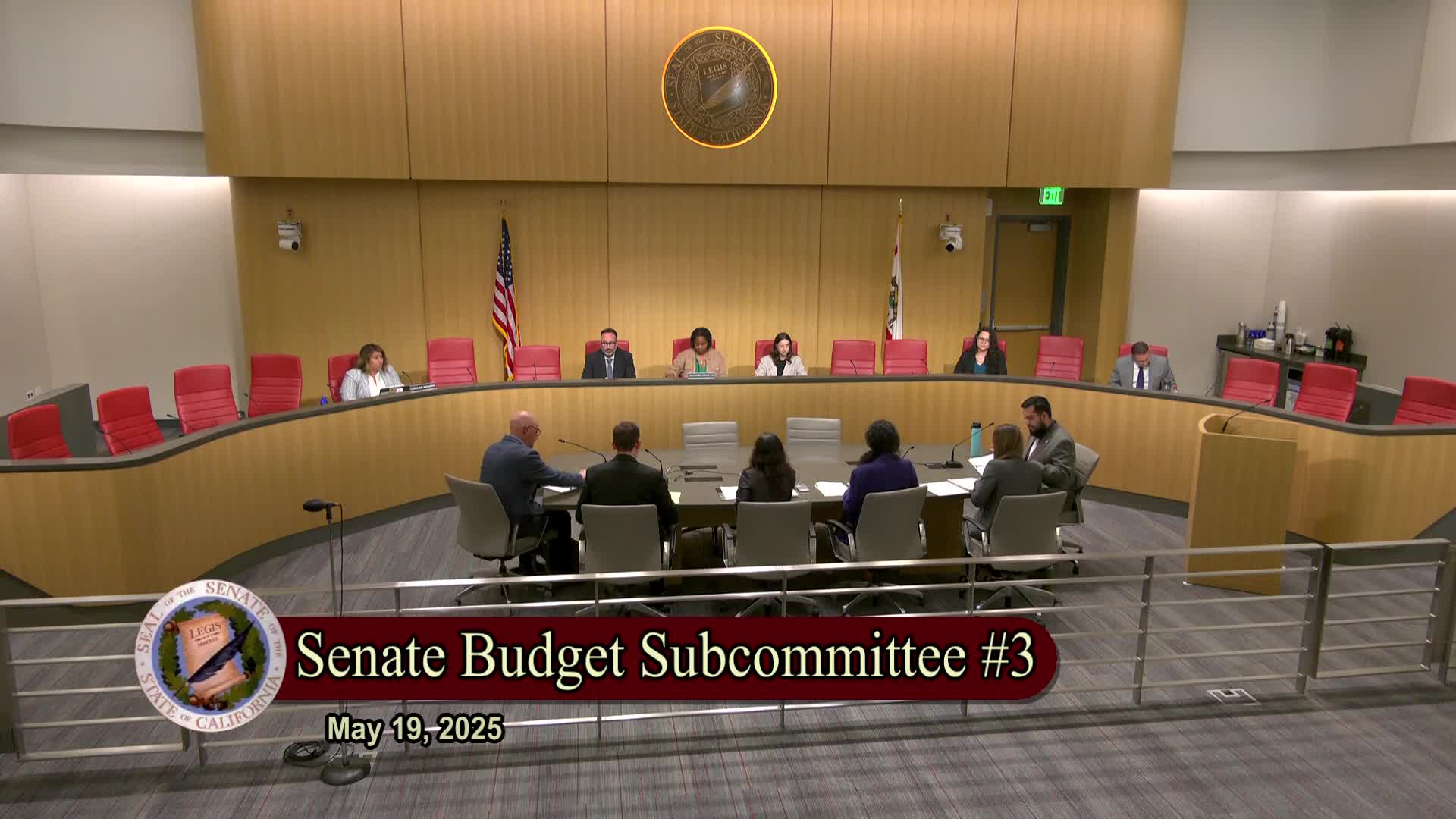
Good afternoon. Jennifer Troia, director of the California Department of Social Services, told the Senate Budget Subcommittee No. 3 that the governor's May revision suspends the 2025–26 childcare COLA, reduces emergency bridge funding for foster children, and sets aside federal funds for automation to implement a single rate structure.
Good afternoon. Jennifer Troia, director of the California Department of Social Services, told the Senate Budget Subcommittee No. 3 that the governor's May revision includes major changes for childcare funding and implementation.
The May revision "includes $6,800,000,000 total funds in 24–25 for child care," Troia said, and proposes multiple general‑fund and federal‑fund adjustments in 25–26 to close the state's estimated shortfall and to begin implementation activities for a new single‑rate structure.
Why it matters: The proposals would suspend the 2025–26 cost‑of‑living adjustment (COLA) for subsidized childcare, reduce funding for the emergency childcare bridge program for foster children, and allocate one‑time federal funds to build automation and prospective payment capabilities. The changes affect providers, counties that administer local programs, and families relying on subsidized care.
What officials said
- Troia said the May revision contains a proposed reduction of "$60,700,000 general fund in 25–26," which "represents the amount of funding that would have otherwise been provided to childcare for the cost of living or COLA adjustment." She also described a reduction of "$42,700,000 general fund in 25–26 and ongoing" for the emergency childcare bridge program.
- On automation and payment reform, Troia and CDSS staff described $21,800,000 in one‑time federal funds to support startup costs to implement a single rate structure and associated automation changes. CDSS said the technical work likely will take "at a minimum 2 years" and that a federal liquidation date of 9/30/2028 constrains the use of the federal dollars.
- Tamar Webber of the Department of Finance said the governor's May revision is addressing a broader estimated $12 billion budget shortfall and explained the COLA suspension would yield "$60,700,000 ongoing general fund savings while maintaining current reimbursement rates for all providers." Krishan Malhotra (DOF) summarized the proposed $42.7 million reduction to the emergency bridge program while noting $51 million in ongoing funding would remain.
Questions and concerns from legislators and the LAO
- Senator Menjivar asked whether the two‑year automation timeline included the COLA; CDSS replied the two‑year estimate referred specifically to implementing the single rate structure and associated automation, not to the COLA.
- On the emergency bridge program, CDSS said counties report spending levels and that FY 2023–24 data showing roughly half of allocated non‑voucher and voucher dollars were spent informed the proposed reduction. CDSS acknowledged the data are preliminary and "not audited just yet." A committee member pressed that unspent prior allocations drove the right‑sizing decision.
- Dylan Hox of the Legislative Analyst's Office recommended rejecting proposed language exempting the $21.8 million automation work from Department of Technology review, saying: "As a rule, our office opposes similar exemptions, as that review can help prevent projects from exceeding proposed timelines and budgets." LAO also asked for more detail about exactly what the $21.8 million would finance and recommended additional oversight and reporting on prospective payments given existing federal waivers.
Implementation and next steps
CDSS and DOF said automation work, training, guidance to counties, and bargaining with family childcare provider representatives are necessary before the single rate can be implemented. CDSS said adopting the proposed language in the budget would permit prompt work on automation and implementation; officials repeatedly cautioned that exact timing depends on bargaining outcomes, rollout pacing across programs, and federal constraints.
Discussion vs. decisions
All items discussed in the hearing were budget proposals; no formal votes or final actions were recorded in the transcript. The subcommittee heard clarification and raised oversight questions. The LAO requested added review of project oversight and reporting; legislators asked for county‑level impact data on the bridge program and implementation timelines.
Ending note
Legislators pressed the administration for county‑by‑county details on the bridge reductions, for clearer breakdowns of automation costs, and for assurances about federal compliance if California moves from attendance‑based to enrollment‑based payments. CDSS and DOF said they will provide additional detail as required by the legislature and noted statutory or bargaining processes still apply to some changes.