Get Full Government Meeting Transcripts, Videos, & Alerts Forever!
Get email alerts on the Class Size topic
No spam. Unsubscribe anytime.
Kirkwood board hears class-size report as enrollment shifts could trim elementary sections
Summary
District staff told the board the district is on a narrow margin at several elementary grades and could collapse up to five elementary sections compared with 2024-25; trustees asked administration for fiscally responsible options to preserve sections where possible.
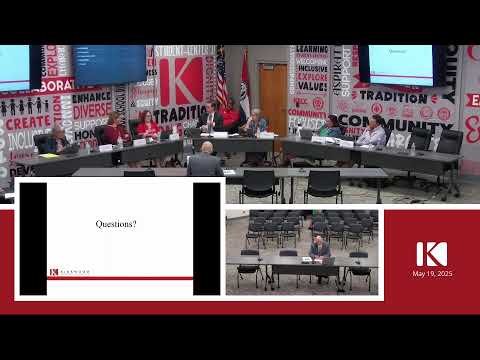
Kirkwood R-VII Board of Education members heard detailed class-size and enrollment projections May 19 that show small shifts in student counts could change how many elementary classroom sections the district offers in 2025–26.
The district presentation, given by Dr. Fields, focused on actual May enrollment compared with mid‑series projections and showed the district is ‘‘6 students away from collapsing 4 additional elementary classroom sections and 6 students away from adding 3 additional elementary classroom sections,’’ Dr. Fields said in the presentation. The district would have a net reduction of five elementary classroom sections compared with the 2024–25 school year if both scenarios occur.
Board members pushed for options that would limit disruption to classrooms and asked administration to return recommendations that are fiscally responsible and achievable before the start of the 2025–26 year. Board member Hepburn said the conversation should consider equity and student needs beyond raw head counts: "You don't give them all the same box, you give them the box that they need to be able to see the game," she said, arguing for flexibility in how sections are allocated.
Presenters gave school-level detail showing differences between mid‑series projections and actual May enrollment used in Infinite Campus. Examples presented by staff included:
- Kaiser: mid‑series kindergarten projection 75; actual May kindergarten 56. Other grades at Kaiser ranged from 70 to 112 depending on grade. - North Glendale: mid‑series kindergarten 93; actual May kindergarten 75 with first grade 84 and other grades near 79–103. - Robinson, Tillman and Westchester: each school showed gaps between projected mid‑series and actual May counts; Westchester's reported actual fifth‑grade enrollment in May was 120.
Board members raised specific local concerns. Andrews asked about a North Glendale class whose counts have hovered around thresholds that trigger adding or collapsing a section; Dr. Fields explained that small changes (two students or so) can move a grade above or below the district’s threshold for adding a section, and noted the district will not collapse sections after the July board meeting if that timing would otherwise require it.
Several trustees urged a faster review of class-size policy and operational changes that could reduce the chances of collapsing sections in ways that harm students or staffing. Neiman and Hepburn both asked for a practical timeline to examine options and for administration to return concrete, fiscally responsible proposals; Dr. Fields said administration would run preliminary scenarios and report back.
The board repeatedly framed the question as a tradeoff between preserving positions and sections and the district's longer‑term staffing and budget plans. Board member Caffey warned of ripple effects if the board tries to maintain sections without accounting for the district’s staffing and recruitment needs. Dr. Fields and other administrators said attrition and budget contingencies give the district some flexibility but that any permanent change should be vetted and balanced against budget assumptions.
The discussion produced direction rather than immediate action: administrators were asked to return recommended options that would be "fiscally responsible," with projections run both with and without the contingency teachers built into the preliminary budget, and to coordinate with the incoming superintendent on any proposal that would alter the preliminary budget.
The board and administration scheduled follow up at the June work session so members who were absent can participate in decisions about any reallocation of contingency funds or changes to the class‑size policy.
Ending: The board did not vote on policy changes at the meeting; trustees asked administration to produce concrete, budget‑aware options that could affect the 2025–26 year and to bring those options to the June work session for board review.