Get Full Government Meeting Transcripts, Videos, & Alerts Forever!
Get email alerts on the Environment Water topic
No spam. Unsubscribe anytime.
Upper Trinity Regional Water District presents Greenbelt Plan to Argyle council, offers draft resolution
Summary
Upper Trinity Regional Water District urged Argyle to adopt goals from the Denton County Greenbelt Plan to protect watershed areas and drinking-water sources; staff provided a model, voluntary resolution and noted recommended strategies such as riparian buffers and conservation easements.
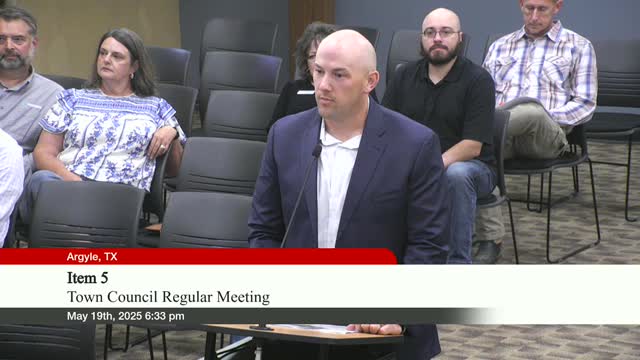
Blake Aldridge, representing the Upper Trinity Regional Water District, presented the Denton County Greenbelt Plan and a companion conservation trust program and asked the council to consider adopting a resolution supporting the plan's voluntary goals.
Aldridge said the district now serves about 460,000 people in Denton and Collin counties and that protecting creek corridors, floodplains and riparian areas reduces water-treatment costs and preserves reservoir capacity. "Our latest estimates were now serving drinking water to 460,000 people here in Denton and Collin Counties," Aldridge said. He described conservation easements held by the Opportunity Conservation Trust and listed recommended strategies in the county plan, including 100-foot riparian setbacks on both sides of creeks, conservation easements, cluster development alternatives and green stormwater infrastructure.
Aldridge pointed to the Denton County Greenbelt Plan adopted in 2017 by county leaders and the water district as a living document that prioritizes greenbelt preservation and provides an implementation "toolbox" for cities to use on a voluntary basis. He said staff included a draft resolution in the council packet; the draft would state that the town supports the plan's goals and would consider appropriate implementation steps, but would not require any specific regulatory action.
Council members broadly supported vetting a formal, staff-drafted resolution for a future council agenda. Planning staff and council discussed how the town's northern drainage flows to Lewisville Lake while the south flows to Grapevine Lake, and noted Argyle lies in multiple high-priority watersheds in the county mapping.
Why it matters: the Greenbelt Plan is a voluntary, regional approach to protecting watersheds upstream of major reservoirs that supply drinking water. If Argyle adopts the plan or elements of it, staff would be encouraged or authorized to consider specific model ordinances, setbacks and incentives for green infrastructure when reviewing future development proposals.
Clarifying details: Aldridge said riparian buffers of about 100 feet on each side of creeks deliver material water-quality and flood-mitigation benefits; the presentation cited county figures estimating that conservation easements on Texas lands can yield large returns (the presenter cited summary figures including $69,000,000 per year in water-treatment savings and $316,000,000 in captured usable water at statewide scales), and that conservation and riparian vegetation reduce sediment inflow to reservoirs.