Get Full Government Meeting Transcripts, Videos, & Alerts Forever!
Get email alerts on the Public Safety Financing topic
No spam. Unsubscribe anytime.
Clear Creek County officials review sales-tax and mill-levy options to close $7 million budget gap
Summary
County commissioners, municipal leaders and the Clear Creek Fire Authority met May 19 to review a presentation on a structural general-fund shortfall, discuss options including a public-safety sales tax and mill-levy increases, and set next steps toward ballot language and public outreach.
Clear Creek County commissioners, municipal officials and the Clear Creek Fire Authority met May 19 for a joint session to review a county staff presentation on a structural general-fund shortfall and to discuss financing options for public safety services, including countywide sales-tax measures and property-tax (mill) increases.
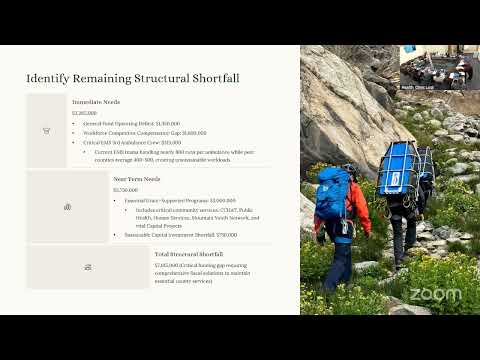
The presentation, prepared by county staff, described a roughly $7,000,000 structural gap in the county general fund and identified a remaining near-term shortfall of about $4,800,000 after cost-control steps and near-term revenue opportunities. The materials and presenters said the county faces capital shortfalls, a shortfall in competitive employee compensation, high staff turnover and an operational need for a third ambulance crew; they also described a separate operating shortfall at the Clear Creek Fire Authority (CCFA) of about $623,000 a year.
Why it matters: County staff and local fire officials said the shortfalls threaten service levels across law enforcement, emergency medical services and fire protection. Presenters framed the options as (1) additional cost controls and service reductions, (2) voter-approved revenue via sales tax and/or property-tax (mill) increases, or (3) some combination and sequence of those steps. Officials emphasized timing: several speakers said they need additional revenue or cost changes in the next one to five years to avoid layoffs and significant service reductions.
Most of the presentation focused on three ballot-option models: a county public-safety sales tax (examples modeled at 1–2 percent), a hybrid mix (1 percent sales tax plus a 7-mill increase to the general fund), and property-tax–only approaches centered on additional mills targeted either countywide or inside the fire protection district. Staff projected that a 2 percent public-safety sales tax that exempts groceries would net approximately $3.7 million; the same rate without exemptions would produce more revenue but would raise the per-household burden, particularly for higher-spending households. The hybrid option was shown as generating revenue largely through added mills while limiting the sales-tax increase on residents.
Speakers repeatedly noted a complicating factor: recent property revaluations and possible state actions (discussed in the meeting as TABOR-related and state-level assessment-rate decisions) could materially change property-tax revenue estimates and the political environment for mill-levy measures. Presenters warned that rising assessed values cause public concern even when state-level adjustments later reduce effective tax increases, and several elected officials said that makes a mill-levy-first approach politically difficult in the short term.
On the fire authority: CCFA representatives described a faster timeline for imminent cuts if no new revenue is secured. “If we don’t get approved money on the ballot question this year ... I’m gonna have to lay off the shift crew that we put in Georgetown,” a CCFA representative said during the meeting, citing staffing and reserve pressures. Municipal leaders said voters in some towns have shown willingness to support fire funding passed through municipal budgets or an ESD/ESGID mill levy, and several participants said a CCFA-only mill measure appeared more politically viable than a larger countywide package that included sheriff and EMS funding.
Discussion points and concerns raised in the meeting included: - Service impacts: staff described possible outcomes of a $5 million unresolved gap—reduced patrol coverage, longer emergency response times, elimination of community programs, reduced permitting and planning support, closure of the waste transfer station and other reductions. - Distributional effects: presenters illustrated how sales-tax options affect households differently (e.g., households that spend more in-county or purchase more taxable goods would pay more under a sales tax than those who purchase outside the county). Several participants raised concern for seniors and fixed-income residents; staff noted senior exemptions and other mitigations but said those do not fully resolve political sensitivity to property-tax increases. - Tourist and business effects: the county’s large share of non–sales-taxable services (rafting, recreation, mountain operations) means many high-demand users pay little in local sales tax; participants discussed the mismatch between who uses emergency services and who contributes via the existing tax base. - TABOR and state-level uncertainty: multiple participants noted that recent legislative or executive actions at the state level have altered assessed values or assessment rates in past cycles and warned that those actions are unpredictable, complicating revenue forecasting.
Next steps and procedural items: participants agreed to continue the process and set a target follow-up meeting. Meeting participants asked staff to prepare simplified materials for public outreach (to explain mills, sales tax, ESD boundaries and distributional impacts), to collect and use pending survey results, and to draft potential ballot language and revenue splits among fire, EMS and sheriff. The group set a working target for a June meeting (proposed June 16, 11 a.m.–1 p.m.) and discussed notifying the county clerk in July that the county intends to pursue a ballot measure, with formal ballot language to follow in August or September if the board proceeds.
Quotes from the meeting: Paul said, “Great, great presentation,” during the review. A CCFA representative warned of imminent staffing impacts: “If we don’t get approved money on the ballot question this year ... I’m gonna have to lay off the shift crew,” citing reserve use and timelines.
What was not decided: The board did not vote on any ballot language or formally adopt a plan at this meeting. Participants left open multiple sequencing options—run a countywide sales-tax package that dedicates portions to fire, EMS and sheriff; run a CCFA-specific mill levy in the fire district and a separate countywide tax for sheriff/EMS; or pursue a hybrid staged approach. Staff and elected officials emphasized unresolved questions about assessed-value changes, TABOR constraints and voter receptiveness that will inform final choices.
What to watch next: the county will circulate survey results and draft ballot-language options, hold the next joint meeting (target June 16, 11 a.m.–1 p.m.) and intends to notify the clerk in July if the board plans to place a measure on a future ballot. Officials said public outreach and clear explanatory materials for voters will be critical to any campaign for voter-approved revenue.