Get Full Government Meeting Transcripts, Videos, & Alerts Forever!
Get email alerts on the Budget topic
No spam. Unsubscribe anytime.
Gettysburg Area SD board hears 1.5% proposed tax increase; members debate trimming 0.5% to protect fund balance and capital plan
Summary
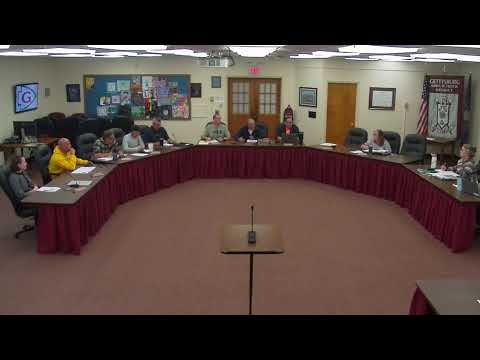
Gettysburg — At a public budget hearing May 20, Gettysburg Area School District business staff recommended a proposed 1.5% tax increase for the 2025–26 fiscal year, prompting board discussion about whether to remove a 0.5% portion and use one-time audit adjustments or fund balance instead.
Gettysburg — At a public budget hearing May 20, Gettysburg Area School District business staff recommended a proposed 1.5% tax increase for the 2025–26 fiscal year, prompting board discussion about whether to remove a 0.5% portion and use one-time audit adjustments or fund balance instead.
Belinda, the district business office presenter, told the board that the administration's recommendation is “a 1 and a half percent increase.” She said the total proposed revenue shown in the presentation ties to a roughly $77 million revenue estimate and about $79 million in proposed expenditures, with salaries and benefits representing the largest expenditure slice (about $47 million).
The recommendation included dedicated funding for ACTI (the county career and technical program). Board members pressed options for reducing the taxpayer increase by 0.5 percentage points while maintaining near-term capital funding and the board's chosen fund-balance guideline.
Why it matters: The district projects declines in federal one-time pandemic-era funding (ESSER) and is using fund balance as a backstop in the short term. Business staff presented a five-year projection showing that without additional revenue the district could face cumulative deficits, and that the fund balance target under district policy is 6% to 8% of expenditures. The board must adopt a final budget June 16 after a review and a recommendation on June 2.
Key budget details and context
- Composition of revenue: The presenter said local sources make up about 68% of revenue, state about 30.7% and federal the remainder; the proposed total revenue is roughly $77 million. - Major expenditures: The budget slides shown to the board list salaries and benefits at about $47 million, purchase of services at roughly $18 million, supplies and property at about $3.7 million and debt service at about $9.3 million, for total expenditures near $79 million. - Fund balance: The presentation showed a fund-balance figure of about $4.7 million, which the presenter said equates to the district's 6% policy minimum based on a $76 million expenditures baseline. - Federal dollars: The presenter noted past ESSER and COVID-related federal funding inflated federal revenue in some years; federal funds are expected to be lower and more variable going forward. - Tax impact: For an average homestead assessed value cited in the presentation ($273,891), a 1.5% tax increase was shown as raising approximately $46.70 annually; homestead/farmstead calculations reduce that net effect for qualifying properties.
Board debate and follow-ups requested
Board members who spoke asked for more historic audit information and scenario analysis before committing to the 0.5% change. Jeremy (board member) urged caution about a $25,000 annual district contribution to GAF (a local arts organization), saying that after grants the net return to the district appeared small and that the board should consider directing staff to evaluate whether to stop that contribution. The business presenter replied that the GAF contribution was established by prior board action and would require explicit board direction to remove.
Several board members proposed an approach in which the administration present two versions of the budget at the next meeting: the full 1.5% proposal and a version that preserves the 1% earmarked for ACTI while eliminating the 0.5% capital portion. The board asked staff to provide: - Historical audit "windfall" figures (actual post-audit increases to fund balance over recent years) so members can judge the risk of using expected audit receipts instead of raising taxes; the presenter cautioned that ESSER-era receipts distort the recent history. - A recalculation showing the net dollar effect of removing 0.5% (the presenter said that equates to about $188,000 in revenue) and the resulting changes to the capital appropriation and fund-balance target. - Clarification of what would have to change if the district chose to use fund balance (or to delay capital appropriations) and the projected five-year impact if no additional recurring revenue is found.
ACTI funding and staffing tied to the budget conversation
The board's conversation linked closely to ACTI (the county career and technical center). The proposed budget includes a 1% allocation for ACTI; members said they wished to hold that portion while exploring whether the 0.5% for capital could be deferred or replenished from later audit results.
Separately during the regular meeting, ACTI Director Sean Eckenrode explained the joint operating committee's request to create an "assistant to the administrative director" position. The committee approved advertising a salary range of $80,000–$90,000 for that role; when benefits were factored in the total salary-and-benefits package estimated by ACTI staff reached about $150,000. Eckenrode said ACTI serves roughly 272 students and that the program receives about 292 applications for roughly 147 seats, leaving approximately 40–50 applicants unserved each year. Board members noted the connection between sustaining or expanding career and technical education and the district's broader budget decisions.
Other budget items raised
- Family navigators: Board members asked for a cost estimate to convert two currently contracted family navigator positions to district employees; staff estimated an additional roughly $50,000 (salary and employer-side benefits) to bring the contractors into district payroll and benefits plans. - Property tax appeals: The business presenter warned that assessment appeals by large local taxpayers (for example, Gettysburg College) could materially reduce local tax revenue and affect future budgets. - Enrollment and per‑pupil calculations: Staff said enrollment reported to the state has been stable and that the presentation used PDE (state education department) enrollment figures; staff also cautioned that general fund expenditures divided by district-educated enrollment is a different and broader per-student cost than some state per-pupil metrics.
Next steps
The board asked staff to present two budget scenarios and historical audit-return data at the June 2 meeting so members can decide whether to remove the 0.5% increase and, if so, from where to temporarily reallocate funds. The final budget adoption is scheduled for June 16, when the board must vote on the budget and any tax-rate changes.
Ending note
Board members repeatedly emphasized the need to balance conservative budgeting (to avoid running beneath the 6% fund-balance guideline) with the desire to protect programs, capital needs and ACTI funding. The business office cautioned that delaying recurring revenue choices merely defers difficult decisions and that without new revenue or cuts the five-year projection showed a multi-million‑dollar shortfall.