Get Full Government Meeting Transcripts, Videos, & Alerts Forever!
Get email alerts on the Cannabis Regulation topic
No spam. Unsubscribe anytime.
Department of Cannabis Control proposes shifting illicit-market enforcement costs to cannabis tax fund and new authority to seal illicit premises
Summary
The Department of Cannabis Control proposed shifting illicit-market enforcement costs from licensing-fee revenue to the Cannabis Tax Fund and sought authority to seal premises used for illegal cannabis operations; analysts urged the Legislature to weigh the fund shift against pending excise-tax changes and to vet sealing authority in policy hearings.
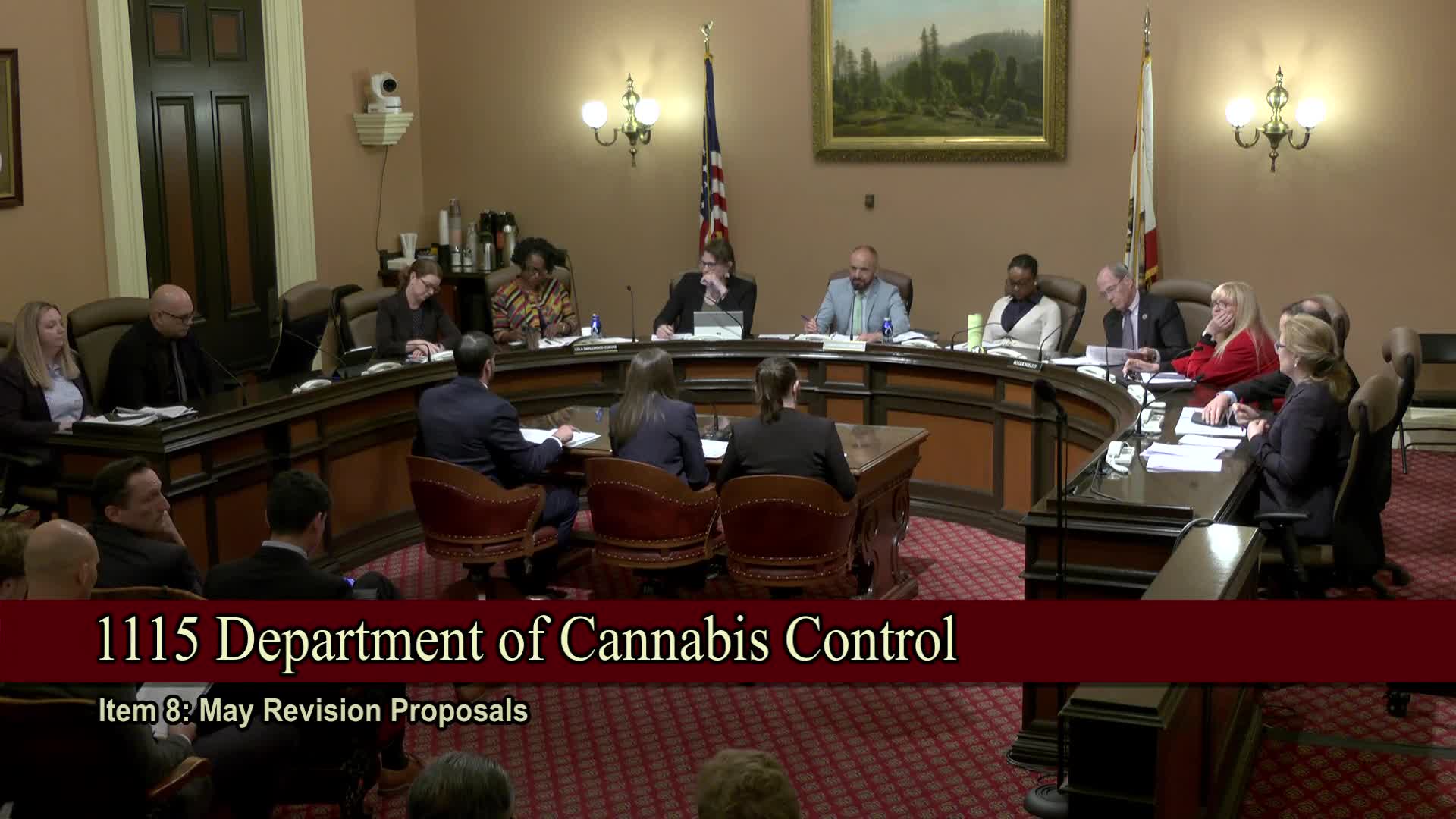
The Department of Cannabis Control (DCC) presented May revision proposals focused on sustaining illicit-market enforcement while limiting cost pressures on licensed businesses.
Proposal highlights - Fund shift: DCC asked to move illicit-market enforcement costs from the Cannabis Control Fund (funded by licensing fees) to the Cannabis Tax Fund (funded by excise and sales taxes). DCC said the Cannabis Control Fund is structurally insolvent and cannot absorb the department's enforcement burden without large license-fee increases or staff reductions. - Sealing authority: DCC proposed a new enforcement tool to seal buildings used for illegal cannabis activity after execution of a warrant, arguing that illicit retailers often reopen quickly after enforcement sweeps. Under the proposal, property owners would receive notice and could challenge a seal or remove it after abatement. - BSCC grant refinements: The administration proposed adjustments to the Board of State and Community Corrections (BSCC) grants (Allocation 3) to broaden eligible small jurisdictions and better prioritize law-enforcement grants for the illicit market.
Analysts' and committee reaction - LAO advice: The Legislative Analyst's Office recommended the committee consider the fund-shift proposal in the context of AB 564 (bill on the excise tax rate) because a separate bill to keep the tax at 15% would materially affect Cannabis Tax Fund resources; the LAO also recommended policy committee review of any new sealing authority because of legal and constitutional implications. - Legal and civil-liberties concerns: Senators and LAO counsel urged that sealing authority is a policy change with potential Fourth Amendment implications and asked that it be vetted in a policy committee before final budget action.
Budget and market context - DCC presented data showing a large illicit production estimate and low licensed-market share: the department said roughly 11.4 million pounds of illicit cannabis are produced annually in California compared with 1.4 million pounds in the licensed market and that only about 40% of consumers purchase from licensed sources.
Outcome: The subcommittee held the proposal open. Finance noted the cannabis control fund faces a negative balance by FY 2026-27 absent changes and warned that deferring action could create implementation challenges; the LAO suggested pairing any fund-shift decision with the Legislature's action on excise-tax policy.
Next steps: The subcommittee requested further fiscal modeling that incorporates pending excise-tax legislation and legal review of sealing authority.