Get Full Government Meeting Transcripts, Videos, & Alerts Forever!
Get email alerts on the Housing Policy topic
No spam. Unsubscribe anytime.
May revision would revert $31.7 million and advance climate-aligned housing changes including a VMT mitigation option
Summary
Department of Finance told the subcommittee the May revision proposes reverting $31.7 million in unexpended affordable-housing funds and advancing a set of "climate-aligned" housing changes including a VMT mitigation banking option.
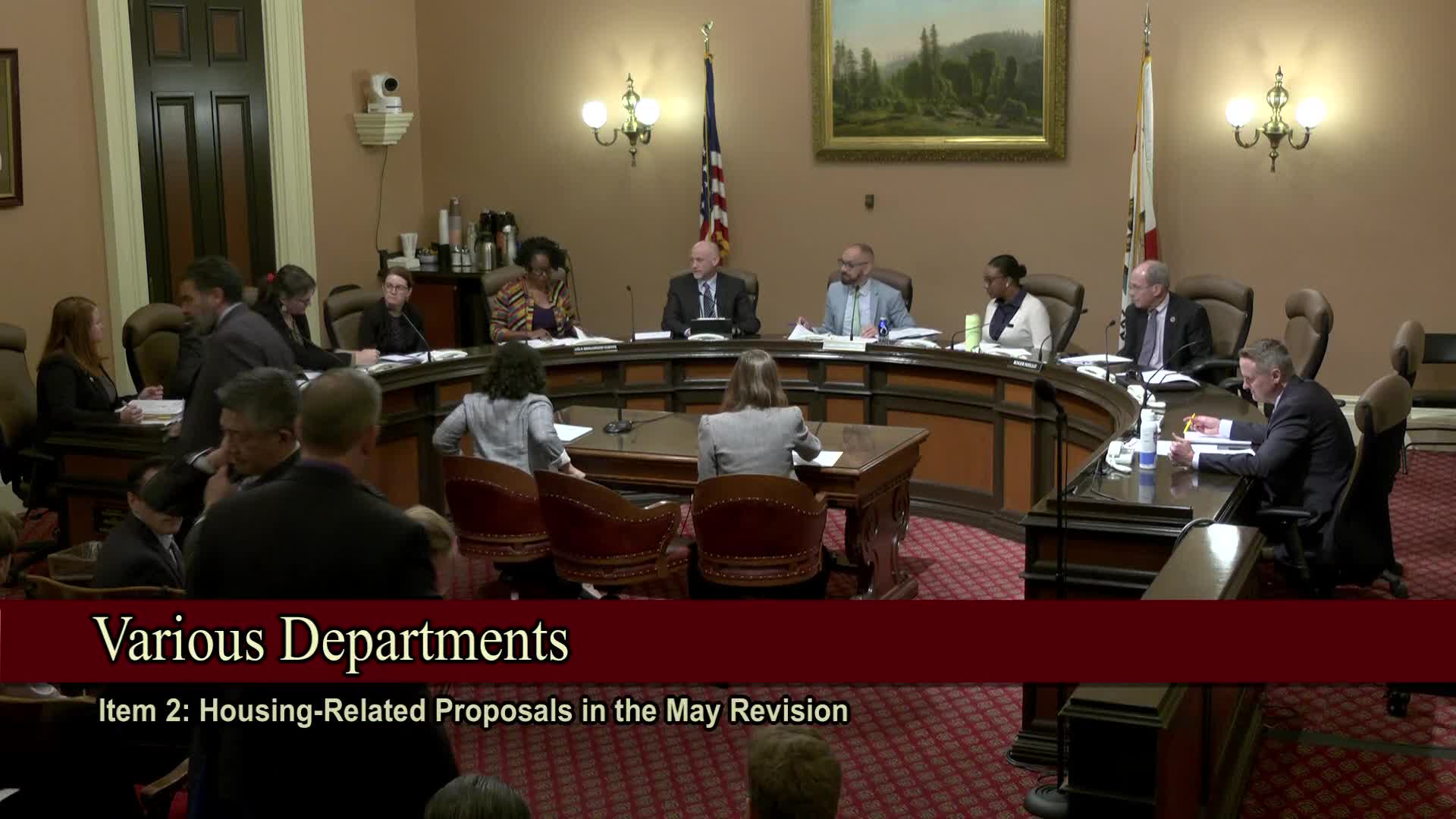
The subcommittee heard the May revision's housing proposals from Department of Finance and the Business, Consumer Services and Housing Agency (BCSHA). Finance staff said the governor's May revision proposes a budget-year savings of $31.7 million by reverting unexpended affordable-housing funds from older budget acts, and includes trailer-bill language to implement several "climate-aligned housing" policy changes.
What the administration proposed - Funding reversion: Megan Tokonaga Block of the Department of Finance described the plan as "the reversion of $31,700,000 in unexpended affordable housing funding from prior budget acts," characterizing the amounts as under-subscribed or not expected to be liquidated by the current deadline. - Climate-aligned trailer bill: Sasha Kurgan (deputy secretary for housing at BCSHA) described three main elements: (1) remove a current Permit Streamlining Act exemption for the Coastal Commission so permitting rules apply uniformly; (2) expand access to CEQA judicial streamlining so housing projects larger than $100 million may use the same streamlined judicial pathway as smaller housing projects, with guardrails requiring infill location and affordability thresholds; and (3) create a statewide Vehicle Miles Traveled (VMT) mitigation banking system that would let project applicants pay a fee into a fund administered by HCD to finance affordable housing and infrastructure near transit.
Administration rationale: Officials said the VMT mitigation option is intended to link transportation mitigation to affordable housing near transit and to provide a flexible, statewide mechanism that can produce additional affordable homes and reduce the per-project mitigation burden.
Legislative Analyst Office and committee concerns - Timing and process: The LAO recommended deferring complex, policy-oriented trailer-bill decisions until the Legislature has more capacity to study them separately from urgent budget trade-offs. The LAO also flagged legal and design questions about the VMT banking approach and recommended careful legislative scrutiny. - Reversion trade-offs: The LAO and Finance described the $31.7 million reversion as a reasonable budget solution given the state's fiscal condition and the funds' underutilization to date, but acknowledged trade-offs for local grant programs.
Administrative detail and pipeline - HCD officials said there remains a large funding pipeline: Finance and HCD staff cited roughly $3.4 billion in active notices of funding availability (NOFAs) across HCD programs and that HomeKey-plus and other large appropriations remain in the pipeline. - HCD and administration staff said that, in the absence of new state dollars in the May revision, they expect to pursue program and permitting reforms that could lower development costs and help existing dollars go further.
Subcommittee outcome: The item was left open for further negotiation. Senators emphasized that reversion decisions and the trailer-bill proposals are material to housing production and should be negotiated alongside any bond plans or other funding streams the administration pursues.
Sources and numbers cited in hearing: $31.7 million proposed reversion; roughly $3.4 billion in active HCD NOFAs; administration described HomeKey-plus and related accounts; HCD noted certain trailer-bill guardrails such as 15% affordability threshold for projects using the judicial-streamlining pathway and the requirement that projects be infill and consistent with regional planning tools.
What to watch next: How the Legislature treats the trailer-bill reforms (CEQA/judicial streamlining, CARB-scoping-plan option, and VMT banking) and whether reverted funds are restored or redirected during budget negotiations.