Get Full Government Meeting Transcripts, Videos, & Alerts Forever!
Get email alerts on the Land Use topic
No spam. Unsubscribe anytime.
Valley County commissioners gather community comment on McCall area of impact; debate management, code gaps and sewer capacity
Summary
Valley County commissioners opened an hour of public comment May 19 on a revised McCall area of impact map after the City of McCall invoked a 90‑day statutory notice; residents and staff pressed the panel on annexation risk, conflicting city and county rules for short‑term rentals and whether sewer capacity allows future annexations.
Valley County commissioners opened an hour of public comment on the proposed McCall area of impact on May 19, hearing residents’ concerns about annexation, short-term rental enforcement and water and sewer capacity as the county prepares to finalize a revised map after a 90-day letter from the City of McCall shortened the review window.
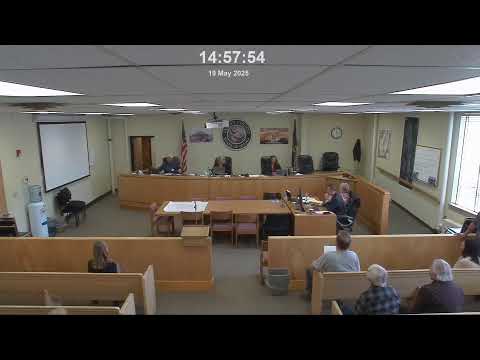
The session was convened to gather input the county will incorporate into a draft map; commissioners said they would complete the map, attach public comments received at the meeting and proceed to a follow-up workshop and formal public hearing. “This is not an official public hearing. This is just community comment,” the chair said at the start of the session.
Why it matters: The area of impact (AOI) is meant to identify where a city and county should plan jointly for growth and services; the county must follow state AOI procedures and a compressed schedule after the city’s 90‑day notice. Residents said map boundaries matter because they affect which rules, permits and enforcement apply to properties and because any future annexation could change taxes, services and development requirements.
Public comments: Many people who spoke objected to being included in the impact area. Mike Barton, a longtime homeowner in Valley View Subdivision, told commissioners “We wish to be removed” and said residents have relied on county jurisdiction for decades. Craig Lawson, who also represents Valley View lots, said residents have wells, septic and privately maintained roads and do not want “the privilege of paying taxes for something we don't need.” Several other subdivision representatives made similar requests.
Other speakers urged retaining protections tied to the AOI. Becky Ryan, who lives within walking distance of McCall city hall, said her neighborhood wants to “retain the protection of residential zoning” the joint comprehensive plan currently affords. Carl Ricola said the city gives residents “a little more input” and that he trusts the city more than the county on certain land-use decisions.
Short-term rentals and enforcement gap: Dr. Gregory Irvin described long-running problems with a neighboring short-term rental and said he found himself “in no man's land with regard to enforcement” because McCall’s code enforcement only applies inside city limits while the county’s land-use code governs the AOI. Michelle Grunavelt, Valley County community and economic development director, confirmed there is a county ordinance for the McCall impact area and said the city updated its short-term rental rules in February 2022; the county chose not to adopt the city’s newer rules. She summarized the enforcement gap: “City code enforcement is in the impact area now ... Anything beyond that, we can try to get voluntary compliance ... and then if we don't, then it gets elevated to county legal. The sheriff's office has jurisdiction, not McCall PD, in the impact area.”
Code differences noted at the meeting included occupancy limits (city rules require a conditional use permit at lower occupant counts than county rules), and shoreline setbacks (county staff cited 30-foot setbacks vs. City of McCall’s 50-foot standard). Grunavelt said the impact-area ordinance is county-adopted code and that the two jurisdictions have not kept the impact-area code in sync since the city updated its permitting and business-license sections in 2022.
Water, sewer and capacity constraints: Commissioners and a representative of the local sewer district said sewer capacity and infrastructure are central to whether annexation and new density are feasible. Jeff (identified at the meeting as with the State Lakes Water & Sewer District) said the district’s storage pond currently holds about 268,000,000 gallons, noted longstanding inflow-and-infiltration (I&I) problems and gave an engineering estimate of roughly 93,000,000 gallons of infiltration in the system. He said the district operates under an emergency discharge permit at times and that replacing the pond liner and expanding storage are complex, costly and constrained by land and regulatory limits. “If we have two wet years in a row, that pond is not big enough,” he said.
Commissioner positions and process issues: Commissioners debated whether the county should assume governance over the full existing impact area or shrink the AOI to match state statutory criteria for likely annexation in five years. One commissioner said, “I would like to see the county take back all the governance and all the impact area,” arguing a single county governance approach would stabilize rules. Other commissioners supported narrowing the AOI to parcels with plausible near‑term annexation or service extension and said a smaller AOI could allow a blended approach — joint planning for a limited area and county code for areas unlikely to be annexed.
Legal and staffing constraints: County leaders cautioned that defending land‑use decisions in a large AOI would increase the county’s legal workload. The county’s counsel and commissioners noted a potential need for additional legal support to represent the county in joint hearings and appeals if the AOI remains broad, which would raise costs to taxpayers.
Next steps: Commissioners closed the public comment portion of the meeting and moved into a work session to draw map lines and discuss code alignment and sewer capacity. Staff said the city’s 90‑day notice sets an August 14 target for decisions tied to that timeline; the county also scheduled a follow-up work session and a formal public hearing will be required before any final map adoption.
What was not decided: No final boundary change or ordinance revision was adopted at the May 19 meeting. Commissioners directed staff to complete a map that incorporates written comments and to return with analyses of sewer capacity, parcel‑level ownership (including conservation easements) and proposed code changes for any reduced AOI.
Ending: The county will post the comments and the draft map to the meeting minutes and hold the required public hearing and future workshops before making any formal boundary change. The commissioners told residents they would accept written input and follow up with outreach to property owners whose parcels could be affected.