Get Full Government Meeting Transcripts, Videos, & Alerts Forever!
Get email alerts on the Downtown Redevelopment topic
No spam. Unsubscribe anytime.
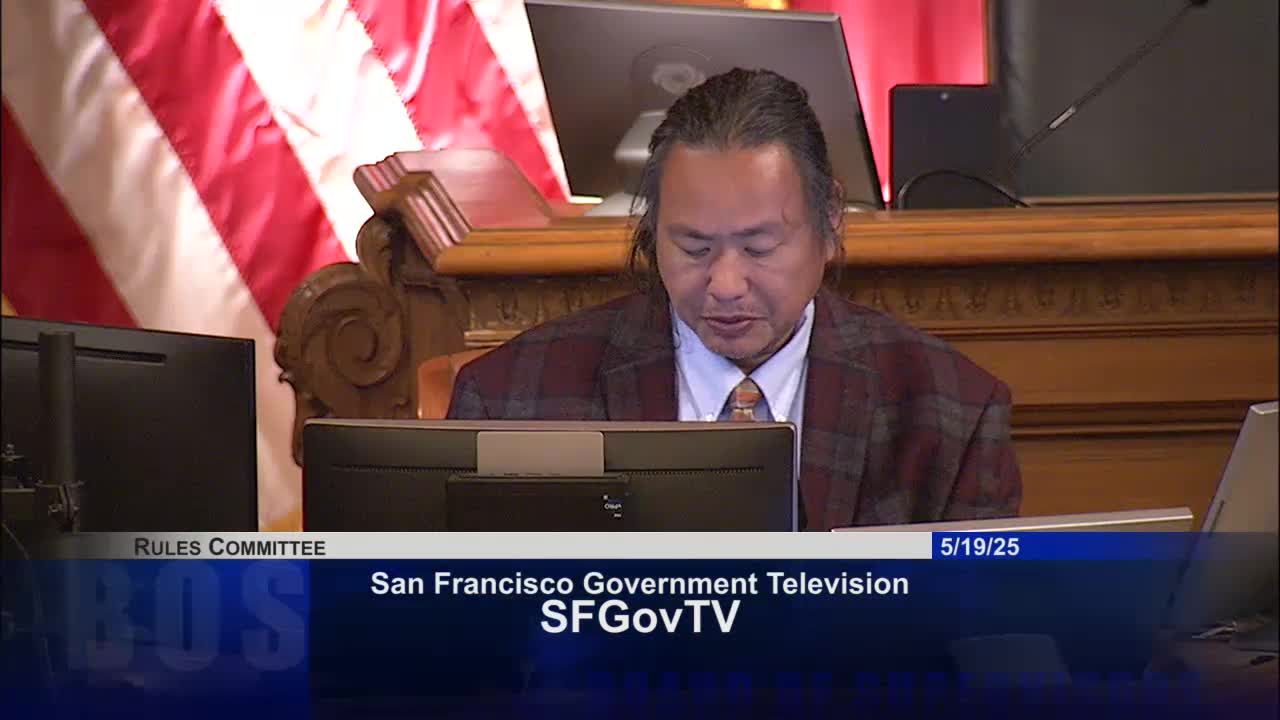
Rules Committee backs ordinance to form downtown revitalization financing board under AB 2488
Summary
The Rules Committee of the San Francisco Board of Supervisors on a May meeting approved an ordinance to establish the board of directors for a downtown revitalization financing district authorized by Assembly Bill 2488, a state law the committee said would permit diversion of incremental property tax revenue to support office-to-residential and commercial-to-residential conversions.
The Rules Committee of the San Francisco Board of Supervisors on a May meeting approved an ordinance to establish the board of directors for a downtown revitalization financing district authorized by Assembly Bill 2488, a state law the committee said would permit diversion of incremental property tax revenue to support office-to-residential and commercial-to-residential conversions.
Supervisor Dorsey, who introduced the ordinance, said the district is intended to “incentivize adaptive reuse projects” and help revive downtown by producing housing and supporting ground-floor uses. Jacob Bentliff of the Office of Economic and Workforce Development briefed the committee on the mechanics of the law and the proposed district board.
The committee’s action moves an ordinance creating the district’s board of directors forward to the full Board of Supervisors with a positive recommendation. The resolution of intention to form the district is scheduled to be considered by the Budget and Finance Committee later this week, and items acted on at today’s meeting are expected to appear on the Board’s June 3, 2025 agenda.
The nut graf: Under AB 2488, San Francisco may create one downtown revitalization financing district. Projects that opt into the program would receive annual payments for up to 30 years drawn from the incremental property tax increases those projects generate, a financing incentive officials say could offset conversion costs and speed residential developments in underused commercial buildings.
According to OEWD’s preliminary consultant analysis cited by Bentliff, roughly 50 commercial properties within the proposed district could be good candidates for conversion, with potential to yield about 4,400 housing units. Bentliff told the committee the city is at the start of the process: the board of supervisors must adopt a resolution of intention, an ordinance establishing the district board, and the district board would then prepare and present a financing plan following public hearings before the Board could adopt a final plan and the district could be formed.
Committee discussion addressed governance and administration. Bentliff said the district board would be a separate legal entity subject to the Brown Act and the city’s Sunshine Ordinance and would be composed of five members and one alternate: three members who are supervisors (one of whom would serve as alternate) appointed by the Board president, plus two community members nominated by the president and appointed through the Rules Committee process. Terms would be staggered, with most members serving four-year terms and one supervisor and one community member serving initial two-year terms.
Alyssa Samara of the Clerk of the Board outlined administrative responsibilities and costs. Samara said the Clerk’s Office would staff the new board and estimated annual administrative costs of about $130,000 based on four meetings per year; that estimate covers clerical staffing, interpretation and translation, broadcasting, noticing and other meeting costs. Dr. Edward Diaz of the Clerk’s Office said a budget request will seek advance funding because incremental tax proceeds likely will not be available to reimburse the city for three to five years after the district begins operations.
Supervisor Sauter voiced support for the ordinance and cited a recent study, saying it found the district could convert 49 buildings, create 4,400 units and generate about $15,500,000 per year in incremental tax revenue. Several community groups and developers, including Mark Babson of Emerald Fund, SPUR, and the Housing Action Coalition, spoke during public comment in support of the district, describing conversions as a way to produce workforce housing where transit and services already exist.
The committee approved Supervisor Dorsey’s motion to send the ordinance to the full board with a positive recommendation. Vice Chair Cheryl and Chair Supervisor Shamann Walton joined Dorsey in voting “aye”; the motion passed without objection.
Looking ahead, OEWD and the district board would be responsible for drafting eligibility guidelines, an opt-in process for projects, and an annual report once the district is formed. The Board is scheduled to consider the accompanying resolution of intention at the Budget and Finance Committee hearing this week, and the clerk’s office will submit a formal budget request during the upcoming budget season to cover interim administrative costs.
Details not specified in the hearing included final project lists, exact district boundaries beyond the map presented, and the precise schedule for project opt-ins; staff said projects must opt into the program by the end of 2032 and that participating projects could receive payments for up to 30 years under the statute.