Get Full Government Meeting Transcripts, Videos, & Alerts Forever!
Get email alerts on the Use Of Force topic
No spam. Unsubscribe anytime.
Austin panel hears external review of APD use-of-force reporting; task force to overhaul data, policy and training
Summary
The Austin Public Safety Committee on May 19 took up a briefing on a review of how the Austin Police Department counts and reports use-of-force incidents, hearing that inconsistent definitions and data practices have inflated public counts and complicated oversight.
The Austin Public Safety Committee on May 19 took up a briefing on a review of how the Austin Police Department counts and reports use-of-force incidents, hearing that inconsistent definitions and data practices have inflated public counts and complicated oversight.
Dr. Robin Engel, a senior research scientist at The Ohio State University, told the committee that her review found multiple inconsistencies in APD reporting, statistical analysis and the oversight processes that together make it hard to produce reliable public use-of-force statistics. “One of the highest risks is use of force, and that risk is for officers as well as the public,” Engel said.
Engel summarized her work for the committee: interviews with APD command staff and units (including the Force Review Unit and Special Investigations Unit), ride-alongs in the Sixth Street/George sector, review of prior reports (including the CORL and Kroll-related materials), selective body-worn camera footage, and a large data review with APD analysts. She said the department’s public numbers can double depending on the unit of analysis used for counting and that the issue is large enough to warrant pausing public reporting until the problems are fixed.
The review found that in 2024, APD recorded 2,919 individual subjects who had force used against them but published counts at the report level that totaled 6,301 — a difference Engel attributed to counting methods. She also said level 1 force events (the most severe) represented less than 1% of incidents, while a large share of entries were categorized as “level 4,” a category that appears to include many very minor contacts in APD’s current practice and that can inflate summary statistics.
Assistant Chief Mike Chancellor described how the department created a separate “level 4” some years ago to capture borderline events and said APD now sees that many of those incidents are hard for supervisors to reliably classify in the field. “When we talk about a level 3 and 4, we created a level 4 and separated out of the level 3 many years ago,” Chancellor said, noting the department has been reviewing level 3 and 4 incidents through the same formal process and is proposing clearer guidance and reporting changes.
Engel and APD staff outlined data problems beyond definitional issues: duplicate counting when officers file reports for overlapping sectors, unexplained changes in counts when data are pulled at different times (a variable data lag), and inconsistent reporting between APD units (for example, the Force Review Unit and Research & Planning producing different totals). Engel asked Office of Police Oversight Director Gail McCant to pause reporting of APD use-of-force patterns to OPO while APD and the task force resolve data integrity questions; Engel said McCant is aware of the issues and has assigned staff to the task force.
Recommendations presented to Chief Joseph Davis and the committee include: reexamining reportable force categories (including whether and how to retain level 4), changing the form/terminology from “response to resistance” to “use of force,” reorganizing patrol oversight under one assistant chief (a change APD reported has already occurred), creating a permanent internal use-of-force task force co-chaired by Engel and APD assistant chiefs, conducting a comprehensive external data audit, training APD analysts in sound statistical methods, updating the open data portal so counts are reported at the individual (subject) level rather than the report level, and reissuing corrected historical reports with clear context for the public.
Engel said APD’s published percentage of arrestees who experienced force (about 9–11% in recent years) is higher than some peer agencies and that the department’s inclusion of many minor contacts in level 4 likely contributes to that elevation. She presented disparity analyses showing that removing or reclassifying level 4 incidents would not materially change racial disparity conclusions in APD’s data but would improve clarity and public interpretability.
Chief Davis told the committee she expects the work to take “at least a year” to get right and said the department has already implemented some organizational recommendations. “I think when you look at this... I think it’s gonna look at least a year. We want to get this right,” Davis said.
Committee members praised the data-driven approach and asked for follow-up to the committee as the task force produces recommendations. Engel said the task force has met multiple times, will meet again and will train APD analysts so the department can sustain reporting and analysis internally. Engel also recommended pairing the data work with changes to training and first-line supervision, noting ICAT (Integrating Communications, Assessment and Tactics) de‑escalation training as a research-backed program; Engel referenced a randomized evaluation in Louisville that showed a 26% reduction in citizen injury after ICAT-style changes.
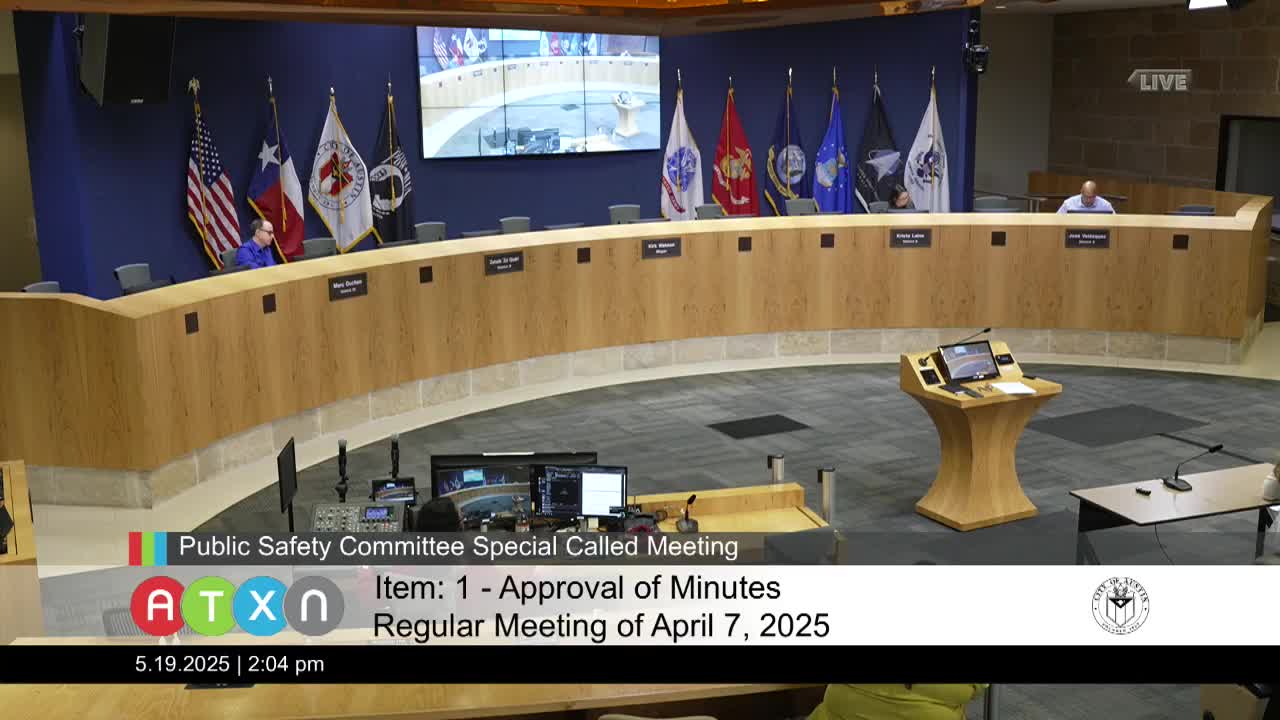
No formal policy action or vote on APD operations occurred in the committee meeting; the only formal motion recorded in the transcript was approval of the committee minutes from April 7, 2025. Committee chairs asked APD and the task force to report back to the committee as progress is made and to provide corrected public reports once data integrity and definitions are settled.
The briefing closed after roughly an hour and 18 minutes of discussion that ranged from technical data issues to training, oversight and community-facing reporting practices. Engel and APD officials said they would return to the committee with recommendations and corrected reporting that explain methodological changes to the public.