Get Full Government Meeting Transcripts, Videos, & Alerts Forever!
Get email alerts on the Gaza Humanitarian Aid topic
No spam. Unsubscribe anytime.
UN reiterates call for Gaza ceasefire as limited aid deliveries resume
Summary
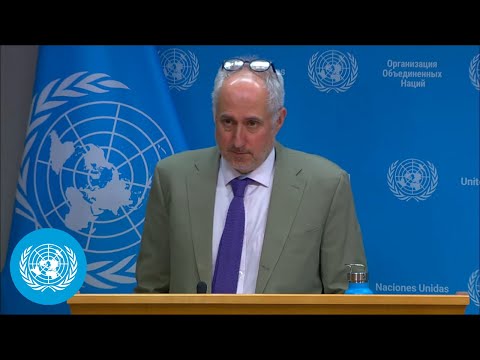
At a UN press briefing, Spokesperson Stéphane Dujarric said Secretary‑General António Guterres called for a permanent ceasefire, the unconditional release of hostages and large‑scale humanitarian access after Israeli authorities allowed a temporary, limited delivery of aid into Gaza — nine trucks that UN officials said are insufficient.
United Nations spokesperson Stéphane Dujarric told reporters at a New York press briefing that Secretary‑General António Guterres has called for a permanent ceasefire in Gaza, the unconditional release of all hostages and "the rapid, safe, and unimpeded delivery of humanitarian assistance at scale" after Israeli authorities temporarily allowed a limited delivery of aid into Gaza.
The remark came as UN humanitarian officials reported that Israeli authorities permitted what the UN was told would be nine trucks carrying mainly nutrition supplies to cross from Israel into a pickup zone for collection inside Gaza. Dujarric said the supplies had not been picked up by UN teams by the time of the briefing because of security and daylight concerns and that "9 trucks is better than no trucks, but we need a massive uptick of humanitarian aid."
Why it matters: UN and humanitarian partners warn that civilian needs in Gaza far exceed the small, intermittent deliveries that authorities have allowed. Dujarric and the UN emergency relief coordinator, Tom Fletcher, said a sustained, scaled flow of food, fuel, medicine and other supplies is required to avoid famine, reduce looting and protect civilians and aid workers.
Dujarric said the secretary‑general is "alarmed by the intensification of Israeli air strikes and ground operations in the Gaza Strip" and warned that continued violence risks "a broader regional conflict." He repeated that the UN "firmly rejects any form of forced displacement of the Palestinian population" and urged all parties to adhere to international humanitarian law.
Tom Fletcher, the UN emergency relief coordinator, said in a statement cited by Dujarric that the limited cross‑border entry of supplies is "a drop in the ocean of what is urgently needed" and that "significantly more aid must be allowed into Gaza starting tomorrow morning." Fletcher urged authorities to open additional crossings, simplify procedures, lift quotas and allow humanitarian movements on multiple routes to reduce looting and reach those most in need.
UN officials gave several operational details and caveats: Dujarric said the nine trucks were primarily nutrition supplies from WFP and UNICEF; UN colleagues reported that none of the trucks had been picked up from the pickup zone by the time of the briefing due to late daylight and security constraints. Dujarric also noted conflicting counts reported externally — Israeli authorities at one point said five trucks had entered — and said the UN expected to have a final count within hours.
Humanitarian impact reported by the UN: Dujarric said "almost half a million people have been displaced across the Gaza Strip since mid‑March." He reported attacks and damage to health and water infrastructure, naming the Al Awda Hospital in North Gaza and operations ceasing at primary health clinics in Al Karara and Daribala in Khan Yunis. He said an airstrike affected 15 pallets of medical supplies at Nasser Hospital and that solid‑waste management and water pumping were disrupted in areas including Beit Lahia.
On aid delivery mechanisms and partnerships, Dujarric said the UN will distribute any supplies through its existing warehouses, partner NGOs and UN agencies and will not "bend on our principles." He repeated that the UN "will not participate in the Gaza Humanitarian Foundation process" because, he said, it does not meet UN humanitarian principles and may heighten risk by concentrating distribution points and requiring people to move to those sites. Dujarric added that the UN prefers to return to "the tried and true system" that it said worked during the prior ceasefire.
Casualties among UN staff and agencies were highlighted: Dujarric said more than 300 UNRWA staff members were killed over the weekend and that three additional UN staff had been killed that day; he described those deaths as "condemnable and tragic" and a stark illustration of the risks UN personnel face.
Reporters pressed for detail on whether the temporary crossings would continue and how many trucks would be sufficient; Dujarric and others said the UN had capacity to pick up and distribute more trucks but that "nowhere is safe in Gaza," and warned that small, sporadic shipments increase risks for staff and recipients. On allegations of aid theft, Dujarric said looting by armed individuals has occurred and that "what lowers the risk of looting is having more aid in." He said the UN has not had direct contacts with leaders of the Gaza Humanitarian Foundation and was not aware whether that group is operating on the ground.
Other items raised during the briefing included the secretary‑general's recent travel to Baghdad and meetings on Iraq (including reference to the pending non‑extension of the UN assistance mission in Iraq mandate beyond the end of the year), UN concern about civilian harm in Libya and Sudan, and a call for stronger global health architecture in reference to WHO pandemic preparations. Those items were discussed briefly and were secondary to the Gaza humanitarian situation.
The briefing ended with Dujarric repeating the UN position: large‑scale, sustained humanitarian access is required, civilians must be protected under international humanitarian law, and the UN will continue to operate where it can do so under its humanitarian principles.