Get Full Government Meeting Transcripts, Videos, & Alerts Forever!
Get email alerts on the Municipal Budgeting topic
No spam. Unsubscribe anytime.
Norwood approves FY26 budgets across town departments after debate over free cash use
Summary
Town Meeting approved the finance commission'recommended appropriations for general government, public safety, infrastructure, schools and enterprise funds; debate centered on use of roughly $47 million in free cash and long-term planning.
Town Meeting in Norwood voted through the Finance Commission'recommended Article 4 appropriations on a series of motions covering general government, public safety, infrastructure, shared costs and schools, approving each category by majority votes after extended public and member discussion about the town's reliance on free cash.
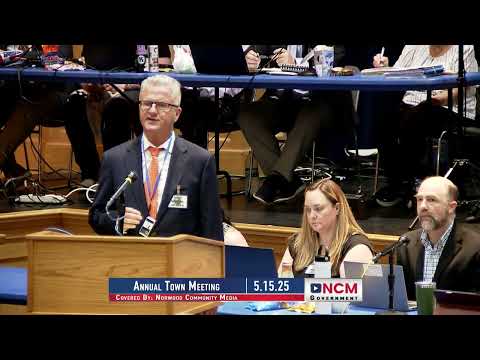
The town's finance chair, Bodenhofer, told members the budget plan relies in part on this year's unassigned free cash and that the budget-balancing group tried to balance near-term needs with setting money aside. "We are using 25% of that amount for this year's operating budget," Bodenhofer said, and added the commission plans to roll a portion forward: "we are passing a little over 35% of this year's free cash forward to next year." The Finance Commission recommended each motion before the meeting.
Why it matters: Members repeatedly pressed officials about using a one-time windfall to cover recurring costs. Several town meeting members warned that relying on free cash to balance operations raises the risk of a future override or staff cuts if the extra revenue does not recur. Finance officials said the choice was between using some free cash now, seeking an override later, or cutting staff and services now.
What the meeting did: The meeting recorded nine separate Article 4 motions from the Finance Commission covering operating and capital categories. Votes and appropriation summaries (motion text condensed):
- Article 4, Motion 1 (General government): Move transfer of $240,798 from water/sewer receipts, $311.80 from free cash, $6,525,750 raised by taxation; general government total presented in the motion. Vote: 137 yes, 28 no, 1 abstention — Approved.
- Article 4, Motion 2 (Public safety): $986,304 from free cash; $20,690,394 raised by taxation; public safety total noted in the budget. Vote: 150 yes, 14 no, 2 abstentions — Approved.
- Article 4, Motion 3 (Infrastructure): Transfers from cemetery receipts, water/sewer receipts and free cash; $8,653,265 raised by taxation for infrastructure; total $9,645,615. Vote: 151 yes, 20 no, 4 abstentions — Approved.
- Article 4, Motion 4 (Health & human services): $77,142 from free cash; $1,618,258 raised by taxation. Vote: 167 yes, 6 no — Approved.
- Article 4, Motion 5 (Culture & recreation): $140,691 from free cash; $2,951,368 raised by taxation; total $3,092,059. Vote: 161 yes, 11 no, 3 abstentions — Approved.
- Article 4, Motion 6 (Facilities, first shared-costs item): $424,969 from free cash; $8,914,861 raised by taxation; total $9,339,830. Vote: 163 yes, 13 no — Approved.
- Article 4, Motion 7 (Shared costs): $166,682 from water/sewer receipts; $2,126,480 from free cash; $44,608,646 raised by taxation; shared-costs total $46,901,808. Vote: 156 yes, 14 no, 13 abstentions — Approved.
- Article 4, Motion 8 (Education operating budget): $2,970,836 from free cash; $62,324,089 raised by taxation; total requested $65,292,117 (bottom-line vote required by state law). The Norwood Schools superintendent presented the request and described staffing, safety, special education and transportation needs; he said collective-bargaining costs and transportation increases account for a large portion of the increase. After an amendment to add $250,000 from free cash failed, the main motion passed: 149 yes, 24 no, 4 abstentions — Approved.
- Article 4, Motion 9 (Water & sewer enterprise fund infrastructure): $23,943,878 to be raised by rates and appropriated for the enterprise fund. Vote: 147 yes, 11 no — Approved.
Discussion highlights and directions from the meeting: - Multiple town meeting members, including Brian Gunning (Town Meeting member, District 3), urged deeper structural cuts and five-year planning, warning that the town faces a fiscal squeeze. Gunning said, "very soon, this town is going to be facing a financial crisis. We are not going to have enough revenue for the expenditures that we're making." - Bodenhofer and town staff countered that the Finance Commission and budget-balancing committee reviewed scenarios and decided to use a mix of free cash for one-time items, add to stabilization, and reserve some funds to soften a potential near-term shortfall. Bodenhofer summarized the committee's approach: capital, reserves, operating support, and carried forward amounts to smooth transitions. - Town staff answered operational questions on public safety equipment and facilities: Fire Chief Tim Bailey reported on the department's ladder truck repairs: "We hope to have the truck back either late tomorrow or first thing on Monday," and noted mutual aid and engine-ladder availability while the vehicle is out. Police Chief Chris Patton explained holiday-pay budgeting and staffing impacts on overtime. - School leaders described program shifts and added positions tied to opening Coakley Middle School and to a higher share of students with special needs; Superintendent Luff said the budget includes 6.6 additional FTEs and that special education and transportation increases drove a large share of the school request.
What the votes do not do: Several members asked about specifics that would require later administrative action (for example: whether the airport may expand runways; whether particular positions are grant-funded). Speakers made clear when remarks were discussion or direction rather than formal action.
Looking ahead: Finance officials reiterated that the choices made this year leave options open but do not eliminate future tradeoffs. Bodenhofer said the budget-balancing committee may recommend a citizen referendum (Proposition 2—and a half override) in the future if spending at the current level continues and available free cash declines.
Ending note: The meeting then moved on to Community Preservation Act business and other articles.