Get Full Government Meeting Transcripts, Videos, & Alerts Forever!
Get email alerts on the Legacy Funding topic
No spam. Unsubscribe anytime.
House adopts conference report on legacy funding bill; 113-21 vote
Summary
The Minnesota House adopted the conference committee report on House File 25 63 (legacy), approving funding changes that shift and increase grants for parks, museums and cultural programs; the roll call was 113 yeas, 21 nays.
The Minnesota House adopted the conference committee report on House File 25 63, a legacy-funding bill, concluding debate and repassing the measure as amended by the conference committee by a roll call of 113 yeas and 21 nays.
The conference report, read into the record at the start of the floor session, reflects agreements reached between House and Senate conferees and alters funding levels and carve-outs across the Outdoor Heritage, Clean Water, Parks and Trails, and Arts and Cultural Heritage funds.
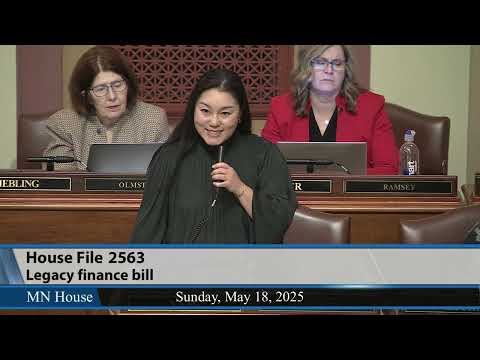
Representative Vang, who moved adoption of the conference committee report, summarized some of the changes the conference committee made to the House position, saying the report “returned to Peace in the Valley, taking out wilderness inquiry and funding it in the arts and culture fund.” Vang also said the agreement increased the Minnesota Zoo appropriation to $3,400,000, raised the award for the Minnesota Children’s Museum to $1,000,000 and created “another carve out for $1,500,000 for children’s museums across the state in a competitive grant pool,” and increased funding for the Science Museum to $700,000.
Supporters on the floor described the bill as a package of investments in Minnesota’s natural resources and cultural institutions. Representative Hussain said the bill “invests in Minnesota cultural heritage, natural resource, and educational programs,” and noted that the Outdoor Heritage Fund portion of the bill protects “over 160,000 acres [of] land for the wildlife and nature,” while the Clean Water Fund and Parks and Trails Fund would support water quality and access to outdoor recreation. Hussain also highlighted a new community identity and heritage grant program intended for underserved communities.
Representative McDonald, co-chairing the House legacy negotiation, praised the bipartisan work with the Senate conferees and said the House “did really get some really good provisions in the legacy this year.” Representative Scraba, who said he sat in on some meetings, listed nonprofit conservation groups that received awards in the package, including Pheasants Forever, The Nature Conservancy and the Ruffed Grouse Society, and noted money directed to moose habitat work in northern Minnesota.
Members on the floor pointed to additional programmatic priorities included in the conference report. Representative Vang described a competitive pool to support musicians and creative music production across the state. Representative Perez Vega emphasized cultural projects funded for Latino communities, citing installations and performances that will take place in Greater Minnesota and on Raspberry Island.
Several members also noted technical or budgetary context: one speaker said the legacy allocation was somewhat reduced in this cycle because of a “clip of $33,100,000” tied to a counting error; Representative Schultz observed that some state agencies receiving appropriations in the bill had also requested fee increases, a point he raised to underline cost pressures on residents.
After brief floor debate and expressions of thanks to committee staff, the House adopted the report and the clerk ordered the third reading of House File 25 63 as amended by conference. The clerk recorded 113 yeas and 21 nays, and the House agreed to the bill title.
The conference report was described on the floor as having been signed by four of four House conferees and four of five Senate conferees; the text read on the floor recommended that the bill be repassed as amended by the conference committee.