
Legacy finance conference committee adopts compromise funding package after debate over priority projects
Get AI-powered insights, summaries, and transcripts
Subscribe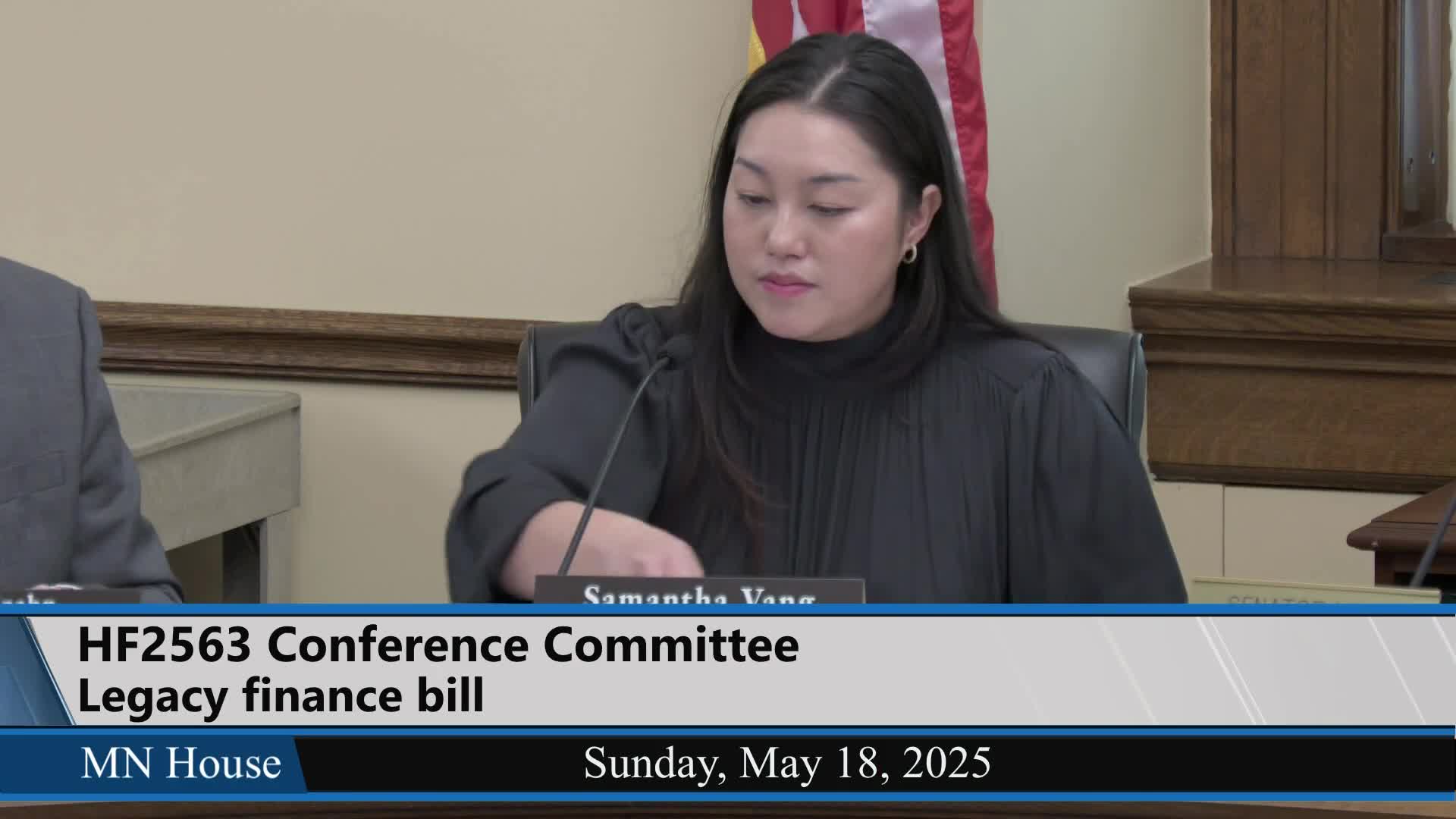
Summary
The Legacy Finance Conference Committee on May 18 approved a conference committee spreadsheet reconciling House and Senate positions on Minnesota’s Outdoor Heritage, Clean Water, Parks and Trails and Arts and Cultural Heritage funds, after members debated whether named projects should remain as priority applicants.
The Legacy Finance Conference Committee on May 18 approved a conference committee spreadsheet reconciling House and Senate positions on the Outdoor Heritage Fund, Clean Water Fund, Parks and Trails Fund and the Arts and Cultural Heritage Fund.
The action, moved by the Senate co-chair, was adopted by voice vote after about 48 minutes of discussion that centered on how the arts and cultural dollars will be distributed and whether projects formerly funded by direct appropriations should remain as named priority applicants. The committee reported the conference agreement to members for signatures following adoption.
The committee’s fiscal analyst, Brad Hagemeyer, provided a line-by-line review of the spreadsheet and the dollar amounts included in the agreement. Hagemeyer said the Outdoor Heritage Fund appropriation in the report is $162,111,000. He reported the Clean Water Fund total at $303,926,000 and the Parks and Trails Fund at $130,167,000. On the Arts and Cultural Heritage Fund, Hagemeyer said the conference report appropriates $179,911,000 and that the State Arts Board allocation in the package is $84,558,000, “which maintains the statutory requirement of 47%.”
Hagemeyer also listed numerous named and priority organizations and program carve-outs included in the arts and cultural section of the report, including statewide historic and cultural grants, history partnerships, the Minnesota Historical Society competitive grants, Minnesota Public Radio ($2,000,000), Ampers public radio ($3,600,000), Minnesota Public Television ($8,300,000), the Como Park Zoo and Conservatory (just over $3,000,000), the Science Museum ($700,000), the Minnesota Children’s Museum (priority funding including $500,000 per year for the St. Paul museum), and other museum and cultural grants. The report also contains grants to tribal language and immersion programs administered through the Indian Affairs Council and funding for county fairs and Future Farmers of America through the Department of Agriculture.
The committee’s debate focused on a proposed A1 amendment, offered by Senator Eric Pratt, that would have defined “priority applicant” to include any project whose proposal had been heard in at least one legislative committee with jurisdiction over legacy funds and would have struck the named priority projects from the bill. Pratt said the amendment was intended to broaden which legislatively‑heard projects would be treated as priority applicants. He argued the change would give “equal footing” to projects heard in committee.
Opponents said the conference process and prior work in committee set a compromise list of priorities and that reverting to a broader list would undercut projects that had been vetted through the committee process. Representative Samakap Hussain opposed the amendment on those grounds, saying, “This undermine[s] our community to under represent community that facing challenge, fighting to funding. We really promise, let's keep this as it is, this bill, and move forward.” The amendment was defeated on a voice vote; the chair announced, “The motion does not prevail.”
Committee members also referenced statutory allocation language that remains in the report: members noted language on page 68 (lines 18–23 of the conference committee report) that the conference committee retained to allocate smaller and larger grants within the arts and cultural pool. As described in committee discussion, the retained approach reserves a larger share of the small-grant pool for projects requesting $200,000 or less and a smaller reserved share for projects above that level—language committee staff pointed members to during debate.
Several members voiced frustration with aspects of the conference process. Senator Pratt said he was “disappointed” with the process and with what he described as limited opportunities for open amendment debate in the conference committee stage. Other members, including House members and co-chairs, defended the compromise and said the priority list combined with agency vetting in a competitive grant process was intended to balance fairness and programmatic review. Representative Joe McDonald (House member listed on the committee) and others said the committee had tried to avoid a return to widespread direct appropriations in favor of a priorities-and-competitive-grant approach.
After further brief remarks from members and recognition of staff, the Senate co-chair moved adoption of the conference committee spreadsheet. The committee adopted the report by voice vote; members were told to sign and return the conference committee report electronically. The meeting adjourned after the adoption vote.
Votes at a glance - A1 amendment (Senator Eric Pratt): proposed definition expanding “priority applicant” and striking named priority projects — defeated (voice vote). The committee record shows discussion and a voice vote; no roll-call tally was recorded in the transcript. - Adoption of the conference committee spreadsheet (conference committee agreement reconciling House and Senate legacy fund language and dollar amounts): adopted (voice vote). The committee directed members to sign the conference committee report via email.
The conference report moves the Legacy Finance package to the next steps in each chamber’s process; the committee did not record roll-call vote tallies in the transcript for the actions taken.