Get Full Government Meeting Transcripts, Videos, & Alerts Forever!
Get email alerts on the Commemorative Artwork Pillbox topic
No spam. Unsubscribe anytime.
Capitol Area Architectural and Planning Board holds public hearing on proposal to commemorate early 20th-century "Pillbox" ballpark
Summary
The Capitol Area Architectural and Planning Board (CAAPB) heard public comment on an application to place commemorative artwork on the State Capitol grounds recognizing the early 20th‑century Downtown Ballpark, known as the "Pillbox," after staff said the application meets Minnesota Rules 2402.703 subpart 2 review criteria.
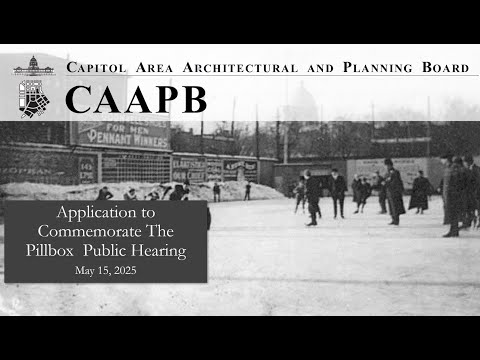
The Capitol Area Architectural and Planning Board (CAAPB) held a public hearing to gather input on an application to install commemorative artwork on the State Capitol grounds honoring the Downtown Ballpark, commonly called the "Pillbox." Tina Kimonzu, CAAPB staff, said the application was received Dec. 18, 2024, and that staff have reviewed it under Minnesota Rules 2402.703, subparts 2–5 and determined it meets the subpart 2 criteria for consideration.
The application, submitted by Stu Thornley of the Halsey Hall chapter of the Society for American Baseball Research (SABR), proposes artwork to memorialize a small ballpark that stood at the northwest corner of 12th and Robert streets and was used from about 1903 to 1910. That site was a frequent home of an African American team known as the Saint Paul Gophers (also called the Saint Paul Colored Gophers) and hosted a range of events including speed skating and professional wrestling. The transcript of the hearing references pitcher Andrew "Rube" Foster throwing a no-hitter there in 1908 while playing with the Gophers.
"I believe the application does meet all the four requirements," said Dave Landy, a member of the Halsey Hall chapter, referring to the review criteria. Landy told the board he had submitted written comments outlining how the application satisfied documented public support, statewide significance, respect for Minnesota's diversity and a rich public experience.
"I appreciate Tina and Jesse, Eric, Peter and others who helped me navigate the system," said Stu Thornley, the applicant and a Halsey Hall chapter member. Thornley said local and regional media had covered the proposal and that he hopes a marker would help surface the "hidden history" of Black baseball and the neighborhood context before nearby freeway construction altered the area.
Ed Watts, who identified himself as president of the Halsey Hall chapter, said the proposal offered an educational opportunity to explain the segregated nature of early professional baseball and its local, statewide resonance through more than 100 years of Minnesota town-ball traditions. "It gives a very good opportunity to have some artwork that explains a little bit about the segregated nature of baseball," Watts said.
Kimonzu reviewed the CAAPB process: written comments received during the March 31–May 5 public comment period will be summarized along with oral remarks from the hearing; staff will make a recommendation to the board on whether the application meets the criteria in Minn. R. 2402.703 subpart 2; the board will then hold another public hearing and vote. If the board votes to advance the application, CAAPB staff, the applicant and architectural advisers will undertake a site-selection study and later return to the board for design review and a site vote. No date was set for the board meeting.
Speakers at the hearing described the Pillbox as part of the urban fabric connecting downtown Saint Paul to neighborhoods such as Rondo before construction of the freeway. Speakers also noted the site's later abandonment around 1910 and its subsequent redevelopment; the transcript describes the present site as occupied by a laboratory building near the highway interchange often called the "Spaghetti Junction." The application file and staff report are posted on the CAAPB website, and staff provided an email (tina.kimonzu@state.mn.us) for written comments.
CAAPB staff closed the public hearing after receiving the comments on the record and said they will include the oral remarks in the written summary provided to the board.
Next steps include staff summarizing the hearing and public comments, issuing a recommendation on whether the application meets Minn. R. 2402.703 subpart 2, a board public hearing on the recommendation, and a board vote. If approved by the board, a site-selection study and subsequent design review would follow.