Get Full Government Meeting Transcripts, Videos, & Alerts Forever!
Get email alerts on the County Budget topic
No spam. Unsubscribe anytime.
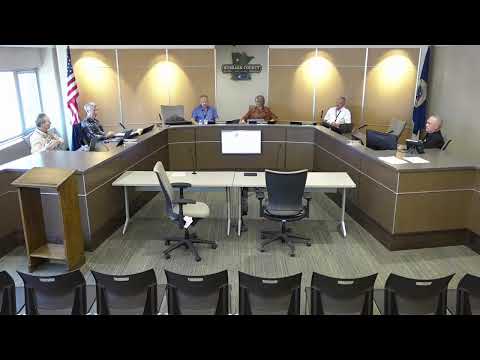
Hubbard County previews 2026 budget book; commissioners weigh 7% levy cap, staffing requests and program cuts
Summary
Blake, a county budget staff member, presented an early draft of the 2026 budget book format and said the document will include multi-year historical tables, levy and FTE trends, department narratives, org charts and debt-repayment projections.
Blake, a county budget staff member, presented an early draft of the 2026 budget book format and said the document will include multi-year historical tables, levy and FTE trends, department narratives, org charts and debt-repayment projections drawn in part from other counties' examples.
The briefing matters because commissioners will use the book to set a preliminary levy and budget assumptions in August. Blake said some numeric fields remain blank while state and federal outcomes are finalized; the work session focused on format and the types of information commissioners want to see in the first draft.
Blake said the budget book will compare Hubbard County to surrounding counties (Beltrami, Cass, Clearwater, Becker and Wadena) and that department-level sections will show programs, anticipated revenues and the hours allocated to them. "What I've been working on is the background information for the upcoming 2026 budget book," Blake said.
Commissioners and staff discussed preliminary budget targets and known pressures. Staff estimated the county will need roughly a 5–6% increase to carry current staff salaries, wages and benefits; the board chair said the county will not present a preliminary levy number higher than 7% at the next step. Commissioners noted earlier projections in March had looked worse (double digits) but recent state-level agreements eased some pressure.
Department staffing requests were summarized for the board. Items flagged as proposed additions or changes included a family-based service provider (to replace a contracted provider no longer available), an accountant position, additional IT support, seasonal park workers, and an environmental coordinator reclassification that was presented as a reassignment/promotional change rather than a full additional FTE. Staff said some positions would be partially reimbursed by state or federal sources; Blake and staff indicated human services positions are often 40–50% reimbursable depending on program and eligibility.
Human services and health program funding drew specific attention. Commissioners discussed PrimeWest membership and a plan that would allow PrimeWest partners to move to a single-payer arrangement; staff said changes at PrimeWest could stabilize reimbursements for county services. Blake and a commissioner discussed a roughly $6,065,000 figure in the context of reimbursement rates (staff phrased that as 40–50% of $6,065,000 is anticipated reimbursement for certain programs).
The board discussed program-level and external funding concerns: an anticipated 50% reduction in aquatic invasive species (AIS) aid under the state agreement, an estimated AIS fund balance (staff referenced roughly $256,000 as recent annual AIS funding), and a change to the transit cost-share that will raise the county match from 5% to 10% under a new transit agreement. Commissioners asked staff to analyze how those changes would affect service levels and fee structures.
Solid-waste funding and a recent state bonding bill were also discussed. Commissioners noted a $700 million bonding bill had passed at the state level with allocations for local road and bridge programs (42 million for LRIP, 20 million for local bridge work, and 5 million for local road wetland replacement cited), and they discussed possible bonding to support solid-waste capital projects while flagging that operations and fee structures would need planning to cover ongoing costs.
Staff told the board they will populate the draft budget with final wage and benefit numbers, then circulate worksheets to department managers for operational revenues and expenses. Blake said commissioners will see the first draft of the budget and proposed levy in about seven weeks. The board did not take a formal vote at the work session; commissioners directed staff to proceed with the budget book, incorporate comparative tax-capacity data requested by commissioners, and return with a draft levy and full departmental proposals in August.