Get Full Government Meeting Transcripts, Videos, & Alerts Forever!
Get email alerts on the Rent Control Enforcement topic
No spam. Unsubscribe anytime.
Portland holds workshop after tenant audit alleges widespread rent‑control noncompliance
Summary
Portland city leaders and tenant advocates met in a June workshop to review how the city enforces its rent‑control ordinance after tenant groups presented audits they said show widespread noncompliance and slow or inconsistent enforcement.
Portland city leaders and tenant advocates met in a June workshop to review how the city enforces its rent‑control ordinance after tenant groups presented audits they said show widespread noncompliance and slow or inconsistent enforcement.
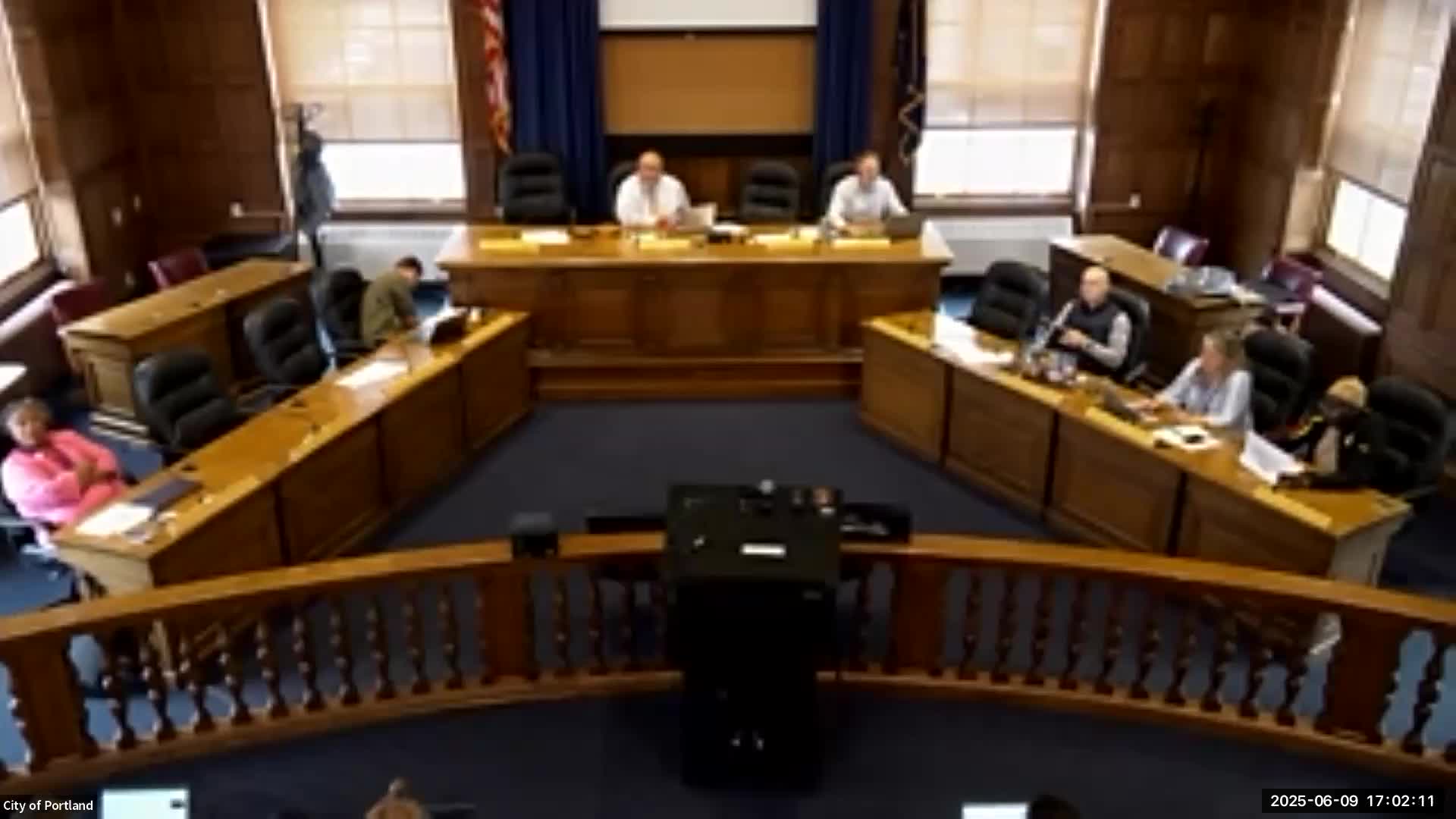
The workshop, convened by Mayor Mark Dion on June 25, brought tenant unions, the Rental Housing Alliance of Southern Maine, staff from the City’s Permitting and Inspections Department (Housing Safety Office), and the city’s corporation counsel to the same table to discuss audits, enforcement tools, data systems and potential next steps.
Tenant auditors: claims and demands
Bradley Davis, representing the Portland Tenants Union, told the council the union audited online rental listings and municipal registration records and found a high rate of apparent noncompliance. The union examined a sample of 240 advertised units and, Davis said, ‘‘145 of the 240 units that we reviewed were noncompliant in some way with the rent stabilization ordinance,’’ including 52 units the auditors could not find registered at all.
Davis said the union’s audit and review of the rent board’s 2024 annual report show recurring errors in registration data (including hundreds of reported increases over the ordinance limit) and a lack of verification at registration. He criticized a largely reactive, complaint‑driven approach to enforcement, limited collection of leases and other documentation at the time of registration, and an enforcement practice that, he said, often closes cases without fines after a landlord corrects a violation. ‘‘You can break the law as much as you want,’’ Davis said, ‘‘and as long as you give the money back once you get caught, there’s no penalty whatsoever.’’
The Trelawney Tenants Union echoed those concerns. Abigail Jacob said her group traced what it called a pattern of repeated violations by a single landlord and estimated at least $330,000 in overcharges linked to roughly 230 instances across multiple buildings. Jacob said tenants have been reimbursed only after long delays and that the rent board’s recommendations for stronger enforcement have not been implemented.
Landlords’ perspective
Bridal Vitaleas, president of the Rental Housing Alliance of Southern Maine, said many local landlords are small, family owners and that the registration and compliance paperwork is complex. ‘‘Most landlords are actually community members who care deeply about housing stability and about their tenants,’’ Vitaleas said, while acknowledging there are bad actors. She urged continued education and outreach for small property owners and warned that enforcement policy should avoid driving out small landlords.
City staff: how enforcement works and recent results
Jessica Hanscomb, director of Permitting and Inspections, reviewed how the Housing Safety Office administers rent control in Portland and walked the council through the department’s processes and recent statistics. She noted that the initial ordinance passed by referendum in 2020 went into effect on short notice and that the city delayed registration initially to set up the systems. Since 2023–2024 the department added dedicated staff focused on rent control and began proactive audits and quality control work.
Key figures Hanscomb presented (data cited as of May 31 unless noted): - Total registered units: roughly 20,027 units (about 19,000 long‑term rentals and ~800 short‑term rentals). - Units reviewed in 2025 proactive work: about 4,188 (roughly 22% of units). - Investigations completed in 2024: about 3,911 units investigated with 95 units found in violation. - Money returned to tenants from enforcement: about $148,000 in 2024 and $409,000 as of May 31, 2025 (Hanscomb said the figure is likely to rise while the office completes retroactive audits going back to 2020).
Hanscomb described the department’s enforcement workflow: an initial data review and request for documentation; audits that verify exemptions, unusually low or zero rents, or increases above the allowable percentage; notices of violation when staff confirm problems; 30 days to cure or appeal; and referral to the city’s corporation counsel and the courts if violations are not corrected. She said the office conducts about 850 inspections or reviews a month across complaint‑based and proactive work and uses city data sources (assessor records, building permits, certificates of occupancy) plus documents from landlords and tenants.
City legal perspective and limits on enforcement tools
Amy McNally, an associate in the corporation counsel’s office, explained the legal framework governing enforcement and why civil enforcement often ends in negotiated resolutions rather than contested trials. She said the city’s rent‑control provisions sit in Chapter 6 of the city code and rely on local enforcement procedures and a Maine court rule (Rule 80(k)) and statutes that govern municipal enforcement. She emphasized constitutional constraints (Fourteenth Amendment due process and Eighth Amendment limits on excessive fines) and court rules of evidence that apply in court but not in administrative or rent‑board proceedings.
McNally described two practical constraints that shape enforcement choices: 1) proof and admissible evidence in court. To obtain monetary penalties or other court‑ordered relief the city must prove a violation ‘‘by a preponderance of the evidence’’ in a courtroom that applies rules of evidence and typically requires live witnesses to authenticate documents (for example, a signed registration or lease). 2) procedural limits. Notices of violation must provide due process; if a recipient appeals or contests a notice the matter can proceed to a multi‑step court process that can take many months. She cautioned that monetary penalties authorized by the code (the ordinance and Portland’s general penalty provision, §1‑15) are not automatically collectible fines like a tax; they generally must be obtained by consent agreement or court order. McNally also said recent Maine Law Court decisions characterize these municipal monetary penalties as coercive (to compel compliance) rather than punitive, and judges will consider factors such as prior violations and how quickly a violator remedied a problem after notice in setting penalties.
Council response and next steps
Councilors and the mayor pressed staff and counsel about several recurring issues: the city’s data systems, whether leases and other documentation should be collected at registration, the size of staff needed for proactive auditing, and whether the council should qualify enforcement priorities or direct counsel to pursue more aggressive litigation.
Council members voiced two consistent points: tenants want faster restitution when they are overcharged, and the city should pursue operational fixes (data access, online registration) and staffing increases as immediate steps. Staff and councilors discussed specific near‑term measures: improving the citizen self‑service portal so past registration records are easier to search, ensuring registration forms can be submitted and validated online rather than by paper, expanding the number of inspectors or investigators in the Housing Safety Office, and clarifying what documentation the office will request during audits.
No formal vote or ordinance change occurred at the workshop. Council members directed staff to continue the discussion in the Housing and Economic Development Committee (HEDC) so councilors could get detailed briefings and assess policy or operational changes, including IT upgrades and options for stronger enforcement tools.
Why this matters
Councilors, tenant groups and landlords framed the meeting as a test of whether the city can translate voter‑approved rent controls into consistent, enforceable practice. Tenant groups argued the current approach is too reactive and relies on tenants to police compliance. City staff and legal counsel described how municipal and state law limit what the city can do in court and why thorough investigations and properly authenticated documentation are necessary before seeking court orders or fines.
The council instructed staff to return to HEDC with more detail on system fixes, staffing needs and a clearer inventory of legally available remedies. Participants said they expect further public meetings and an ongoing dialogue between tenant groups, housing providers and city enforcement staff.
Ending
The workshop ended without a vote. Councilors said they will continue the issue at HEDC and asked staff for concrete proposals on improved data access, a timeline for online registration and an analysis of staffing needs for proactive audits. Tenant groups said they will provide detailed audit data to staff for follow‑up. Corporation counsel and the Housing Safety Office signaled they will return with legal and operational options for the next committee meeting.