
TCEQ begins stakeholder outreach to implement EPA methane emission guidelines for existing oil and gas facilities
Get AI-powered insights, summaries, and transcripts
Subscribe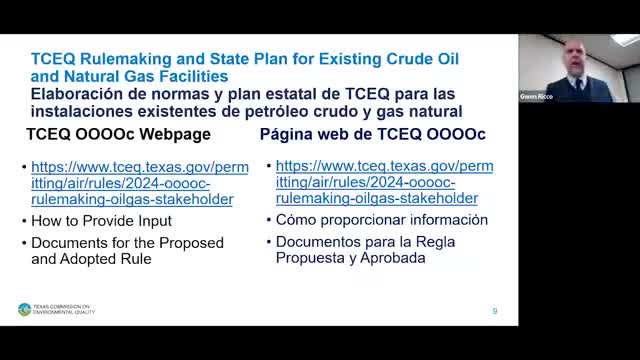
Summary
The Texas Commission on Environmental Quality opened a stakeholder process Nov. 6 to draft a state plan to implement EPA emission guidelines (40 CFR part 60, subpart OOOOc, “Quad O C”) for existing oil and natural gas facilities, outlining applicability, monitoring requirements, and a schedule for public comment through late December.
A rulemaking team from the Texas Commission on Environmental Quality (TCEQ) outlined Nov. 6 that the agency is drafting state rule language and a state plan to implement EPA emission guidelines for existing oil and gas facilities (40 CFR part 60, subpart OOOOc, commonly called “Quad O C”) and invited stakeholder input through a series of meetings and written comment.
David Munzenmeyer, rural project manager for the TCEQ, told attendees that he is “the best single point of contact if you wanna reach somebody and ask a question, get some additional input or need some feedback,” and described the session as informal stakeholder outreach that precedes the formal proposal, public comment and adoption steps.
The rule and state plan package being drafted will implement EPA’s emission guidelines for existing, unmodified sources in the oil and gas sector while preserving Texas’s authority to regulate those sources through a state plan. Dan Sims, air-permits division technical specialist, summarized the rule’s purpose: “The intention of this rule is to reduce methane emissions from existing and unmodified sources in the oil and natural gas industry.”
Why it matters: EPA’s guidelines require states to adopt enforceable programs for existing sources. TCEQ has 24 months from the federal effective date to submit a state plan to EPA, and EPA allows up to 36 months after plan submittal for facilities to reach compliance, meaning affected sites could have as much as roughly five years in total to comply, depending on the schedule included in the approved plan.
Scope and key thresholds - Covered sectors: onshore production, processing, natural gas transmission and storage, and certain gas-handling operations; distribution and petroleum refining processes are not covered by Quad O C. - Associated gas threshold: existing associated gas producing more than 40 tons per year (tpy) of methane must be routed to sales, used on-site (for example as fuel), reinjected, or, if technically infeasible, routed to a control achieving 95% methane reduction; if technical infeasibility is claimed, it must be documented annually. - Tank batteries and storage: the rule defines ‘‘tank battery’’ (manifolded tanks for liquid transfer) as the affected facility. A tank battery with methane emissions over 20 tpy must meet a 95% reduction requirement for a 12‑month period; after meeting that requirement, an operator may stop controls if emissions remain below 14 tpy for a consecutive 12 months. NSPS Subpart KB (petroleum liquid storage) may be relied on in lieu of Quad O C controls for tanks if a floating roof is installed and flash losses occur elsewhere. - Compressors: operational leakage limits are specified by type (wet‑seal centrifugal 3 SCFM per seal; dry‑seal centrifugal 10 SCFM per seal; reciprocating 2 SCFM per seal). Reciprocating compressors have a compliance path requiring rod‑packing replacement and maintenance or routing emissions to a closed‑vent and control system. - Controllers and pumps: natural gas‑driven pneumatic controllers and pumps are subject to a near‑zero emission expectation (route to closed vent or be self‑contained). For pumps, the zero‑emission standard applies when the site has electrical grid access and at least three diaphragm pumps; otherwise, operators may route emissions to a vapor recovery or a 95% control device.
Monitoring and inspection requirements - Fugitive‑component monitoring varies by site type: single wellhead and small well sites require audio/visual/olfactory (AVO) inspection once per quarter; multi‑wellhead sites require AVO plus semiannual optical gas imaging (OGI) or EPA Method 21; well sites with major equipment (or centralized production facilities) require AVO every two months and OGI/Method 21 quarterly; compressor stations require monthly AVO. - Natural gas processing plant process units are subject to OGI monitoring on a bimonthly basis and must follow protocols in Appendix K of 40 CFR part 60 (camera specs, survey procedures, and training requirements). EPA indicated Appendix K currently applies to processing plants and may be extended to other source types in future rulemaking.
Reporting, well‑closure and other requirements - EPA updated electronic reporting requirements via its Compliance and Emissions Data Reporting Interface (CEDRI); the TCEQ presentation noted recent updates to reporting and well flowback notification processes. - Marginal or low‑producing wells remain subject to leak detection and repair (LDAR) requirements; operators may conduct a documented well closure process that includes OGI verification and corrective actions if the closure survey finds emissions.
State‑plan mechanics and requests for input TCEQ staff said the state plan must identify enforceable mechanisms, compliance schedules, performance testing, monitoring, recordkeeping and reporting, plus meaningful engagement documentation. The state plan may apply less stringent limits or longer compliance timelines for existing sources where a remaining useful life demonstration or other factors justify such treatment, pursuant to 40 CFR part 60 subpart BA.
Public participation and next steps TCEQ described this meeting as the first of three stakeholder meetings (Nov. 6 webinar; Nov. 14 in Arlington, in‑person only; Nov. 20 in Midland, in‑person only). Staff asked for written comments and said comments would be accepted via the TCEQ comment portal, eFax or email through the end of the year; presenters repeatedly asked commenters to reference project number 2024027113AI. David Munzenmeyer provided contact details (david.munzenmeyer@tceq.com) and the rule project web page for background documents and instructions on submitting input.
What the session did not decide No formal regulatory language was adopted at this meeting; presenters described the stakeholder outreach phase that will inform a formal proposal and public comment process. Staff solicited input on remaining useful life, possible less‑stringent options, compliance timing, and how to apply Appendix K protocols.
Ending: The agency will use stakeholder input to inform a formal proposal package, publish that proposal for formal public comment and a hearing, and then pursue adoption and submittal to EPA under the state plan schedule.