Get Full Government Meeting Transcripts, Videos, & Alerts Forever!
Get email alerts on the Eminent Domain Reversion topic
No spam. Unsubscribe anytime.
Committee hears bill to allow property owners to reclaim unused eminent-domain land after 25 years; bill held in committee
Summary
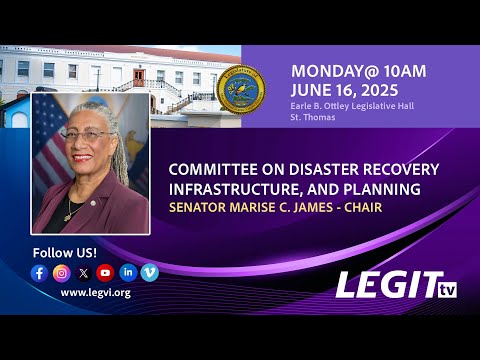
The Legislature's Committee on Disaster Recovery, Infrastructure and Planning on Wednesday heard testimony and debate on Bill No. 36-0070, a proposal to let previous owners or their successors petition a court to reclaim land taken by eminent domain if the government has not devoted the property to its intended public use within 25 years.
The Legislature's Committee on Disaster Recovery, Infrastructure and Planning on Wednesday heard testimony and debate on Bill No. 36-0070, a proposal to let previous owners or their successors petition a court to reclaim land taken by eminent domain if the government has not devoted the property to its intended public use within 25 years.
The bill would add a new section to Title 28, chapter 19 of the Virgin Islands Code. Under the proposal, a former owner or successor could file a petition in the Superior Court to have the property returned after repaying the original compensation; the bill also includes a 10-year bar preventing the government from initiating another condemnation on the returned parcel. Sponsor Senator Alma Francis Heiliger said the measure seeks to correct long-term government land holdings that never produced the public uses promised. "It is unfair that our government takes people's properties and we don't use them and then start to utilize it as if though they're part of, our inventory," Heiliger said during her presentation.
Supporters and government officials described the bill's intent as accountability for public land use. Lisa Maria Alejandro, Commissioner of the Department of Property and Procurement, told the committee the department understands the bill's goals but warned that a rigid 25-year deadline could hinder long-term projects and expose the government to litigation and financial risk. "A rigid 25 year deadline risks undermining long term projects and creating unnecessary pressure on agencies to rush development in order to avoid potential reversion claims," Alejandro said.
The Department of Planning and Natural Resources echoed concerns about long planning timelines for large infrastructure and environmental reviews, and recommended adding flexibility such as a repurposing clause, periodic public review, and expanded definitions of public use so parcels acquired for one purpose could be reassigned for an alternate public use without triggering reversion. Assistant Commissioner Josette J. Walker told the committee that permitting, federal reviews and other processes can make projects take decades. "Large scale capital projects such as schools, transportation corridors, recreational facilities, and resilient infrastructure often span decades of planning," Walker said.
Witnesses recommended several alternatives or clarifications to reduce legal risk and protect the public interest: define or expand the statutory meaning of "public use," create objective markers of "progress" or "devotion" so courts can assess whether a public use has been pursued, require periodic agency reaffirmation of intended use, build a transparency/reporting requirement for eminent-domain holdings, and consider a right-of-first-refusal model when the government elects to dispose of condemned land.
Committee debate ranged from members who said a 25-year limit is appropriate accountability to those who warned that decades-long projects and federal reviews could make 25 years too short. Sponsor Heiliger said she is open to amendments that would strengthen the bill. After discussion, Senator Dwayne M. DeGraff moved that Bill No. 36-0070 be "held in committee at the call of the chair." The motion was seconded; the committee conducted a roll call and recorded seven yeas, zero nays. The chair ordered the bill held in committee for further drafting and amendments.
The bill's primary provisions as discussed at the hearing: a 25-year timeline for dedication of condemned property to its intended public use; a Superior Court petition process by previous owners or successors if the property was not used within that period; requirement that the petitioner repay the original compensation paid by government; and a 10-year prohibition on subsequent condemnation of the same parcel after reversion. Departments testifying asked the committee to consider a narrower, clearer definition of "devoted to public use," objective progress markers, periodic reaffirmation, and a reporting requirement for long-held condemned parcels.
The committee hearing record reflects strong interest from both the sponsor and executive-branch agencies in finding language that balances private-property protections and the government’s need to plan and carry out long-term infrastructure projects. The bill will return to committee for redrafting and possible amendments addressing the operational and legal concerns raised at the hearing.
Votes at a glance: Motion to hold Bill No. 36-0070 in committee at the call of the chair — Moved by Senator Dwayne M. DeGraff; seconded; roll-call result 7 yeas, 0 nays. The motion carried and the bill was held in committee.