
Hazel Park School District projects roughly $1.3 million shortfall; staff reductions and transfers proposed
Get AI-powered insights, summaries, and transcripts
Subscribe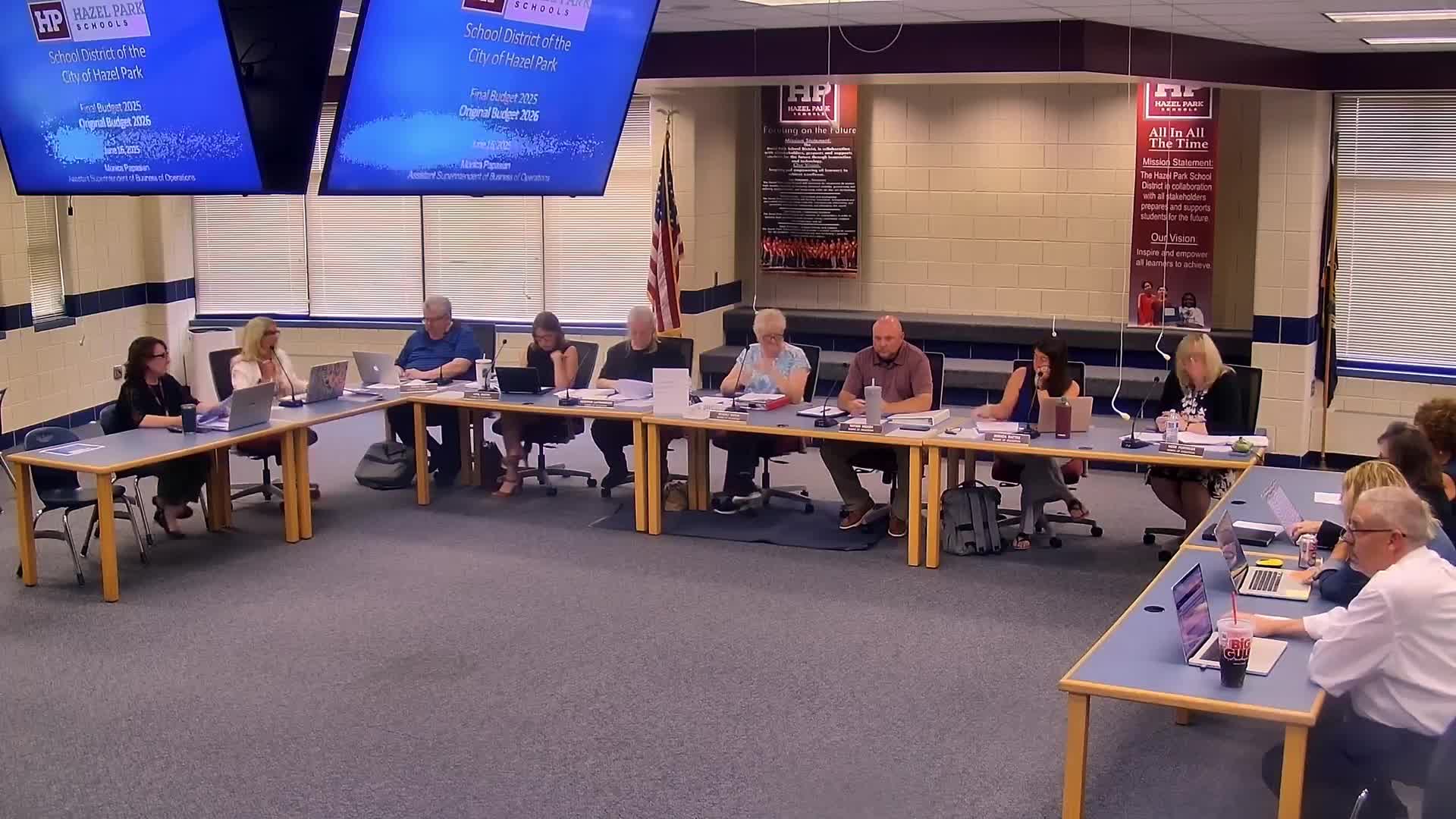
Summary
District business staff told the Hazel Park Board of Education that a rollover 2025–26 budget projects a $1.3 million operating deficit for 2024–25 and a multimillion-dollar shortfall for 2025–26. Administrators outlined staffing consolidations, anticipated state-aid changes and a Treasury reimbursement request as steps to narrow the gap.
At a public business meeting of the Hazel Park School District Board of Education, district finance staff presented preliminary figures showing a $1,326,000 deficit for the current year and described a rollover 2025–26 budget that would start with a multimillion-dollar shortfall.
The presentation, led by district finance staff Monica (staff member) and Crystal (staff member), emphasized that the 2025–26 budget before the board was a starting point based on available May state-aid figures and not a zero-based budget. "It is just a estimation of a starting point, of where we need to be," Monica said, adding that central office staff had worked “very hard” to combine roles and eliminate positions where possible.
Why it matters: the district faces reduced state and program revenues and rising expenses that, as presented, would leave the general fund with a negative balance unless corrective steps and additional revenues materialize. Board members asked for timelines and for more precise numbers once the state finalizes aid amounts and the district closes its books for audit.
Key fiscal figures and drivers - Current-year deficit: district staff reported a $1,326,000 deficit "within the year." - Major revenue reductions cited: approximately $1.1 million tied to special education (referred to in the presentation as "51 c" special-education state aid adjustments), a $511,000 reduction for GSRP (Great Start Readiness Program) and a $388,000 true-up in section 31a state aid. Delinquent property-tax receipts were said to have decreased, contributing about $240,000 to the shortfall. - Offset items: adjustments to interfund rent and indirect cost transfers produced a roughly $385,000 pickup to the general fund, and certain reimbursements or accounting offsets were listed as adding about $528,000 in revenue. - Projected per-pupil foundation: presenters used a projected foundation increase of $350 per pupil (totaling $2,250,000), allocating about $1.7 million to the general fund and the remainder to the center program.
Projected 2025–26 position and fund balances - The rollover numbers presented showed approximately $59 million in projected revenues and $61 million in projected expenditures for 2025–26, yielding an initial budgeted deficit in the neighborhood of $1.7 million to $2.0 million depending on which interim slide is referenced. - Food service, child care and center (special) funds were discussed as separate enterprise funds. The food-service fund showed a shortfall on the preliminary rollforward (presenters cited around $75,000 negative for the current year and a projected $267,000 negative for next year), and the center fund’s budget reportedly included large, but partially overstated, expense lines tied to vacant positions.
Planned adjustments and operating changes - Staffing: administrators outlined a list of position eliminations, reassignments and hiring freezes intended to reduce payroll costs. Examples given included converting some coach positions to paraeducator roles, eliminating an Advantage Elementary classroom position that had been unfilled, moving a K–12 supervisor into a middle-school principal role and combining instructional coach duties. Presenters emphasized that these were largely natural-attrition or vacancy-driven changes rather than layoffs: "There isn't letting go of any teachers," a presenter said. - Non-personnel reductions: the presentation listed estimated savings from lower interest expense, reduced audit fees, reduced attorney fees (staff said 2025 attorney costs were unusually high because of investigations earlier in the year), and cuts to some professional-development line items and implementation fees for software. - Timing and bookkeeping: staff noted that some figures reflect workbook or calculation errors (for example, an overstated cost for PARA positions) and that final numbers will change after year-end close and the upcoming audit.
State aid, Treasury reimbursement and other potential offsets - Presenters said state aid totals remain uncertain until the state completes its budget and the district receives final counts. They referenced a monthly state-aid report (May figures were used for the current presentation). - Treasury reimbursement: staff said they submitted a request to the Michigan Department of Treasury for reimbursement funds intended to offset deficit-related expenditures; the team estimated about $500,000 in submitted items but cautioned the award amount is not guaranteed. Items submitted included professional-development and training costs tied to reducing future expenditures (for example, training tied to seclusion and restraint practices) and some one-time software or process-improvement costs.
Board process and follow-up - Staff told the board it will present updated budget information in July and earlier updates in August and October; a formal amendment was expected in December after the audit and state aid numbers are clearer. Monica and Crystal asked the board to reserve judgment on the rollover numbers and to plan for collaborative budget conversations later in the summer.
Votes and formal actions recorded at the meeting - The board approved the meeting agenda by roll call (motion to approve the agenda was made and supported; board members recorded affirmative roll-call responses). The motion passed. - The meeting concluded with a motion to adjourn that was seconded and carried; no roll-call vote on adjournment was recorded in the transcript.
What remains unresolved: staff repeatedly said the presented 2025–26 figures are a conservative rollforward, not a completed, zero-based budget. They stressed that final state aid, year-end audit results and any Treasury reimbursement award will materially change the district’s fund-balance outlook. Upcoming steps scheduled by staff include closing the books for audit, follow-up discussions on staffing and bringing formal budget amendments to the board later in the year.