
Norwood light department cites stronger financial ratios and imminent fiber-to-home launch
Get AI-powered insights, summaries, and transcripts
Subscribe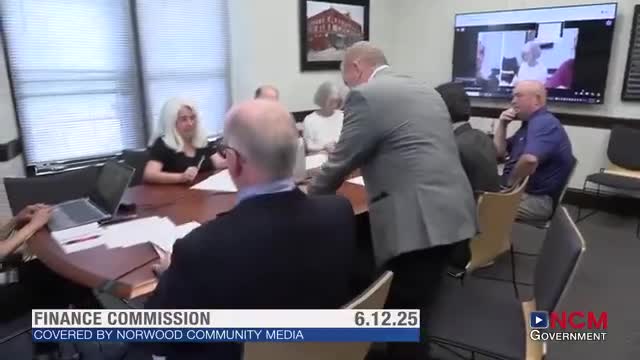
Summary
At its June 12 Finance Committee meeting, light department leaders reported improved liquidity and lower debt, outlined a near-term broadband rollout and described how broadband financing is structured under municipal utility accounts.
Kevin Shaughnessy, superintendent of the light department, told the Town of Norwood Finance Committee on June 12 that the department’s credit metrics and cash position have improved and that a fiber-to-the-home broadband service is expected to go live within weeks.
Shaughnessy said the department’s liquidity “is increased considerably, to about, 36,000,000. With days liquid is 232,” and added that debt has declined by roughly $8,000,000, lowering the department’s debt-to-capitalization ratio to about 33% from about 47% last year. He and Dan Murphy, chief operating officer, described the department as “in pretty good shape” financially and said S&P’s most recent credit review of the utility was published the day of the meeting.
Why this matters: The light department operates as a municipal utility with bonds that, as meeting participants noted, can be general obligation obligations for the town in limited circumstances. The department is also financing and operating a broadband business; if broadband incurs liabilities, the accounting and interfund arrangements affect how costs and repayments appear on town financial statements.
Shaughnessy said the fiber-to-the-home broadband service should begin customer signups in the next two to three weeks in areas where construction is complete. Dan Murphy said the service will offer symmetrical speeds — “1 gig, 2 gig, 3 gig” — and that pricing will be competitive. The department has not finished building the entire network; Murphy said roughly half of the system is complete and software for customer area checks was being implemented so residents can confirm availability.
On financing, department staff said electric operations have been loaning broadband funds during startup. They estimated broadband will owe electric about $6,000,000 when finalized; interest is being charged now but principal repayment will be deferred until final accounting. Shaughnessy also said the department had authority previously to borrow “up to 11” (as stated in the meeting) and that delays during COVID affected earlier borrowing and timing decisions.
On rates and future costs, Murphy said the department does not currently plan to raise residential electric rates; he estimated residential rates near 17.5 cents per kilowatt-hour and said the department compares itself to neighboring municipal utilities and investor-owned utilities. He also warned of future upward pressure from compliance and transmission costs tied to a renewable portfolio target mentioned in the meeting as “by 02/1930.” He said the department has rate-stabilization reserves set aside to mitigate future increases.
The committee asked how broadband and electric are accounted for. Staff said they use separate municipal utility funds—accounts referenced in the meeting as O4 (electric general), O5 (depreciation for electric), O6 (broadband general) and O7 (broadband depreciation)—and that the broadband business is organized under the light department’s municipal enabling statute. Staff said they make separate internal allocations for indirect charges and that both functions are treated using public utility accounting.
Committee members and staff discussed head-end equipment location and the cost to move it; staff said prior estimates to relocate the head end were very high and that reliability considerations kept some equipment in its original building. Staff invited committee members to inspect the head-end facility and to meet with broadband project staff for more technical briefings.
Staff encouraged the committee to contact them with follow-up questions and said they would provide the S&P rating publication and other documents for review.
Ending: Light department leadership left the meeting after the presentation and said they would return on request to explain technical or accounting details to the committee.