Get Full Government Meeting Transcripts, Videos, & Alerts Forever!
Get email alerts on the Public Comment topic
No spam. Unsubscribe anytime.
Public commenters press City Council on sidewalks, East Broadway redesign and surveillance; mixed concerns on housing models and immigrant rights
Summary
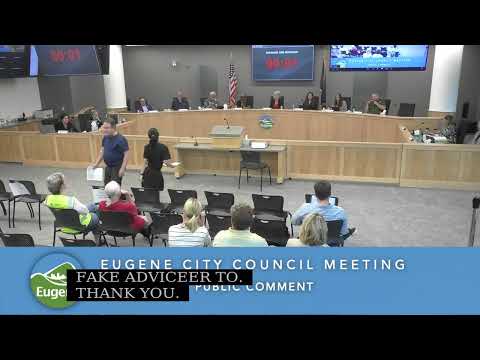
Ten speakers during the June 9 public comment period urged the council to prioritize sidewalk repair and funding, criticized recent roadway redesigns on East Broadway, raised privacy and immigration concerns about commercial surveillance and airline contracts, and offered mixed feedback about affordable housing models and tax/fee proposals.
The June 9 public comment period at the Eugene City Council meeting drew 10 speakers who raised issues including sidewalk repair and funding, concerns about the East Broadway redesign, the local impact of industrial facilities and environmental justice, homelessness enforcement, and surveillance/privacy issues tied to license‑plate tracking and airline contracts.
Sidewalks and walkability Several speakers urged the council to treat sidewalks as public transportation infrastructure and to create stable, equitable funding for repair and maintenance. Nancy Buffum (Ward 7) and Larry Craig (Southeast Neighbors, Ward 2; speaking for CURBS — Citizens United to Repair Our Broken Sidewalks) said damaged and impassable sidewalks harm people who walk, roll or use mobility aids and urged a 10‑year plan and funding mechanisms that include assistance for low‑income property owners. Craig asked the council to “prioritize and expedite this overdue issue” and to establish a stable funding mechanism.
East Broadway redesign and curb treatments Alan Alfredo Gormizano criticized the East Broadway road redesign — describing a lane reduction and curb extensions he said would increase traffic congestion rather than encourage walking. He said a traffic signal at the East Broadway–Patterson turn would have been sufficient and questioned voter approval and the use of property tax dollars for the project.
Homelessness enforcement and neighborhood environmental justice Lynn Woodrich of the Bethel neighborhood criticized a public health survey process she reviewed and raised broader environmental justice concerns, citing the J.H. Baxter industrial site near homes and urging more equitable siting of industrial uses. Alan Gormizano also described an encounter in which a homeless person’s belongings were left on the curb after a police contact, and he expressed concern about loss of personal property for people experiencing homelessness.
Privacy, surveillance and airline contracts Cameron Alexandria Stringfield (Ward 7) raised concerns about new commercial camera systems deployed in Eugene that use automated license‑plate recognition and cited reports that Immigration and Customs Enforcement (ICE) accessed similar systems in California. Stringfield urged the council to assure the public that no city resources will be used to assist federal immigration enforcement and suggested the council consider condemning airline contracts that are used for deportation flights; Ellen Rifkin urged the council to research and consider restricting use of local airport facilities for such operations.
Affordable housing and funding comments John Borofsky, a member of the Affordable Housing Trust Fund advisory committee, thanked the council for the allocations and explained the committee’s difficult choices given limited funds and several competitive proposals. Other commenters raised questions about ownership models — including concerns that ground‑lease fees in ownership models could rise over time and reduce affordability.
Other items One speaker asked the council to keep a proposed fire fee on the ballot and suggested alternative revenue ideas, including modifications to a proposed city operations fee and business license changes.
Ending The mayor closed the public comment period after the tenth speaker. Councilors offered no substantive response on the floor during the comment period beyond acknowledgment and a later councilor signaled willingness to work with sidewalk advocates.