Get Full Government Meeting Transcripts, Videos, & Alerts Forever!
Get email alerts on the Smoke Free Air Law Cigar Exemptions topic
No spam. Unsubscribe anytime.
MDHHS outlines cigar-bar exemptions under Michigan smoke-free indoor air law; lawmakers press on renewal form and fee
Summary
MDHHS staff briefed the committee on Michigan's smoke-free indoor air law and the annual exemption process for cigar bars and tobacco specialty retail stores. Lawmakers questioned the department about a 48-page renewal affidavit, a $500 fee, inspection/enforcement practices, and the statutory cap of 300 exemptions.
Brenda Jagadet, director of the Bureau of Health and Wellness at the Michigan Department of Health and Human Services (MDHHS), and Sofia Hines, director of the division of chronic disease and injury control, briefed the committee on Michigan's smoke-free indoor air law and the cigar-bar/tobacco-specialty exemption process.
Jagadet summarized the statute: Public Act 188 of 2009 (as amended) prohibits smoking in most public places and workplaces and allows limited exemptions for cigar bars and tobacco specialty retail stores. Hines described the annual renewal process and eligibility criteria for exemptions, including that at least 10% of a cigar bar's gross annual income must derive from on-site cigar sales or humidor rentals, humidors must be installed, premises must be physically separated from nonsmoking areas and persons under 21 must be excluded.
Hines told the committee there are always 300 exemptions authorized by the statute; businesses may sell or transfer exemptions but MDHHS reviews affidavits for sales and transfers when submitted. She described the renewal submission window (January 1–31 with a 21-day grace period to Feb. 21) and said MDHHS typically processes renewal affidavits by Aug. 30, though timing varies depending on completeness and follow-up. Hines said previously about 300 exemptions were granted in 2010 and the department still records 300 exemptions (some active, some not).
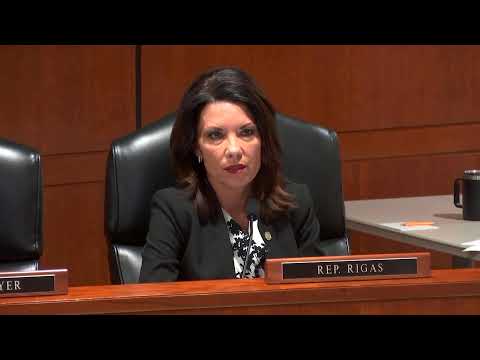
Committee members raised detailed questions about the renewal packet and enforcement. Representative Regis and others described the renewal affidavit as a 48‑page package, asked why photo-quality copies and extensive photo documentation are required annually, and questioned whether the $500 fee is used to support processing. Hines said MDHHS sends the packets by certified mail and does not currently have funds to convert the process to an online submission system; she said the $500 fee goes to the state general fund and not to MDHHS staffing for the exemption process. MDHHS staff said they review applications in the order received and that a previously approved exemption remains in effect while the renewal is under review.
Representatives pressed about inspections, HVAC requirements, enforcement steps after complaints, whether MDHHS issues cease-and-desist letters without inspection and how transfers of exemptions are handled. MDHHS staff said inspections are part of the review process and that the department will follow up with members on specific enforcement procedures and on questions about outdoor smoking in tents and at events. MDHHS also said it will follow up about whether background checks are part of transfer approvals.
Members repeatedly urged the department to consider streamlining and automating the renewal process; MDHHS said it had investigated automation but lacked current funds for a digital system. The committee did not take any statutory or appropriations actions during the hearing; the session concluded with adjournment.