
Nevada committee holds hearing on bill requiring investigations of threats against political candidates
Get AI-powered insights, summaries, and transcripts
Subscribe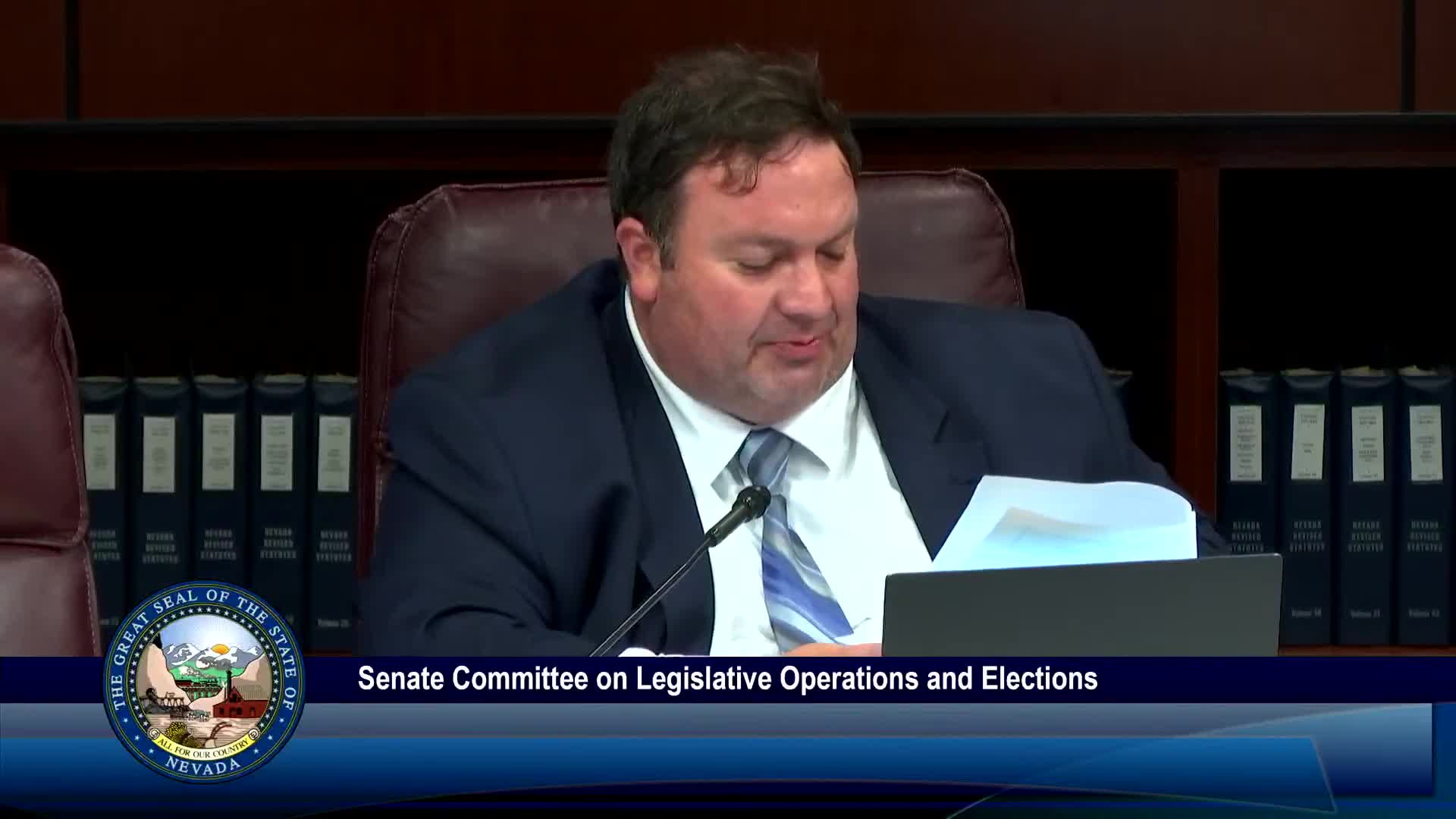
Summary
The Senate Committee on Legislative Operations and Elections heard Assembly Bill 123 on a measure to create a formal investigatory process for threats and intimidation directed at political candidates.
CARSON CITY — The Senate Committee on Legislative Operations and Elections heard Assembly Bill 123 on a measure to create a formal investigatory process for threats and intimidation directed at political candidates.
Assemblymember Hanati Nadeem, sponsor of AB 123, told the committee she introduced the bill after receiving death threats while running for office and said candidates should not have to face such intimidation.
"I was subjected to disgraceful campaign tactics that incited others to threaten my life," Assemblymember Hanati Nadeem said. "I believe AB 123 will help achieve that goal."
The bill would bar persons from communicating direct or indirect threats of bodily injury to a candidate or a candidate's family, or threats of property damage, if the communication places the candidate in reasonable fear the threat will be carried out. Section 3 would allow a candidate who believes they were targeted to file a complaint with the Nevada Secretary of State; the bill would require the Secretary of State's investigators to examine the complaint and — if appropriate — refer it to the Attorney General's Office for a prosecutorial determination. At the conclusion of an investigation the bill would require a written report to the candidate describing the alleged violation, the investigative steps taken and any referral outcome.
Atar Hasibullah, executive director of the ACLU of Nevada, said the organization initially reviewed the bill to ensure it was constitutionally defensible and that the draft was intended to preserve political speech while addressing true threats.
"This bill is consistent with other provisions of NRS," Hasibullah said. "It precludes the ability to cause threats of bodily injury or property damage and provides a process so candidates know something is being investigated."
Committee members questioned how AB 123 would interact with existing criminal statutes. Opponents at the hearing said Nevada already has harassment and stalking statutes that criminalize threatening conduct. Iris Stone, a member of the public who opposed the measure, argued the bill duplicates NRS 200.571 (harassment) and said the Secretary of State lacks routine criminal investigatory authority.
"Candidates need to know that under NRS 200.571 they can escalate and get their harassment case adjudicated by the Nevada Attorney General," Iris Stone said. "AB 123 is superfluous and should not be considered for a vote."
Ellen Gifford, another caller in opposition, told the committee harassment law already covers threats of harm and asked whether the sponsor had pursued existing remedies before drafting the bill.
Supporters said the bill responds to candidates' reports that complaints are sometimes not investigated fully when law enforcement views threats as political speech. Priscilla Gomez, democracy manager at Silver State Voices, said the measure would help ensure candidates from historically marginalized groups can run without intimidation.
"All Nevada voters deserve to take part in our democracy safely and without intimidation," Priscilla Gomez said. "This legislation is an important step toward ensuring Nevada has a political environment centered around respect."
Bill proponents also said they worked with the Secretary of State's Office and the Attorney General's Office to remove a fiscal note that had been attached earlier in the drafting process.
Committee members asked how penalties would operate if a prosecution followed. Hasibullah said the bill envisions a misdemeanor for a first offense and a gross misdemeanor for a subsequent offense, and that any criminal case would proceed through the ordinary court process with due process protections.
No final action was taken; the committee held the public hearing and accepted verbal testimony from support, opposition and neutral witnesses. The chair limited public testimony for and against the bill to 10 minutes each because of time constraints. The hearing record remains open for written comments the committee will include in the official record.
End of hearing: the chair closed the hearing on Assembly Bill 123 and moved to public comment before adjourning the committee.