
Nevada panel backs bill allowing trauma-level 4 designation for remote critical-access hospitals
Get AI-powered insights, summaries, and transcripts
Subscribe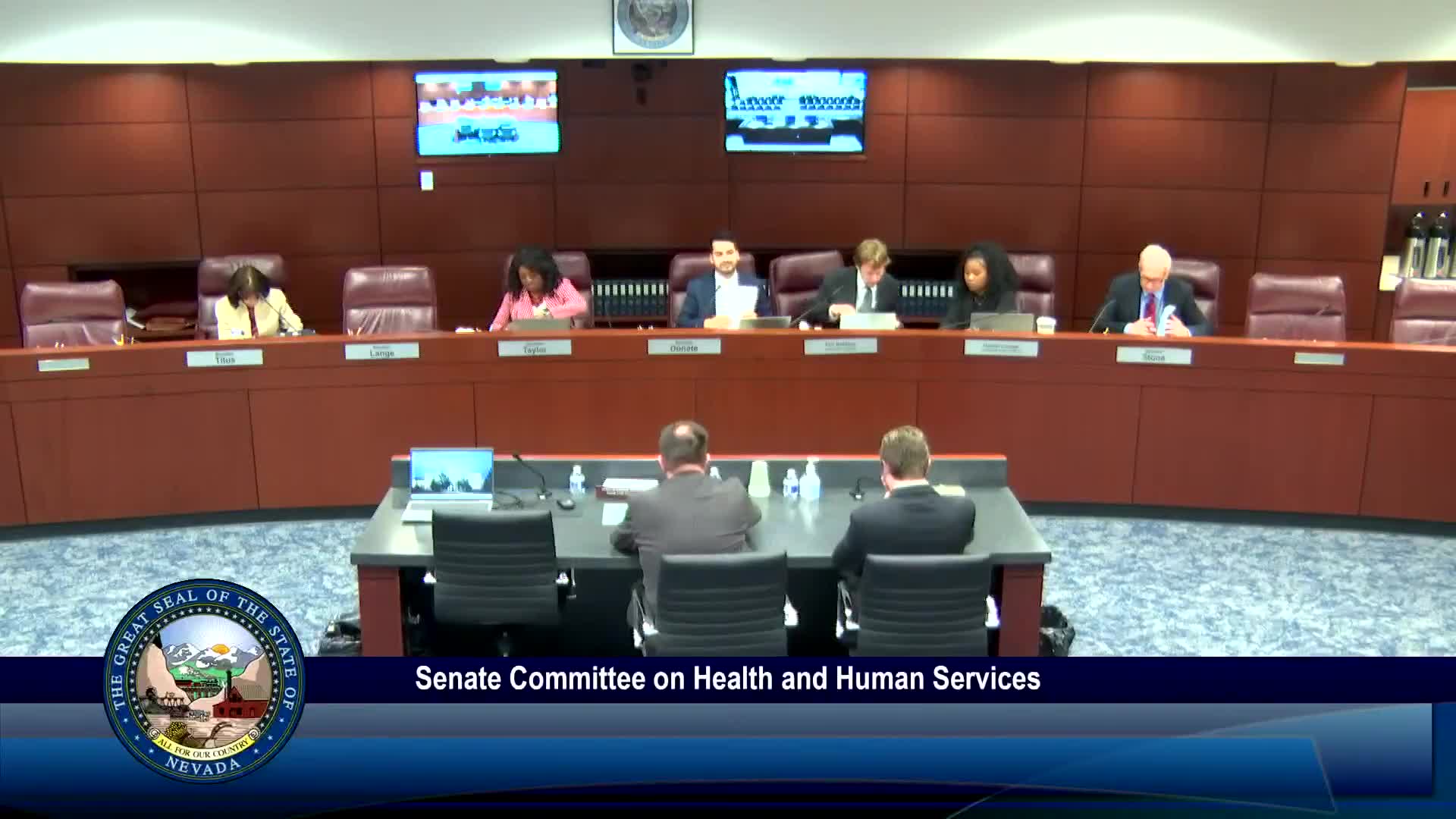
Summary
The Senate Committee on Health and Human Services heard testimony supporting Assembly Bill 326, which would authorize the State Board of Health to recognize trauma level 4 designations for certain rural critical-access hospitals; committee members voted to recommend the bill for passage as part of a consent package.
Assembly Bill 326 would permit the State Board of Health to adopt regulations allowing emergency departments at eligible critical-access hospitals to be designated as trauma level 4, supporters told the Senate Committee on Health and Human Services on Feb. 10, 2025.
The bill’s sponsor, Assemblyman Greg Koenig, said the change would align Nevada with surrounding states that recognize a level 4 designation. "What this bill...is doing is it's allowing the emergency rooms of rural hospitals to be designated as category 4, which is something that is done in every other surrounding state but not yet in Nevada," Koenig said.
A representative of Nevada Rural Hospital Partners, Blaine Osborne, told the committee a level 4 trauma center provides advanced trauma life support, evaluation, stabilization and diagnostic services prior to transfer to a higher-level center. He said AB326 would limit a level 4 designation to critical-access hospitals located more than 80 miles from a county with two or more designated trauma centers, and that currently this would not affect Clark County or Southern Nevada Health District operations. "We have 1 critical access hospital currently that is ready to pursue this license," Osborne said.
Proponents said the designation could formalize transfer protocols, standardize procedures and improve training and response time in rural areas. Koenig and Osborne said the bill carries no fiscal note and includes no appropriation.
There were no callers or witnesses in opposition or neutral on the record. After the remaining hearings concluded, committee members placed AB326 on a consent due-pass motion; the committee chair called for the vote and the motion carried unanimously.
The bill hearing on AB326 was closed without amendments during the hearing; the committee later included AB326 in a unanimous due-pass recommendation to advance the measure for further legislative action.