Get Full Government Meeting Transcripts, Videos, & Alerts Forever!
Get email alerts on the Workforce Development topic
No spam. Unsubscribe anytime.
Business and education leaders urge stronger alignment to fill Central Ohio jobs
Summary
At a Columbus Metropolitan Club forum, panelists representing employers and education groups called for earlier career-connected learning, greater employer involvement in school curriculum and counseling, and broader use of work-based learning to address thousands of local job openings and a persistent skills mismatch.
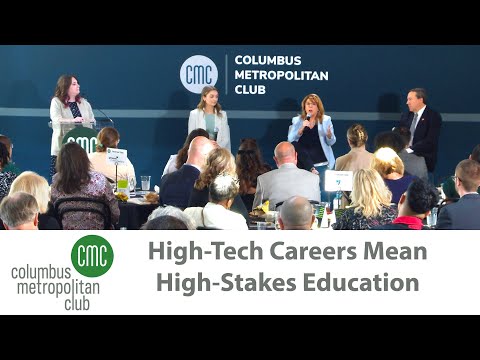
At a CMC forum at the Ellis in Columbus, business and education leaders said aligning schools with employers is essential to fill thousands of unfilled jobs across Ohio and keep economic growth centered in Central Ohio.
Panelists said a lack of alignment — not necessarily lack of funding — is the primary barrier preventing students from filling openings in manufacturing, health care and high-tech industries. "We have to make sure that everybody in the Columbus region shares in the prosperity of this region," said Pat Tiberi, president and CEO of the Ohio Business Roundtable.
The problem is immediate, panelists said. Lisa Gray, president of Ohio Excels, warned that much of Ohio is shrinking outside Central Ohio, and urged scaling proven local partnerships that connect students to jobs. "Central Ohio has benefited in growth to the rest of the state," Gray said. "We have folks coming from all over the state leaving their communities to take advantage of the incredible economic opportunity in Central Ohio, but yet there are people who live within walking distance of this facility who are not."
Employers described existing programs they say help but have limited reach. Gina Gamble, senior talent acquisition specialist at Worthington Enterprises, described the company's "career accelerator" program for high school seniors that awards a certified manufacturing associate credential and funnels participants into full-time roles. "We're on our seventh year of it," Gamble said. "It's great, but not everybody out there knows about it." She also said Worthington runs teacher externships and places staff on local advisory boards to influence curriculum and equipment purchases.
Panelists cited several data points during the discussion. They said career-technical centers serve about 18% of Ohio students; statewide job postings include thousands of openings at large employers — the Cleveland Clinic listed over 3,000 openings on OhioMeansJobs during the panel, GE Aerospace had about 7,700 openings, and Honda and Worthington employers reported roughly 1,000 openings each — figures panelists cited to underscore demand for workers. Panelists characterized these numbers as examples shared during the forum rather than independently verified by the panel.
Speakers urged multiple strategies at once: earlier exposure to careers (some beginning in middle or even elementary school), expanded work-based learning and internships, more teacher awareness of industry needs, and policy changes to scale successful local models statewide. "Policy does matter," Gray said, advocating for state budget investments to expand career-connected learning statewide rather than only in affluent districts.
The panel discussed artificial intelligence and education, and rejected blanket bans. "These kids are gonna be living in a world with AI. They need to learn how to use it," Gray said. Employers said they are already introducing AI tools and want students to understand ethical and critical-thinking limits of those tools.
Panelists also addressed recent state-level higher education changes. Asked about Senate Bill 1, Pat Tiberi said the overhaul "probably will, unfortunately" have an impact and that aligning education to local jobs is more productive than focusing on culture-war debates in policy. Panelists did not propose a specific state-level legislative action during the forum.
Audience members — including educators and IT professionals — asked about practical steps. Panelists recommended business leaders join local school advisory boards, reach out to career-technical centers, and partner with groups such as the Columbus Partnership and 1Columbus for navigation and scaling. "Call your school district and ask about their business advisory council," Gamble said.
Panelists closed by urging a dual focus: technical credentials and basic "soft" or employability skills such as punctuality and communication. "Have a skill. Have a credential. Have a focus. But have those soft skills that will translate across the spectrum," Tiberi advised.
The forum was a discussion rather than a policymaking session; no formal motions or votes were taken. Panelists and audience members urged follow-up between employers, school districts and intermediaries to scale successful programs beyond individual districts.