
Charlton Select Board votes 4-1 to send letter asking Dudley‑Charlton school committee to publicly reject antisemitism, contingent on legal review
Get AI-powered insights, summaries, and transcripts
Sign Up Free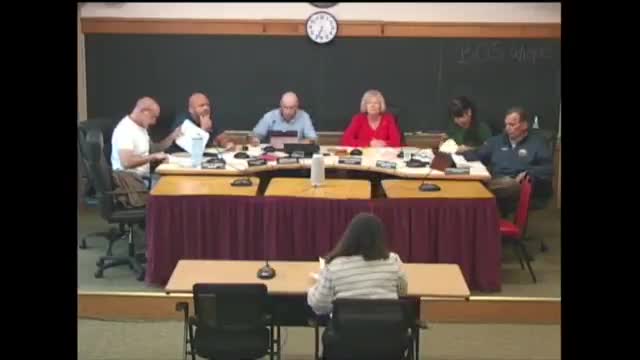
Summary
The Charlton Select Board on Tuesday, June 10, 2025, voted 4‑1 to approve sending a letter to the Dudley‑Charlton Regional School Committee asking it to publicly condemn antisemitism, bigotry and racism and to refuse certain Massachusetts Teachers Association materials, with the board’s approval contingent on town counsel review.
The Charlton Select Board on Tuesday, June 10, 2025, voted 4‑1 to approve sending a letter to Superintendent LaMarche and the Dudley‑Charlton Regional School Committee asking the committee to take a public stance condemning antisemitism, bigotry and racism, and to decline use of certain Massachusetts Teachers Association (MTA) materials related to the Israel‑Hamas conflict; the board’s approval is conditional on review by town counsel.
The move followed a public comment by Jean Costello, who identified herself as a member of the Dudley‑Charlton Regional School Committee but said she was speaking as a private citizen. Costello accused a Select Board member of having made false and defamatory accusations against her in a previous meeting and urged the board to reaffirm a commitment to civil discourse. “These accusations are entirely false and defamatory,” she told the board. “I condemn terrorism, antisemitism, and hate in all forms.”
The letter, drafted by Select Board member David Singer and read aloud at the meeting, asks the school committee to (1) prepare and release a public statement condemning distribution of the disputed materials, (2) refuse to utilize MTA‑provided materials related to the Middle East conflict, and (3) reiterate that the Dudley‑Charlton School District is “no place for hate.” Singer said the request followed previous appearances before the school committee and multiple opportunities for the district to respond.
Board members debated the scope and process for sending the request. Supporters said a formal request from the Select Board is an appropriate, nonbinding way to ask the school committee to deliberate publicly. Select Board member Pete (first name used in the meeting) said the issue “is in the news” and that the board should ask other local bodies to make statements as well. Opponents raised concerns about the Select Board’s authority and the risks of acting on or basing formal action on individual social media posts. One board member said legal review was prudent before sending a letter that touches on materials used by educators and on the conduct of an autonomous elected school committee.
The board amended the motion to make approval contingent on the town attorney’s review; the amendment passed. The final vote on the amended motion was 4 in favor, 1 opposed. The board did not instruct the school committee how to act; the letter is a formal request for deliberation and a public statement by the Dudley‑Charlton Regional School Committee.
The debate referenced recent activity by the Massachusetts Teachers Association and a state special commission formed to combat antisemitism; Select Board members and speakers disagreed over whether the specific MTA materials in question had been removed and over how to handle claims tied to individual social‑media posts by elected officials. Several speakers urged that allegations about students or harassment be reported to school administrators or law enforcement so they can be investigated rather than raised only in public meetings.
The Select Board directed that the letter be submitted to the town’s legal counsel for review; if the town counsel raises no objection, the board directed staff to send the letter to the Dudley‑Charlton Regional School Committee and the superintendent.
Background: Select Board members discussed the topic at previous meetings on March 25, April 8 and May 27; the new letter formalizes a request that the committee take public action or provide an explanation for its position. The board’s action is a request, not a directive to the elected school committee.
Looking ahead: The school committee will determine whether to take the requested action; the Select Board’s request does not impose penalties or change district policy.