Get Full Government Meeting Transcripts, Videos, & Alerts Forever!
Get email alerts on the Flood Control topic
No spam. Unsubscribe anytime.
Cochise County staff outline flood-control projects, to advertise Coyote Wash construction July 1
Summary
At a June 10 Flood Control District work session, county staff reviewed a slate of flood projects and studies—most notably advertising the Coyote Wash construction contract July 1—and discussed watershed restoration, effluent recharge plans near Bisbee and multiple grant-funded studies. No formal votes were taken.
Cochise County Flood Control District staff reviewed a package of planned projects and studies at a June 10 work session of the Cochise County Board of Supervisors, saying the district will advertise the Coyote Wash construction contract on July 1 and is pursuing multiple grant-funded watershed studies and property acquisitions for future recharge work. The board took no formal votes during the staff briefing.
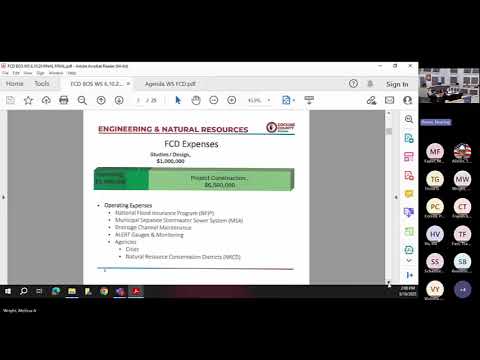
The work session focused on projects intended to reduce roadway flooding and increase groundwater recharge across the county. "The top thing that we do have is we regulate development in flood prone areas," said Ms. Watkins of the county's Engineering and Natural Resources staff, describing operations that include floodplain permitting under state law, the National Flood Insurance Program (NFIP) work, and the municipal separate storm sewer system (MS4) program administered through ADEQ. Watkins told the board the district maintains drainage channels (some with in-house crews, some by contractors) and monitors 21 alert gauges around the county.
Why it matters: staff said the projects target locations where flooding repeatedly impacts roads and residents, and many rely on outside grant funding and federal clearances. County officials repeatedly described the work as contingent on grants, permitting and technical studies rather than immediate construction paid wholly from district operating funds.
Coyote Wash and funding details Coyote Wash is the project the county expects to advertise for construction at the end of June. Watkins said the design is complete and the county has assembled grant funding from a REPI grant from the U.S. Department of Defense, a state grant described in the briefing, and $50,000 in Flood Control District funds. "We will advertise that project for construction end of this month, July 1," Watkins told the board. The project will divert low flows into an old gravel pit to increase infiltration; staff estimated the work will infiltrate about 150–200 acre-feet per year and help reduce flows on Mosen Road.
Effluent recharge near Bisbee and chemical concerns Staff described a separate project to acquire roughly 97 acres to develop a retention basin using treated Bisbee effluent to increase recharge rather than discharging directly to the river. Watkins said the project is at roughly 30% design and that the county has a grant described in the presentation (listed there as a roughly $1.8 million challenge grant); the county is pursuing reimbursement through a REPI grant for eligible costs and plans to discuss an endowment to cover future maintenance with the city acting as fiscal agent.
Board members and staff discussed concerns about pharmaceutical residues and so-called "forever chemicals" in treated effluent. Watkins said the county has discussed treated-effluent recharge with ADWR and ADEQ and would research testing and regulatory requirements. One supervisor noted testing in other Arizona utilities has detected pharmaceuticals; staff said the county would follow applicable state and federal guidance and the ADEQ/ADWR requirements tied to recharge operations.
Watershed restoration, NRCD partnerships and private land Board members asked about smaller watershed-restoration measures such as check dams and gabion walls on private lands. Watkins said the Flood Control District cannot give funds directly to private landowners, but the county can enter an intergovernmental agreement (IGA) with a Natural Resource Conservation District (NRCD), which can deliver or coordinate projects with landowners. "We don't have the staff to really go out and to teach the residents how to do this," Watkins said; she suggested the NRCDs could provide technical assistance while the county provides funding or materials where legally permissible.
Staff and supervisors debated the effectiveness and scale of small check dams and gabions. Watkins characterized such measures as restoring watershed health and slowing flows to increase infiltration rather than eliminating flooding altogether: "The check dams help restore the watershed, the health of the watershed, but they're not, you know, you're talking about a foot." Another supervisor urged maximizing available volunteer or donated labor while ensuring technical oversight to avoid creating hazards.
Wilcox, Douglas and other basin studies Staff outlined a proposed $300,000 watershed study of the Wilcox Basin (about 1,694 square miles, partly in Graham County) to identify multi-benefit recharge and flood-control locations; staff said the study draft is under way and the final report should be complete in October. The briefing also proposed a similar watershed study for the Douglas Basin modeled on work in Wilcox.
Other projects described: - Bay Acres/Colonia area: staff expects design completion this calendar year and said construction would require NEPA clearance and right-of-way acquisition. Staff presented a construction rough order-of-magnitude estimate of about $15 million and said the project could reduce flooding on Columbia and Washington avenues and downstream into the city of Douglas if the board elects to continue beyond design. - Leslie Canyon Pond: county engineers are working through ADWR requirements to remove a jurisdictional-dam designation and repair a berm; staff estimated possible construction costs around $3.5 million and warned that a berm failure could cause two days of downstream flooding and extensive road cleanup. - Wilcox regional mitigation and recharge: staff described a watershed-scale approach and funding challenges; construction grants for mitigation are competitive and some programs were not accepting new applications at the time of the briefing. - Rucker Creek watershed study: funded through a U.S. Army Corps of Engineers Planning Assistance to States grant (100% funding for this disadvantaged area), the county has started a two-phase series of analyses to locate recharge opportunities and a sediment balance for Rucker Creek.
Regulatory, legal and regional issues The briefing repeatedly linked project feasibility to federal and state processes: NEPA clearance is required for projects using federal funds; ADWR and ADEQ review plays a role for recharge and effluent reuse; and REPI grants from the Department of Defense factor into purchases tied to Fort Huachuca land-protection interests. Supervisors and staff discussed the Endangered Species Act, the Gila River adjudication and the "hundred-year water adequacy" certificate administered by ADWR, noting those processes can affect development potential and the practical benefits of water projects. Several supervisors urged more vigorous engagement with federal partners to protect Fort Huachuca mission interests and the Sentinel Landscape funding footprint that can unlock additional grant money.
Monitoring and operations Staff said the flood-control program operates alert gauges (21) that feed the National Weather Service and that the district contributes to partnerships such as the Upper San Pedro Partnership and a local conservation/recharge network. The county also discussed an endowment strategy to cover long-term maintenance for larger recharge projects if initial construction is grant-funded.
No formal votes taken; next steps The session was informational. Staff requested direction on whether to proceed with property acquisition, advertise Coyote Wash for construction, and pursue the Wilcox and Douglas basin studies and various grant applications. The board did not take formal action during the work session. At the end of the meeting the board moved to an executive-session agenda item on county-administrator and clerk-of-board employment matters.
Meeting context: the session was a staff-led work session with supervisors present; the county stated public comment would not be taken during the work session.