Get Full Government Meeting Transcripts, Videos, & Alerts Forever!
Get email alerts on the Business Tax Receipt topic
No spam. Unsubscribe anytime.
Wellington magistrate pauses business-tax case, asks parties for legal briefs on farm-product exemption
Summary
During a contested hearing over whether equestrian stall rentals require a Wellington business tax receipt, the special magistrate deferred a final ruling and ordered both sides to submit written legal explanations within 10 days on statutory exemptions cited by the respondent.
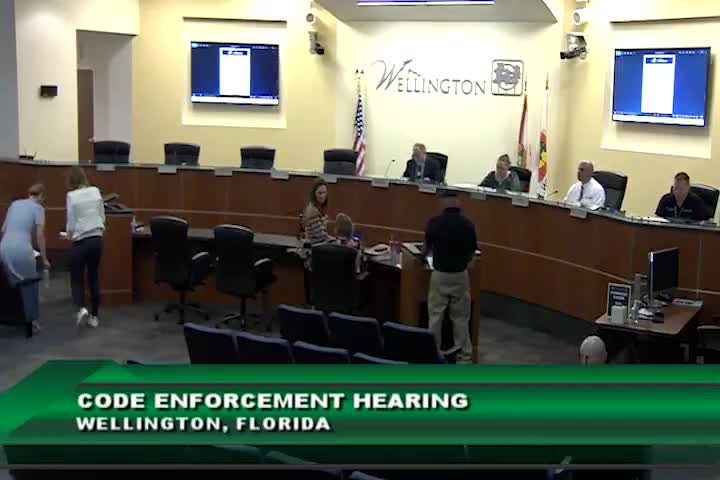
The Village of Wellington Special Magistrate deferred a final decision June 12 after a contested hearing over whether a property that rents horse stalls must hold a local business tax receipt. The magistrate asked both sides to submit written briefs within 10 days addressing statutory exemptions and other legal authorities before issuing a final ruling.
The dispute centers on case CC-1902-2023, brought by code compliance after a staff-initiated inquiry found a business operation renting stalls at a property on 15000–46 Lane South (listed in the record as a barn/stable). Christopher Prasad, a Village code compliance officer, presented the village’s case and recommended the property be required to obtain a business tax receipt (BTR) and pay any outstanding fees and penalties.
Samantha Candela, senior permitting and licensing technician for the Village, testified she received a phone call in 2023 about businesses in the area and, after checking Village records, found no BTR at the property. Candela said she sent an initial courtesy letter in May 2023 and later a formal notice when no application was received.
Attorney Katie Edwards Walpole, representing the property owner (Arian/Aaron Holdings LLC in the record), argued the rental activity falls within exemptions under state law and that the Village’s later 2024 ordinance clarifications should be considered in context. She questioned whether the Village’s BTR requirement was applied consistently and whether county-level operational permit requirements for animal care and control were being conflated with Village licensing.
The Village called senior staff including Samantha Candela and Tim Stillings, the Village planning, zoning and building director, who said the Village amended its BTR code through Ordinance 2024‑13 to clarify that rental activities — including equestrian stall rentals and other rental properties — should be treated as permanent business locations for licensing purposes. Stillings said the change addressed recurring confusion among applicants and staff about how rentals are classified.
Property owner Maria Aurora Rangel de Alba testified that she had rented stalls on a limited, informal basis and told the magistrate she had been unable to rent consistently since a nearby manure-processing operation began operating. Rangel de Alba said that issue had prompted litigation against the neighboring business and that she had lost rental income; she told the magistrate, “since then it's been hell for me.”
Counsel and staff debated the applicability of several Florida statutes during cross-examination: Florida Statutes §205.064 (farm-product exemptions to local business tax), §823.14 (definition of farm product), and §604.5 (exemption for certain farm structures from the Florida Building Code and local code/fees). Magistrate rulings during the hearing noted that §205.064 exempts sales of farm products but does not clearly encompass rental of stalls. The magistrate also observed that §604.5 relates primarily to construction and building-code exemptions and does not by itself remove tax or licensing obligations.
After extended argument, the magistrate said she would not decide the exemption question on the record that day. She instructed both sides to file concise written briefs within 10 days pointing to the specific statutory or ordinance authority they rely upon and to attach the statutory text or other exhibits they cite. The magistrate said she would review the briefs and issue a written ruling and explained the submission process and format for the briefs.
Pending that ruling, no fines or formal license penalties were imposed at the hearing. The magistrate left the underlying notice of violation on the docket and scheduled further administrative follow-up as needed.
Why this matters: Wellington’s equestrian industry includes many private and commercial barns; how the Village interprets state exemptions and applies local licensing could affect dozens of property owners and the local licensing regime.
What’s next: Both sides must submit written briefs within 10 days to the magistrate, who will issue a written ruling after reviewing the materials.