Get Full Government Meeting Transcripts, Videos, & Alerts Forever!
Get email alerts on the Wildfire Detection topic
No spam. Unsubscribe anytime.
Austin Energy expands Pano AI camera network for 24/7 smoke detection across Travis County
Summary
Austin Energy briefed the Technology Commission on Pano AI, a camera‑and‑AI smoke detection system now covering the utility's service territory and most of Travis County. The system is integrated with 911 and Austin Fire Department for situational awareness and is being refined for privacy, data retention and improved smoke classification.
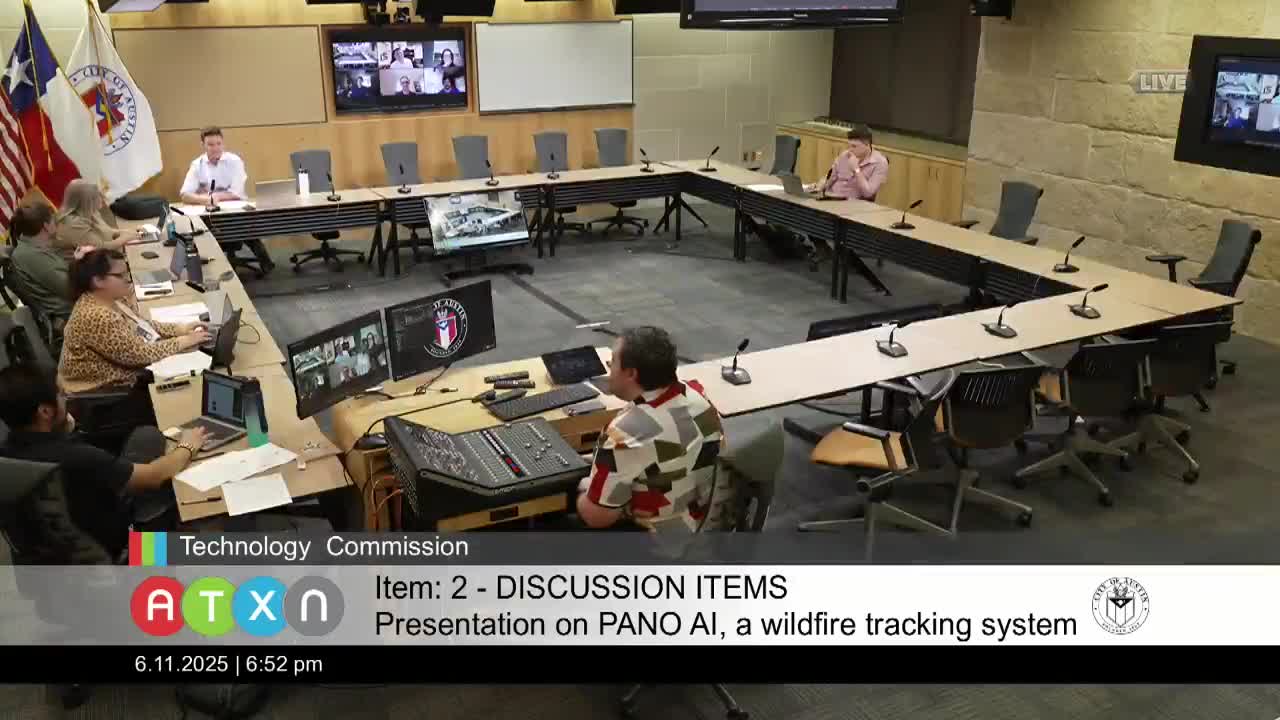
Austin Energy on June 11 told the City of Austin Technology Commission it has deployed Pano AI cameras across its service territory and much of Travis County to detect smoke and provide early situational awareness to emergency responders and the utility.
Pano AI "is basically a full turnkey, smoke detection system," Austin Energy wildfire mitigation manager Chris Fechmiel said, describing a network of cameras, machine learning and a human verification center that sends alerts by text or email. The system, Fechmiel said, provides Austin Energy and the Austin Fire Department with camera views, triangulated GPS locations and analytic data that can help determine whether a reported incident is a structure fire, a prescribed burn or a wildland fire.
Fechmiel said the utility began championing the project in late 2022, held a kickoff in November 2023, activated an initial camera on March 13, 2024, and completed the full system in August 2024. The network now comprises 13 stations (26 cameras) positioned to give double coverage of Austin Energy's 430-square-mile service territory and to triangulate smoke locations that bleed into much of Travis County.
Fechmiel said Pano AI integrates into the 911 dispatch workflow so Austin Fire Department and the emergency call center receive alerts. "We have integrated with Austin Fire Department and the 911," Fechmiel said, adding that the agency can zoom into the view, confirm calls and dispatch appropriate apparatus.
Austin Energy staff described several operational features: - Camera hardware: each station has two 6-megapixel high-definition cameras with up to 30x optical zoom available only to limited users (911, wildfire division, and the utility's energy control center). Fechmiel said the pixelated public view and limited optical-zoom access are part of privacy protections. - Coverage and triangulation: each camera has a guaranteed effective range of about 10 miles; overlapping camera bearings are used to triangulate GPS locations for alerts. - Use cases: Pano AI has detected structure fires, prescribed burns and small wildland ignitions. Fechmiel showed examples where the system identified a scrap-yard fire one minute before a 911 dispatch, and where multiple cameras captured a smoke event that later proved to be a wildfire. - Classification work: Fechmiel said Pano AI currently distinguishes some event types by smoke appearance (for example, darker, black smoke often indicates structure or petroleum-based fires while lighter, whiter smoke is typical of prescribed burns). Austin Energy is working with Pano AI to refine the AI so alerts can differentiate probable structure fires from probable wildland fires.
Fechmiel addressed privacy, licensing and data-retention questions. He said raw camera feeds were pixelated at the camera level before permitting broader access to limit visibility into private property. Initially the vendor provided a limited number of government licenses; Pano AI later adjusted its licensing so additional fire-service partners could receive alerts. Fechmiel said Austin Energy "owns the data" under contract and that data are stored in U.S.-based, SOC 2 / ISO-compliant facilities; he said the vendor's retention practices were under legal review but that the system is used for training and model improvements.
On metrics and evaluation, Fechmiel said Austin Energy is cross-referencing Pano AI alerts with 911 dispatch logs to measure response-time improvements and verify whether the system provides earlier warning than incoming calls. "We are... collecting data from Pano. We're collecting the data from the 911 call center," Fechmiel said, describing plans to analyze call times, utility-asset exposure and whether alerts reduce missed incidents.
Commissioners asked about night effectiveness, transformer explosions and community outreach. Fechmiel said the system can pick up some nighttime structure events and that Pano AI is developing infrared or night-vision capabilities. He said the utility conducted a media outreach campaign when cameras were deployed and is considering a limited public stream subject to legal and compliance review.
Fechmiel said Austin Energy and Pano AI continue to refine integrations and alerts and are discussing sharing data with neighboring utilities and regional partners so overlapping camera bearings can extend triangulation across Central Texas.
The presentation concluded without a formal action item; commissioners thanked Fechmiel for the briefing and asked staff to continue reporting metrics and privacy safeguards as the program matures.