Get Full Government Meeting Transcripts, Videos, & Alerts Forever!
Get email alerts on the City Budget topic
No spam. Unsubscribe anytime.
Soledad staff present balanced $60.5 million proposed FY2025–26 budget; council to consider adoption next week
Summary
City staff presented a status‑quo operating and capital budget for fiscal year 2025–26 that uses $510,000 of the general‑fund operating reserve to balance the ledger, highlights looming capital needs, and schedules formal adoption at the council's next meeting.
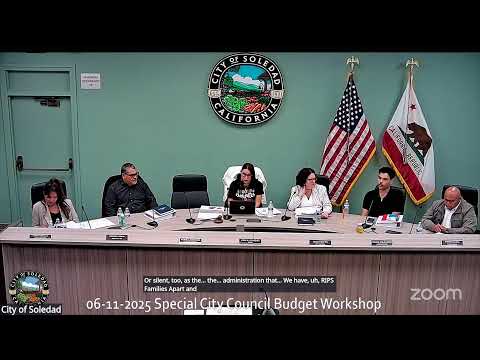
Soledad city staff presented a recommended $60.5 million operating and capital budget for fiscal year 2025–26 at a June budget workshop, asking the City Council to review the document and return next week to take formal action.
The city manager recommended the proposed budget and said it is balanced for 2025–26 “with the use of $510,000 of our general fund operating reserve.” Finance staff described the binder and supporting exhibits as “the collective work of over 200 hours to put this binder together.”
City staff said the proposed budget keeps staffing flat with no new full‑time positions while incorporating three reclassifications: two reclassifications in community and economic development (including converting an administrative assistant and a building permit technician into development permit technician roles), a police sergeant reclassified to lieutenant, and an assistant engineer reclassified to a project/construction manager. Staff noted the budget reflects a status‑quo approach and additional internal cuts were discussed but judged impractical for department operations.
Why it matters: staff described the budget as fiscally balanced for 2025–26 but thin, with limited room for additional operating expenses or capital spending absent new revenue. The presentation stressed several risks that could widen future deficits, including rising personnel costs, escalating construction prices and the scheduled 2032 sunset of Measure Y (the city’s transaction‑use tax), which staff said represents roughly 16 percent of general‑fund revenues.
Key figures and programs cited by staff: - Citywide operating and capital program (proposed): about $60.5 million. - Projected general‑fund capital reserve at 6/30/2026: approximately $7.3 million. - Proposed use of general‑fund operating reserve to balance 2025–26: $510,000. - Measure Y projected annual revenue (staff projection via consultant HDL): roughly $2.4 million (about 16% of city revenues). - Measure S subsidy of recreation by the general fund in the proposed budget: $820,000. - Water fund: projected revenues about $5.0 million, expenditures about $5.2 million; one outstanding debt instrument balance noted at $756,000 (matures in the 2033–34 time frame according to staff). - Wastewater fund: projected revenues about $8.3 million, expenditures about $11 million; budget includes about $2.7 million of capital spending and an annual $1.5 million debt service payment; staff reported about $23 million outstanding on that loan and noted the loan does not retire until the 2039–40 period.
Capital priorities listed in the proposed budget include repairs to city hall and the police‑department roof, reclaimed water ("purple pipe") work, water‑meter replacements, well rehabilitation and water‑tank rehabilitation, slurry seal and pavement preservation, pedestrian safety enhancements, manhole replacements, and the West Street complete‑street project. Staff also said the city will launch a water and sewer rate study this summer to inform enterprise fund rates for the next five years.
Staff also summarized other funds and constraints: enterprise funds (water, wastewater, solid waste, sanitation) operate as separate business units; special‑revenue funds (gas tax, SB1, Measure X allocations, community development grants) are legally restricted to specified uses; and the successor agency remains on autopilot to pay outstanding bonds tied to former redevelopment agency territory.
Next steps and formal requests: staff said they will return to the council at the next regular meeting with the formal adoption ordinance and supporting resolutions. Staff listed the actions they expect to bring for adoption next Wednesday: accepting and approving the FY2025–26 budget, authorizing accounting realignments to close fiscal 2024, transferring $132,715 in sale proceeds into a successor housing fund, adopting position allocations and the salary schedule required by PERS, and reaffirming the city’s emergency contingency reserve policy.
Action taken at this workshop: the council voted to add a standard “council comments” period to the end of tonight’s agenda (motion moved by Councilmember Santo Sanchez; vote: unanimous). No final budget adoption occurred at this meeting.
What staff emphasized for the public: the presentation repeatedly urged transparency and community engagement; staff also noted several ongoing community development projects (Ace Hardware, Dutch Bros, Panda, DaVita dialysis center, Tractor Supply, Real Rock Brew Pub, Holiday Inn entitlement) and a multidecade Miramonte housing project that could add thousands of homes over time and affect long‑term city needs.
Staff contacts and material: the council received the city manager’s budget message, a complete binder of exhibits for FY2025–26 and the five‑year capital improvement program, and a slide presentation summarizing fund balances and key assumptions. Finance staff encouraged council members to submit detailed questions during the week so staff can return with answers before the adoption vote.
Ending: Councilmembers praised the staff work on the binder and said they would review the materials in detail before the scheduled adoption vote next week.