Get Full Government Meeting Transcripts, Videos, & Alerts Forever!
Get email alerts on the Does Budget And Paid Leave topic
No spam. Unsubscribe anytime.
DOES lays out GrowDC workforce investments and apprenticeships; council questions paid‑leave reductions
Summary
Department of Employment Services Director Unique Morris Hughes told the Committee on Executive Administration and Labor on June 11 that the GrowDC FY26 proposal expands youth placements, apprenticeships and the DC Infrastructure Academy while continuing to administer unemployment insurance and paid‑leave programs.
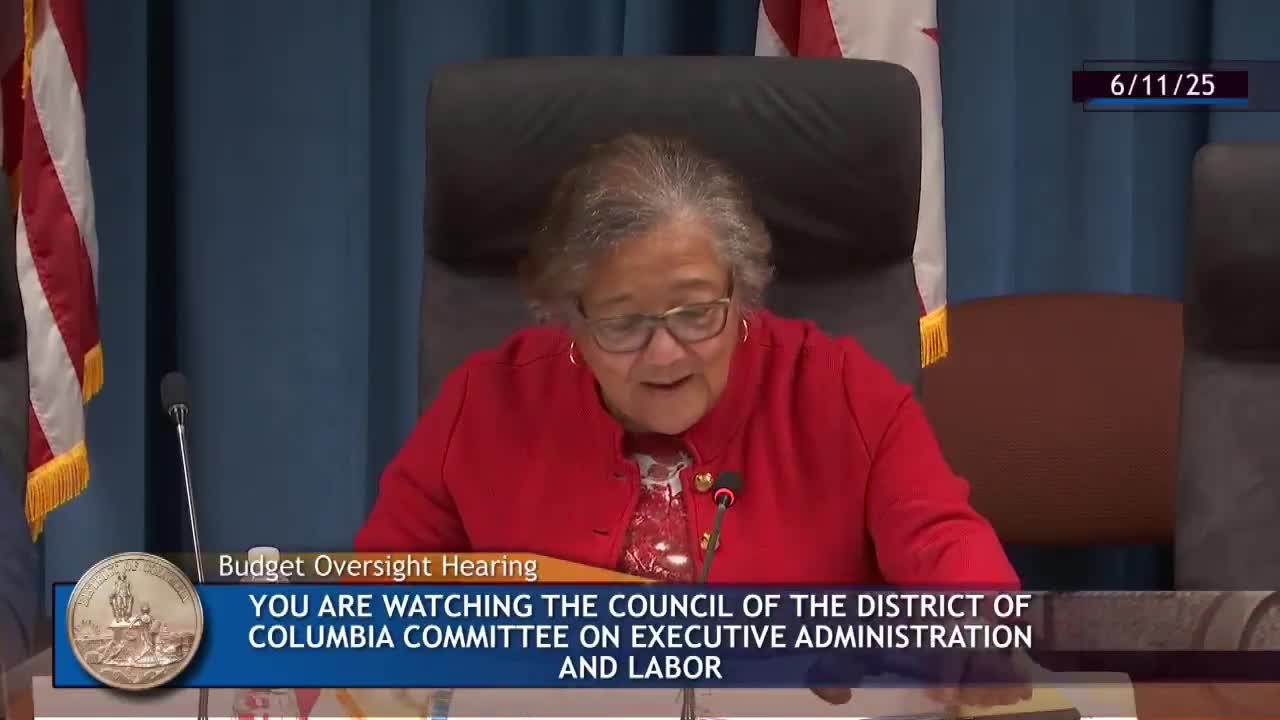
At the Committee on Executive Administration and Labor’s June 11 budget oversight hearing, Department of Employment Services (DOES) Director Unique Morris Hughes presented the agency’s FY26 GrowDC budget and described planned investments in youth employment, apprenticeships and trainings while defending administration of unemployment insurance and paid‑leave programs.
DOES’s overview: Director Hughes said the proposed FY26 operating budget for DOES is $181,600,000, composed of local, federal and special purpose revenue funds. He said the Marion Barry Summer Youth Employment Program would provide roughly 12,000 young residents with six‑week work experiences at more than 725 host sites; the agency intends to place 1,000 high school students in internships and to provide a 22–24 year old “reconnect” program for 175 young adults. Hughes discussed expansion of registered apprenticeships—DOES said it currently works with several hundred sponsors and spoke to a target of growing apprenticeship placements and pre‑apprenticeships, including a recent regionally registered apprenticeship for AI data annotators.
Workforce and training highlights: DOES described the DC Infrastructure Academy (DCIA) as training participants for immediate hiring in IT, energy and construction and said it planned to train about 350 participants and provide roughly 30 paid internships for DCIA graduates across city agencies. The department said it is using partnerships (Howard University, MedStar Georgetown and others) to expand healthcare career pipelines and planned additional on‑the‑job training slots this year.
Safety net and trust‑fund administration: Hughes emphasized DOES’s continuing role administering unemployment insurance (UI), workers’ compensation, the universal paid leave (UPL) program and paid family leave (PFL). He said UI tax collections improved and reported that the UI tax collection unit increased collections and compliance to secure about $11,600,000 in FY25 to protect the UI trust fund. DOES said the Office of Paid Family Leave adjudicated roughly 83,000 claims and paid about $130,000,000 in FY24 and $98,000,000 in FY25 to date.
Council questioning on Universal Paid Leave changes: Committee members pressed DOES on the mayor’s GrowDC proposal to reduce some UPL benefits (for example, a proposed change discussed in the hearing that would cap the weekly payment at $1,000 and reduce maximum weeks for some categories). Director Hughes said the FY26 package was devised to align revenues and benefits amid tight fiscal constraints and provided program utilization figures: average family‑leave utilization about 5.9 weeks and medical leave about seven weeks. The director also supplied a claimant breakdown for recent periods: parental leave claimants with weekly benefits over $1,000 were reported at about 52.3%; medical leave 21.7%; and family leave 15.3% (the department offered to follow up with more granular demographic data requested by council members).
First Source and local hiring: DOES provided First Source monitoring statistics: for calendar 2024 the department said 587 First Source agreements were executed and 889 hires were reported across those projects, with 477 hires (53.7%) filled by District residents. DOES staff told the committee that First Source monitoring and enforcement are ongoing and that assessed wage‑theft penalties are being collected and, when appropriate, directed to workforce training or outreach uses.
Jobs Trust Fund and training grants: DOES described the Jobs Trust Fund (fed by fines/penalties from compliance) as a small but targeted resource for competitive grants and training activities. The department reported $275,363.32 collected as of May 1 (FY25 to date) and signaled a proposed collection target of roughly $600,000 for FY26; DOES said grants from that fund are issued through public notices and competitive RFAs with applicant conferences and scoring.
Ending and follow-up: Committee members asked DOES to provide additional demographic and utilization data related to paid‑leave claims, the percentage of claimants exceeding the proposed new weekly cap, and more detailed job vacancy and apprenticeship cost estimates so the council can evaluate the budget’s fiscal assumptions. The committee left the hearing record open through June 25 and requested written back‑up materials.