Get Full Government Meeting Transcripts, Videos, & Alerts Forever!
Get email alerts on the Higher Education Access topic
No spam. Unsubscribe anytime.
Senate committee advances bill to ease FAFSA verification for justice‑involved youth
Summary
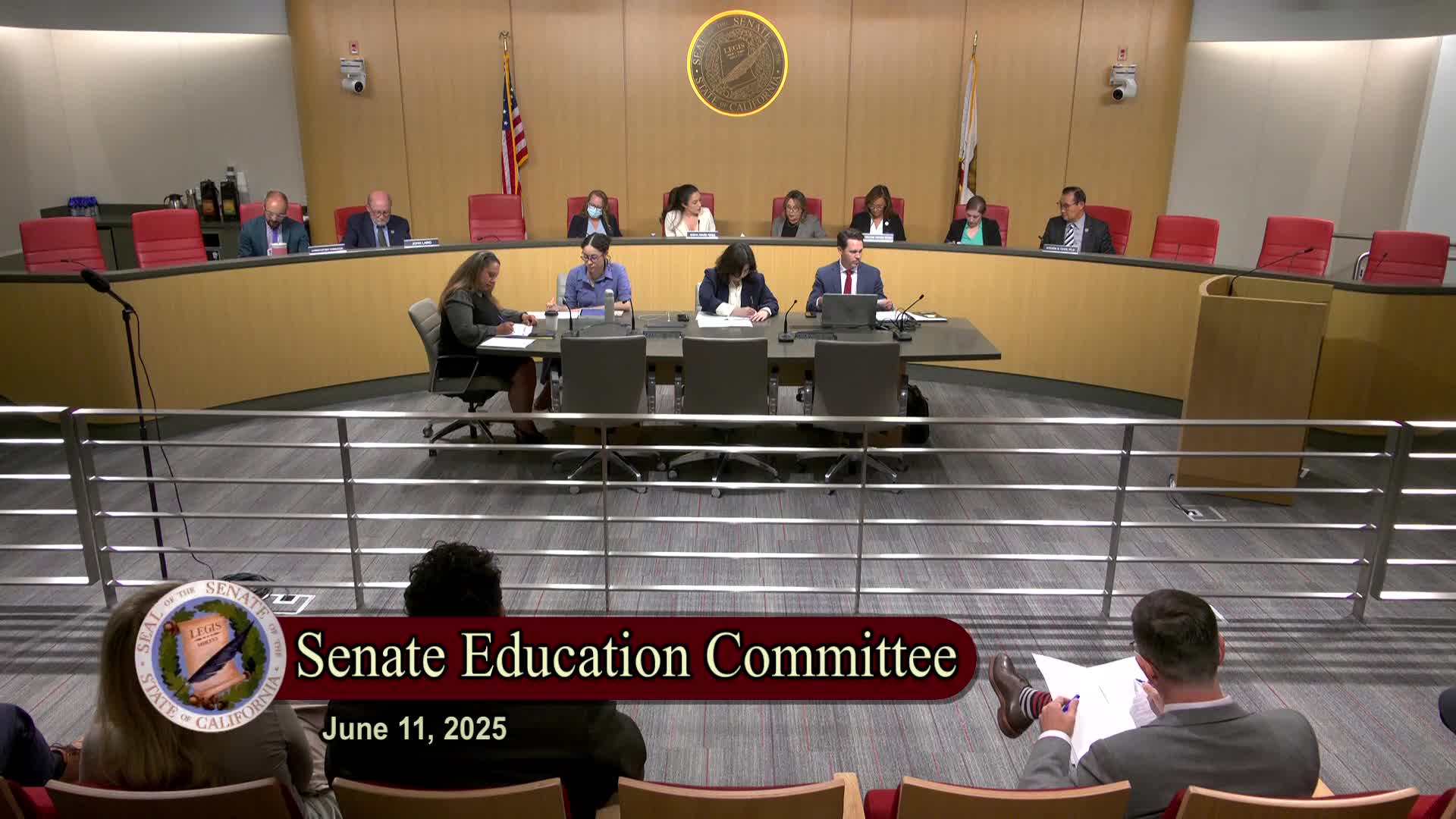
The Senate Education Committee voted to pass AB 243, authorizing an attestation process to verify independent status for justice‑involved or incarcerated youth applying for federal student aid; the bill moves as amended to the Senate Judiciary Committee.
The Senate Education Committee voted to pass AB 243, a measure by Assemblymember Arends, that would create a formal attestation option to help justice‑involved and incarcerated youth verify independent status for the Free Application for Federal Student Aid (FAFSA). The bill was passed as amended to the Senate Judiciary Committee on a 6‑0 roll call.
Supporters told the committee the change would reduce paperwork barriers that currently keep some formerly incarcerated youth from receiving federal and state student aid. “I excelled in my courses. I earned all A’s,” said Daisy D’Amato, a former Secure Youth Treatment Facility participant and current student intern, recounting that she used FAFSA to enroll in college but struggled with two‑factor authentication and verification steps while detained. Jorge Huittron, a college liaison at the Santa Clara County Office of Education, said colleges sometimes request court orders or lengthy professional letters to verify estrangement from parents, and that those requests can force students to disclose sensitive family information.
Huittron urged a formal attestation — a signed declaration confirming a student’s independent status — so financial aid offices can make determinations without seeking intrusive documentation. “An effective and respectful means of verifying the student’s circumstance would be an attestation,” he said. He added that foster‑youth verification is standardized but that incarcerated or estranged students face inconsistent local processes.
Sen. Bill Cabaldon praised the bill as “a carefully tailored solution to a real problem,” describing professional judgment by financial aid administrators as an existing tool used to address special circumstances but arguing AB 243 would streamline the process for a subset of students who are estranged or incarcerated. Sen. Laird moved the measure; the committee accepted the committee amendments offered on the floor before the vote.
The committee recorded six yes votes: Perez, Ochoa Bog, Cabaldon, Choi, Cortese and Laird. The motion carried and AB 243 was ordered as amended to the Senate Judiciary Committee.
Supporters at the hearing included representatives from the Santa Clara County Office of Education and county superintendents; witnesses listed their organizations when they testified in favor of the bill.
The bill does not itself change federal FAFSA rules; it proposes a state law change to facilitate campus‑level verification processes and encourage colleges to accept an attestation. Committee discussion emphasized that the bill would not eliminate existing professional judgment procedures but would provide an additional verification pathway for aid administrators to consider.
The author and supporters said the proposal aims to reduce a practical barrier to higher education for youth with involvement in the justice system. The bill’s next stop is the Senate Judiciary Committee.