Get Full Government Meeting Transcripts, Videos, & Alerts Forever!
Get email alerts on the Governance topic
No spam. Unsubscribe anytime.
Moab tourism board discusses HB456 and potential bylaw changes to include municipal representation
Summary
Board members discussed how Utah’s HB456 affects the tourism advisory board’s composition and whether city appointees should hold voting seats; no bylaw vote was taken.
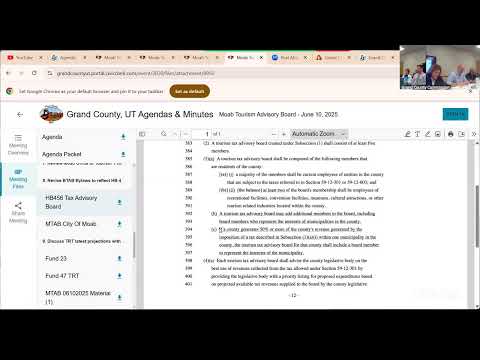
The Moab Tourism Advisory Board discussed draft changes to its bylaws required by Utah’s recently passed HB456 and the practical effects of adding municipal representation on the advisory board.
County staff and the county attorney reviewed the statute language. The law allows counties to add municipal representatives when a municipality generates a material share of county tourism tax revenue; the statute requires representation of a municipality’s interests but is silent on whether the municipal representative must be a voting member. The county attorney advised the board that the language reads as an appointment that “represents the interest of the municipality,” and that appointing authorities should ensure the person is formally designated by the municipality.
Board members raised governance questions including whether adding municipal representation should create an even or odd number of voting members, how to avoid conflicts of interest, and whether the board should explicitly require that municipal representatives be voting members. Several board members noted the practical benefits of closer city/county coordination and pointed out that the advisory board has previously had city liaisons.
No formal bylaw changes were adopted at the meeting. Staff said they will work with county counsel to draft specific bylaw language for a future meeting so the board can consider a formal amendment before the statute’s effective date.