Get Full Government Meeting Transcripts, Videos, & Alerts Forever!
Get email alerts on the Opioids topic
No spam. Unsubscribe anytime.
Austin and Travis County say $2 million federal investment helped cut overdose deaths
Summary
City and county officials reported that a roughly $2 million federal earmark funded harm-reduction programs, naloxone distribution and training that officials say coincided with declines in opioid and fentanyl-related deaths in Travis County.
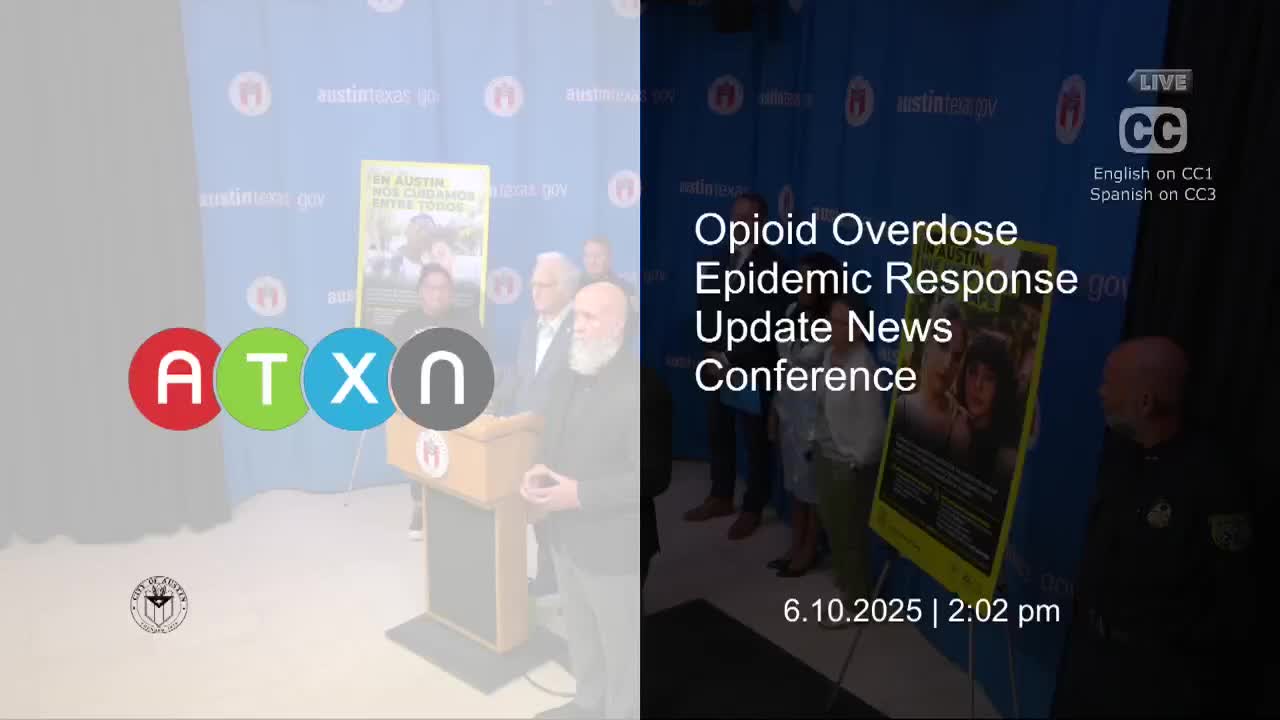
Austin and Travis County officials on Friday described how about $2,000,000 in federal funding helped expand harm-reduction programs, train first responders and distribute naloxone, and said the investments coincided with declines in local overdose deaths.
Mayor Kirk Watson opened the announcement by crediting the federal earmark — secured with help from Congressman Lloyd Doggett — for funding community programs, peer support, naloxone training and media campaigns. "The city of Austin and Travis County are no longer reacting to a crisis. We are building a system that prevents it," he said.
Austin Public Health medical director Dr. Desmar Walks said the city has created an online opioid resource dashboard (austintexas.gov/opioids) and published an opioid overdose surveillance report to make data and recovery resources more accessible. "This epidemic has found its way into all parts of our community," Walks said, and urged simple steps such as never using drugs alone and carrying naloxone.
Robert Lucas, chief of Austin-Travis County EMS, described the Breathe Now program, which trains people to recognize overdoses and administer naloxone (Narcan). Lucas said the program expanded after the grant award and noted rapid community deployment during a 2023 outdoor overdose outbreak that resulted in multiple fatalities. "We've trained more than 1,100 people in Breathe Now to recognize an overdose and administer care," Lucas said. "We've also distributed more than 24,000 doses of naloxone or Narcan."
Travis County Judge Andy Brown outlined county efforts that included peer coaches, jail-based harm-reduction sessions and reentry supports. Brown said peer coaches provided one-on-one support to more than 100 people and that Texas Harm Reduction Alliance led more than 50 harm-reduction group sessions inside the Travis County Jail serving nearly 600 participants. He also reported that coordinated teams conducted nearly 300 assessments and made more than 400 referrals to housing, health care and treatment services.
Officials cited measurable declines in local overdose deaths. Brown said Travis County saw a 22% decrease in overall opioid-related deaths in 2024 (from 486 to 380) and a 36% decline in fentanyl-related deaths (from 279 to 179). He also said the county has allocated about $4,800,000 in local and federal funds over four years to combat opioids and that the opioid abatement fund recently received $1,400,000 to sustain and expand programs.
Speakers at the event described efforts beyond naloxone distribution: continuing provider training, media campaigns and a buprenorphine bridge program intended to help people start medication for opioid use disorder and transition into longer-term care. Lucas said EMS follows up on every opioid overdose in Austin and Travis County to try to link patients with treatment, and Judge Brown and others said expanding reentry supports and a mental health diversion center remain priorities.
Officials acknowledged funding uncertainties but said local revenue streams and settlement money provide ongoing support. "We're getting money regularly from the opioid settlement," Brown said, adding that local investments from city and county budgets will be needed to sustain services. Brown also criticized state leadership for blocking access to fentanyl test strips, saying such tools can save lives.
Officials said the work will continue through partnerships among Austin Public Health, Austin-Travis County EMS, Travis County, community organizations including the Texas Harm Reduction Alliance, and academic partners.
The announcement included practical guidance for residents: recognize overdose signs (pinpoint pupils, reduced alertness, slow or absent breathing); if you suspect an overdose, administer naloxone, start basic life support and call 911; and avoid using drugs alone.