Get Full Government Meeting Transcripts, Videos, & Alerts Forever!
Get email alerts on the Public Health Prevention topic
No spam. Unsubscribe anytime.
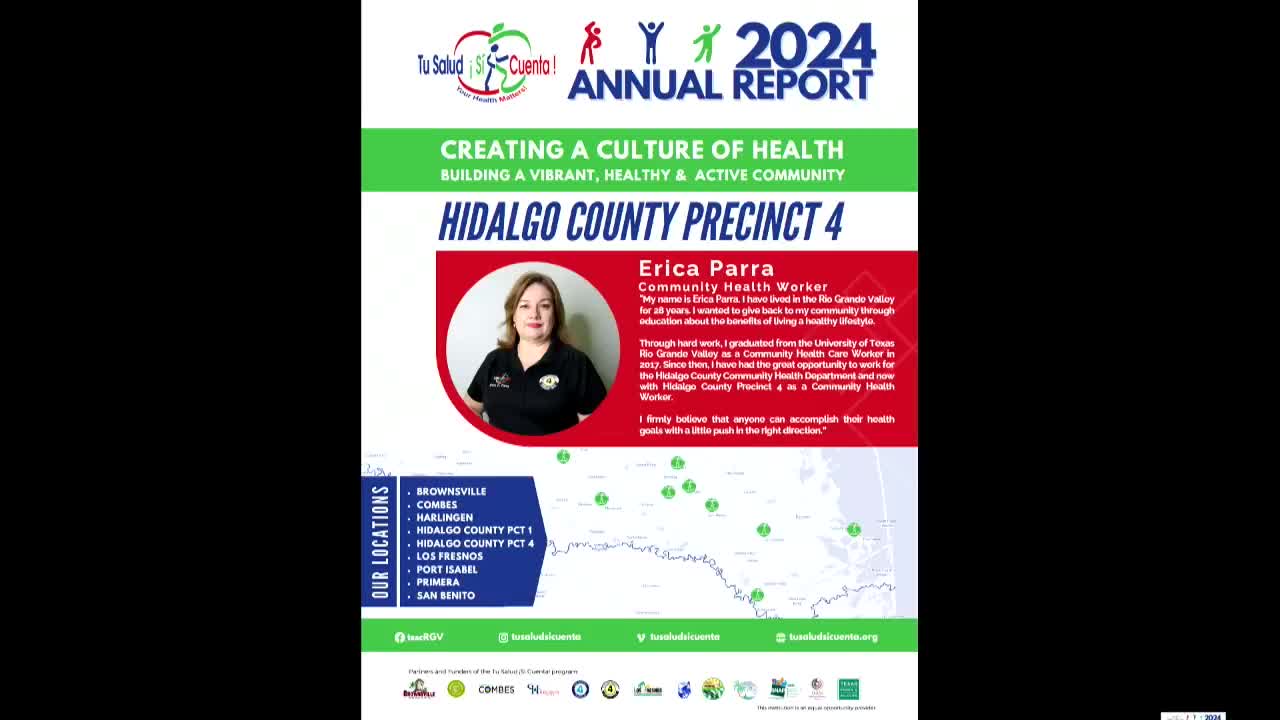
UT Health program reports improved diet and activity outcomes in Precinct 4; county lab to begin employee wellness screenings
Summary
UT Health Houston presented evaluation results showing improved fruit-and-vegetable intake and physical activity among participants in a community health worker program, and Hidalgo County Public Health announced no-cost employee lab screenings this summer.
UT Health Houston representatives on Wednesday reported measurable improvements among participants in the Community Health Worker program operating in Hidalgo County’s Precinct 4 and the county health laboratory announced a no-cost employee wellness screening initiative.
Dr. Lisa Bennett, senior project manager at UT Health Houston School of Public Health, said data collected for Precinct 4 showed 84% of participants increased fruit-and-vegetable intake and 80% increased physical activity. Staff reported that among participants with high blood pressure, 56% showed a decrease in blood pressure and 20% reduced to non-hypertensive levels.
The program, in its fifth year in Hidalgo County, delivers exercise classes, healthy-cooking modules and community outreach, targeting uninsured and low-income residents. Bennett noted the program uses ongoing evaluation to verify health outcomes and that partnerships with county precincts and community organizations helped expand reach.
Separately the Hidalgo County Public Health laboratory announced a no-cost employee wellness screening program running June 16 through Aug. 29, offering a complete blood count (CBC), comprehensive metabolic panel (CMP) and lipid panel. Veronica Quartet, laboratory director, said the lab has the staffing and a contracted medical director to review results and that initial screenings will be offered to employees by appointment with an eventual rollout to the public.
Commissioners and presenters emphasized prevention and lifestyle interventions as complements to clinical care. UT Health staff asked the court to continue support for community-based prevention funding, noting federal SNAP-Ed funding and other grants as key supports for ongoing programming.